Directed by Teinosuke Kinugasa
Some of the movies I write about here appear to be little known outside Japan. They have very few reviews in English. Two of the movies I’ve discussed have no reviews at all on IMDb or Letterboxd. One of the purposes of my blog is to remedy this lamentable lack of information and introduce people to films that I think deserve a wider audience.
Today’s film is not obscure, nor is it hard to track down. It’s readily available: you can buy the Blu-ray from Criterion or watch it on Criterion’s streaming platform. Grand Prize winner at the 1954 Cannes Film Festival and the recipient of Academy Awards for best foreign film and costumes, Jigokumon was Daiei’s first color film. An historical drama set in medieval Japan is the perfect opportunity to pull out all the stops: with its sumptuous Heian period costumes and elegant sets, the art direction is dazzling. The film offers more than a feast for the eye, however. Jigokumon’s stars Machiko Kyō and Kazuo Hasegawa deliver superb performances.
Kinugasa had been making films since the silent era and studied under Sergei Eisenstein in Moscow. Kinugasa had an interesting career trajectory which included performing as an onnagata, a male actor who plays female roles. He is perhaps best known today for his experimental 1926 film Kurutta Ichipēji (A Page of Madness). This was the only Japanese film screened during the entirety of my undergraduate program at what is regarded as the leading film school in the United States.
As shameful as that is to admit, things turned out for the best, because in the years since I have had the great joy of discovering Japanese cinema myself. If I were designing the curriculum for an undergraduate-level course and needed a film from Japan’s silent era, I would have chosen something a little more watchable and user-friendly than A Page of Madness. I’m a jidaigeki enthusiast as you can discern from my previous posts, so I would go for Dokuro (1927). The film’s star Utaemon Ichikawa portrays a Christian samurai and engages in one of the greatest swordfights in film history. It’s a real barn-burner.
Before delving into Jigokumon’s plot I need to rave about the visuals. In its use of color I would place it right at the top beside The Red Shoes (1948) and Black Narcissus (1947). Unlike Powell and Pressburger’s two masterpieces which were shot in Technicolor, Kinugasa’s film is shot in Eastmancolor. The advent of Eastmancolor in 1950 revolutionized color motion picture photography. Eastmancolor film could be processed in an ordinary lab, saving time and money. Kinugasa and Kōhei Sugiyama, the director of photography for Jigokumon, deserve praise for mastering this new format so completely. Jean Cocteau led the 1954 Cannes Film Festival jury which awarded the film its Grand Prize. In his words, Jigokumon had “les plus belles couleurs du monde.” I couldn’t agree more. The film underwent a full digital restoration in 2011 and the results are simply breathtaking. (I apologize for the low-resolution screenshots here, which do not accurately reflect just how stunning everything looks.)
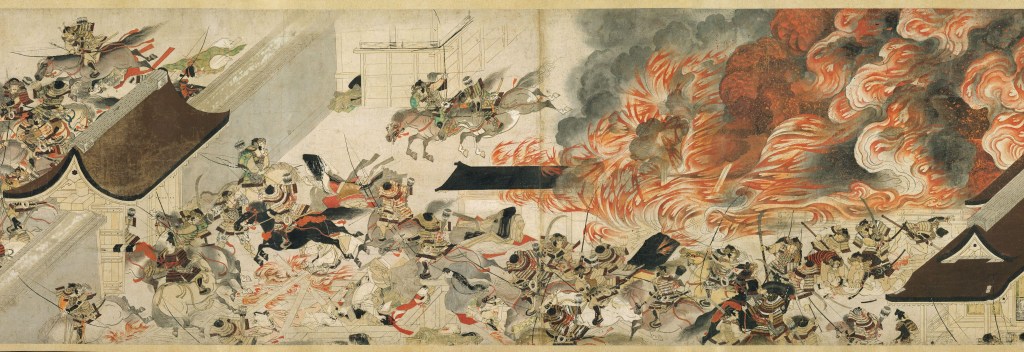
Jigokumon begins in Kyoto during the 1160 Heiji rebellion. Sanjō Palace is on fire and under siege by the forces of the Minamoto and Fujiwara clans.
In order for the Imperial family to escape, a plan is devised to use decoys. When the call goes out for volunteers to pose as the Emperor’s sister, only one person responds. An ethereal young woman appears to the accompaniment of a harp glissando. She is Kesa (Machiko Kyō), a lady-in-waiting at the palace, and she accepts this dangerous mission without hesitation.

A caravan of warriors escort Lady Kesa and the Imperial carriage from the chaotic scene. They clash with forces from the attempted coup on the palace. One of the samurai guarding Lady Kesa, Endō Morito (Kazuo Hasegawa), comes to the rescue and takes the carriage to his house in the countryside. Kesa has fainted. Morito revives her and reassures her that she is safe. Morito’s brother arrives. He has joined the coup and urges Morito to come with him, sparking a furious outburst from Morito, who is unwilling to betray the lord of the Taira clan, Taira no Kiyomori (Koreya Senda). Fearing yet more conflict Kesa quietly escapes.
Kiyomori’s forces defeat the rebels. Morito has lost his brother. During a trip to visit his brother’s grave Morito meets Kesa again. He invites Kesa and her elderly aunt Sawa (Kikue Mōri) to visit him at his house. Kesa is needed back at the palace and politely declines the invitation.
Morito is very taken with her.
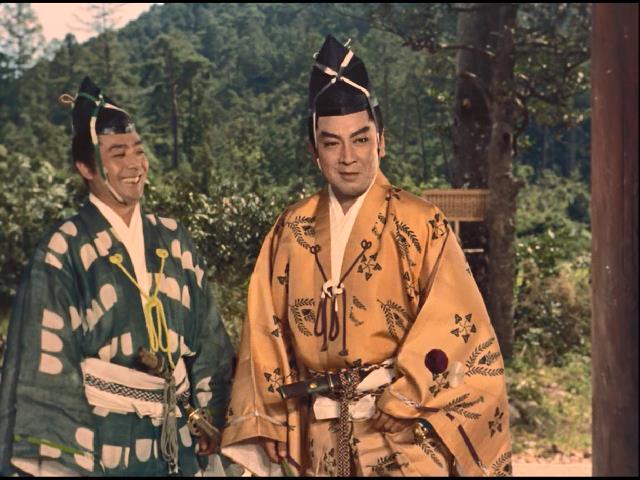
Which is understandable. Kesa is a beautiful young woman.
She is also married.
Morito doesn’t know this. He asks Lord Kiyomori to arrange a marriage to Lady Kesa. Lord Kiyomori agrees. A nobleman interrupts to point out that Kesa is already married: her husband is Wataru (Isao Yamagata), a member of the Imperial Guard. The other samurai present at the scene laugh. Morito, humiliated, doubles down and insists that Lord Kiyomori grant his wish. When Morito is informed that his wish is impossible, he refuses to respond.
Gossip about the incident reaches Lady Kesa and her husband. Kesa is embarrassed and worried that she encouraged Morito to think she was interested in him. As far as Kesa is concerned she was only being polite to the man who rescued her during the insurrection.
Lord Kiyomori sympathizes with Morito and arranges a meeting between Kesa and the obstinate samurai. After Kesa receives the invitation from Lord Kiyomori she is uneasy. She suspects that Morito is somehow involved. Wataru tells her that she cannot refuse an invitation from Kiyomori, and she agrees to attend.
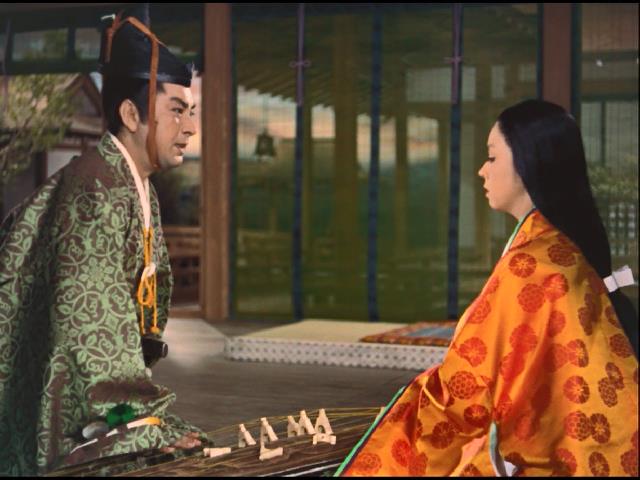
Lady Kesa plays the koto for Kiyomori. Morito is waiting outside. Kiyomori exits and tells Morito that he has invited Kesa here. “Meet with her,” Lord Kiyomori says, “and ask her what’s in her heart.” Kiyomori warns Morito that if Lady Kesa turns him down, that will be the end of the matter.

Morito enters and confesses his feelings towards Kesa: “I’m a man who can’t lie.” He swears that he didn’t know she was married. “For some reason, I can’t give up.”
Kesa tells him he’s being unreasonable.
“I know it’s unreasonable. Lady Kesa, can’t you see how I feel? For you, I will do anything.”
Kesa makes it clear to him that she does not return his feelings. But it is not the end of the matter.
Morito is obsessed with her and is not going to let anything or anyone get in his way. Kesa’s kind albeit ineffectual husband fails to grasp the peril she’s in, leaving her to handle the situation herself.
Morito’s behavior escalates. He comes to Kesa’s house and demands to see her. The scene in which Morito confronts Kesa at her aunt’s isolated residence is a cinematic masterclass in how to build tension. Hasegawa is terrifying. If you thought he was a jerk in Yotsuya kaidan you are really going to hate him in this. It’s hard to understand why in medieval Japan there is not a single man willing to step up and put a stop to this guy. Kesa’s husband Wataru is too nice. He doesn’t stand a chance against a menace like Morito.
As the unwilling target of Morito’s fixation Machiko Kyō’s Kesa is a woman of dignity and courage. She is the only person to volunteer for a dangerous mission at the beginning of the movie, and the only person brave enough to do something about Morito at its end.
Women in historical dramas— not just in Japanese cinema, but in movies worldwide— often get sidelined as ancillary characters, mere collateral damage of the evil that men do. Jigokumon subverts this trope in a subtle way. As you’re watching, consider the following: who is the film’s protagonist? The narrative seems to position Morito as the main character, giving him a lot of screen time. He’s not what you would call an heroic figure, although he himself seems to believe that he’s the lead in a romantic drama. Morito tells Kesa’s aunt: “I’m not giving up… I’m risking my life for her!” (No one asked you to, sir. Please sit down.)
There’s an intriguing hint of feminist critique. We see Lady Kesa tidying up her room. (She looks so cute in this scene and has such an endearing vibe.) When her nosy neighbor admonishes her for performing an ordinary task more suited to a servant than an aristocratic lady-in-waiting, Kesa admits: “I have too much time on my hands.” If Kesa had not met Morito, she could have found purpose beyond her largely decorative role as a nobleman’s wife. She could have become a poet. Or she could enjoy a peaceful life with her husband at their lovely estate and play the koto. Morito took that from her.
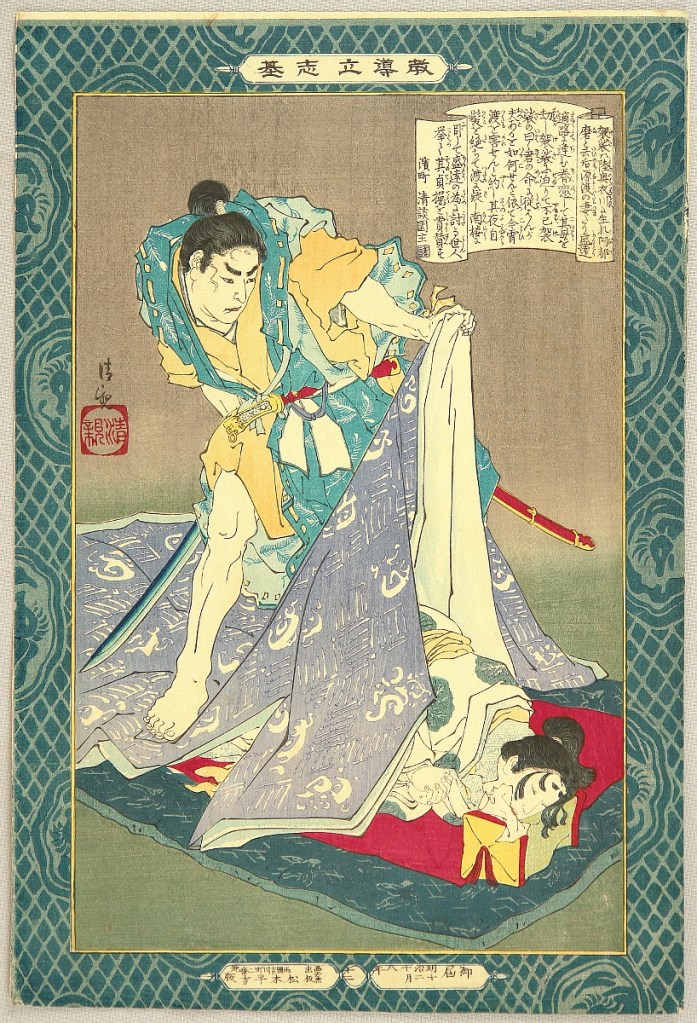
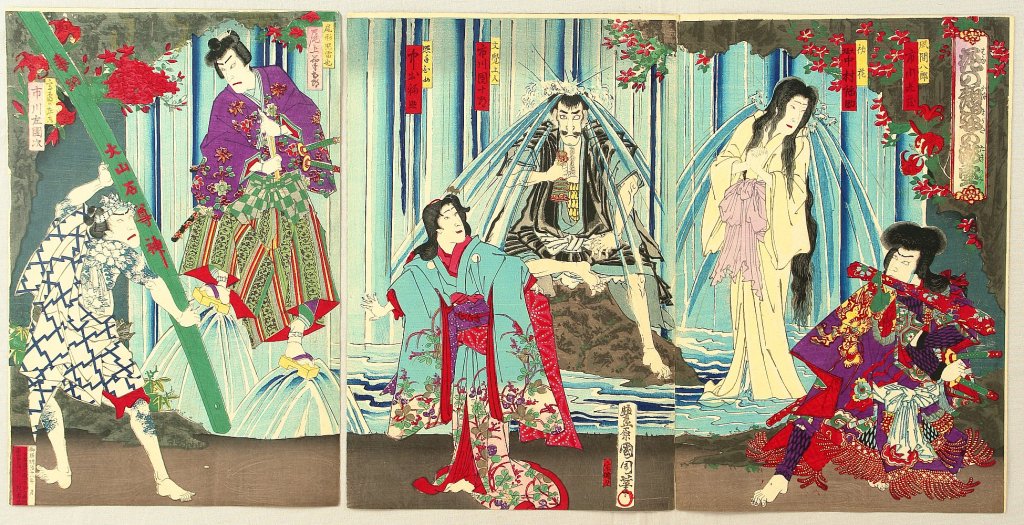
Morito is based upon a real person. He changed his name to Mongaku after becoming a Buddhist monk. Mongaku appears in several Kabuki plays and is often depicted in Japanese art doing penance under an icy waterfall. After watching Jigokumon you may feel that’s not nearly harsh enough.

 Ukiyo-e Owl
Leave a comment