
Directed by Yasushi Sasaki

Crime-fighting samurai Saotome Mondonosuke aka the Bored Hatamoto aka the Idle Vassal was Utaemon Ichikawa’s signature role. He portrayed Mondonosuke over the span of more than 40 years in 30 movies as well as a television series. Not all of Utaemon’s Bored Hatamoto movies have been released on DVD, and it can be tricky to find them on streaming platforms outside Japan. The 1973 TV series is on YouTube with English subtitles. It’s very much of its time, which is to say it’s a bit corny and over-reliant on zooms. Even so, Utaemon still had the same hugely likable presence and deft moves that made him a major star with a long successful career that began in silent film.
I’ve seen reviewers compare the character of Mondonosuke to Sherlock Holmes or James Bond. While he does investigate crimes and malfeasance, Mondonosuke tends to rack up a high number of casualties before closing a case, serving as judge, jury, and executioner. He’s a direct retainer of the shogun and effectively above the law, but he’s not a cold-blooded assassin like Bond, nor is he a cynical seducer of women. Ladies sigh over him because, in the immortal wisdom of ZZ Top, every girl crazy ’bout a sharp-dressed man. In return he treats them with courtesy like the gallant samurai he is.

Mondonosuke isn’t cut out to be a secret agent anyway. It’s hard to imagine him working undercover thanks to his height, that distinctive crescent-shaped scar on his face, and his insanely gorgeous wardrobe. I love a dandy, especially one with old-fashioned movie star charisma, which Utaemon Ichikawa has in spades.
If Mondonosuke does remind me of anyone, it is the flashily dressed retainer Kumedera Danjō (pictured below) who solves the mystery in the Kabuki play Kenuki. Mondonosuke appears to be heterosexual and not interested in pretty young pages like Danjō, who is something of an ambisextrous pest.
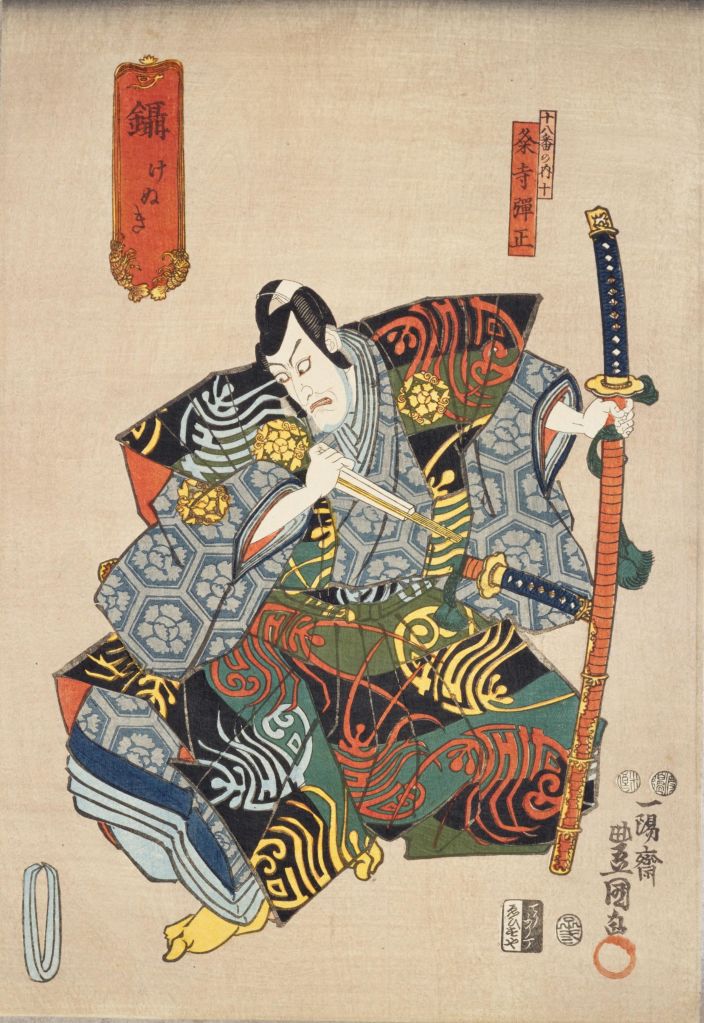
Ichikawa Ebizō V as Kumedera Danjō
In both of today’s films Mondonosuke’s reputation as the most famous samurai in Edo precedes him wherever he goes. Literally everyone in the country seems to know who he is. While it’s not the most optimal situation for a detective, it means that only the most deep-dyed villains (in this case Toei’s go-to bad guys Ryūnosuke Tsukigata and Isao Yamagata) would dare to defy a vassal of the shogun, and a master swordsman at that.
In Island of No Return our hero investigates a series of mysterious disappearances taking place on an island off the coast of Nagasaki. The island, a lawless and insalubrious place reserved for foreigners, nevertheless appears to have a substantial budget for musical theatre. In the course of his investigation Mondonosuke uncovers a sinister conspiracy to import massive amounts of opium into Japan involving an alliance between corrupt local leadership, disgruntled samurai clans, and Chinese drug traffickers. The plan seems to be as follows:
1. Get everyone in Japan addicted to opium.
2. Overthrow the government.
As evil plans go you have to admit this is fairly ambitious.
The film concludes with a swordfight inside a theatre. Mondonosuke, wearing a stunning deep blue kimono with an elaborate gold and white scrollwork pattern, stares down villain-in-chief Musai (Ryūnosuke Tsukigata), who has him at gunpoint. “If you descend from a samurai,” Mondonosuke says, “use a sword.” Musai removes his disguise to reveal his true identity as the disgraced samurai Ukita Hidekuni. Mondonosuke makes short work of him, and soon it’s a wrap for Nagasaki’s nascent drug trafficking business.
In The Cave of the Vampire Bats innocent young women working as shrine attendants at a temple keep turning up dead. Mondonosuke investigates, uncovering a plot featuring a phony prince, ninja assassins, and a nest of traitors attempting to overthrow the shogunate. There are more musical interludes than strictly necessary. The Bored Hatamoto finds plenty to keep him occupied in a climactic swordfight inside the eponymous cave. I lost count of how many dudes he killed.
One thing that sets Utaemon apart from his great contemporary and fellow chanbara icon Chiezō Kataoka is his cheerful energy in fight sequences. Chiezō typically looks VERY intense and grimly focused on the task at hand; Utaemon as Mondonosuke has a manic gleam in his eye that says he’s really going to enjoy every moment of messing up his adversaries. This may be why so many of them run away the second he starts his famous laugh.
Don’t expect something more profound from these movies than a fun way to spend approximately 90 minutes of your time. Bored Hatamoto films don’t aspire to be anything other than crowd-pleasers. A major part of their appeal is adhering to a proven formula: when Mondonosuke directs the bad guys’ attention to his crescent-shaped scar or utters the name of his sword style, you know it’s about to go off. After Mondonosuke outwits the opposition he lives to fight another day in the most splendid kimono you’ve ever seen in your entire life. Utaemon Ichikawa’s magnificent costumes were designed by the Kyoto artist Tadaoto Kainosho (1894 – 1978), who was nominated for an Academy Award for his work on Mizoguchi’s Ugetsu (1953). You can read more about him here.

 Ukiyo-e Owl
Leave a comment