

A casual viewer of Japanese period dramas might wonder what to make of some scenes. The men wear makeup, and they are sometimes depicted weeping openly. What’s going on?
Let’s deal with the makeup first. This doesn’t faze me because everyone in movies— men, women, children, dogs, you name it— wears makeup. It’s not always obvious, but it’s there.
In Japanese historical dramas the makeup can be quite obvious, and you might find yourself asking why these very manly men are wearing eyeliner and lots of brow-enhancing product. The short answer is that the filmmakers want the actors to look good. What is considered attractive is culturally mediated, so what one culture deems appealing is not necessarily going to translate to a different culture.
The longer answer involves an aesthetic that predates cinema, an aesthetic in which physical beauty is not the exclusive preserve of women. Male leads in Kabuki often wear a great deal of makeup and extravagant costumes to create characters who are as gorgeous and eye-catching as a peacock in full display. Pretty young men/adolescents have their own Kabuki stock character (wakashugata), whose purpose is to be decorative and/or to serve as objects of desire. Here’s a photo of the wonderful Kabuki and film actor Nakamura Kinnosuke1 at the peak of his youthful beauty:

There are few men prettier. But anyone who fights him in a samurai movie is in serious trouble. If you’ve ever seen Nakamura Kinnosuke wield a sword you already know this.
I’ve written about the dandified samurai Saotome Mondonosuke whom Utaemon Ichikawa plays in the Bored Hatamoto movies, whose lavish wardrobe must have cost the Toei film studio a fortune. Mondonosuke is no effete fop, however, and is more than capable of eviscerating anyone who gets in his way.
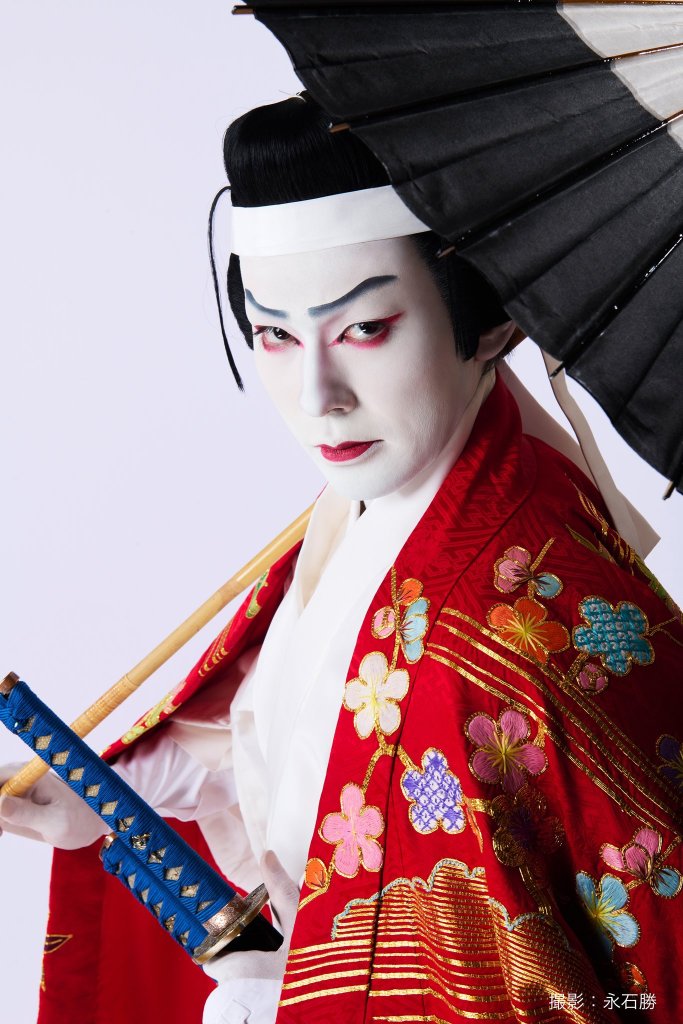
The extraordinary looking gentleman pictured above is Ichikawa Somegorō VIII in the recent Kabuki-za production of Kobikichō no Adauchi (The Vendetta at Kobikichō). Somegorō is the heir to the Koraiya guild of Kabuki actors which dates back to the 18th century and is the great-grandson of Matsumoto Kōshirō VIII. Which brings us to the next topic.
The first time I saw the 1962 Toho production of Chūshingura I knew very little about the story and nothing whatsoever about any of the actors apart from Toshiro Mifune, who has a relatively small role. As I watched it I became fascinated by the film’s lead. Who is this incredible actor, and why haven’t I seen him before? I am of course referring to Matsumoto Kōshirō VIII, who plays Ōishi Kuranosuke. He is amazing, and if you want to know who the greatest Kabuki actor of the 20th century was, look no further:

Theatre is an ephemeral art. If you weren’t there in person to enjoy it, it’s gone forever. Fortunately a number of Kōshirō’s Kabuki performances have been preserved on video. His 1979 portrayal of Sekibei/Ōtomo no Kuronushi in the Kabuki dance drama Seki no To is available on DVD. I could rave about it all day as he is the only actor who has ever made my jaw drop in a literal sense. AND he can dance! The man’s a genius, truly. While his filmography is not extensive, I haven’t seen him give less than a superb 100 percent committed performance, and for me Kōshirō is the definitive Ōishi Kuranosuke. (He’s sexy too, but I’m trying to keep it respectful here.)
Kuranosuke exemplifies a stock Kabuki character referred to as jitsugotoshi. Kabuki21, the indispensable online guide to Kabuki, defines jitsugotoshi as “a wise, righteous and clever man, who appears on stage at the right time to set the record straight, to solve an enigma or foil an evil plot.”
For readers who aren’t familiar with Chūshingura, it’s based on a true story which has been the subject of plays, multiple TV series, a ballet, an opera, and so many movies that it’s impossible to keep track of them all. Details vary in the different versions, but the basic plot involves events ensuing from the death by ritual suicide of a daimyō in 18th century Japan, Asano Naganori. I hope to be able to write in depth about the epic 1962 Chūshingura (its full title is Chūshingura: Hana no Maki, Yuki no Maki) in a future post, ideally during winter, which is Chūshingura season.
All of the samurai who served under Lord Asano have been left masterless and without positions in the wake of his tragic demise, and the shogunate has confiscated the late lord’s estate. Kuranosuke (Matsumoto Kōshirō) is Asano’s loyal chamberlain who devises a secret plan to avenge his master’s death. Before he does that, he has to transfer control of Asano’s estate to the shogunate.
A feudal domain is like a large company, requiring a lot of manpower and sophisticated management skills to keep it running. As the man responsible for administering Lord Asano’s estate Kuranosuke is devastated. During the handover of the castle to the officer in command of the armed forces sent by the shogun this immensely dignified man suddenly breaks down and cries. I’m talking full-on agonized sobs. I was so astonished and moved by Kōshirō in this scene that I burst into tears myself.
I cannot imagine anything remotely like this taking place in a Hollywood movie. Male heroic figures are not allowed access to the full spectrum of human emotion there. In samurai movies, men defy Western gender norms and get emotional on a regular basis. They weep. They show love towards other men. I should clarify that this love is homophilic in nature rather than homoerotic, which would have been off-limits for historical dramas produced in Japan in the 1950s and 60s.
With his stern avuncular presence Chiezō Kataoka plays well opposite various fiery young men in a film he made for Toei about the Shinsengumi. He feels affection for these lads and keeps a paternal eye on them; in return they are prepared to die for him. Nakamura Kinnosuke plays the juvenile lead who meets an untimely death in Shinsengumi Oni Taicho (Shinsengumi’s Devil Commander) (1954). I usually have minimal patience for self-consciously adorable young people in samurai films. Kinnosuke is heartbreaking.
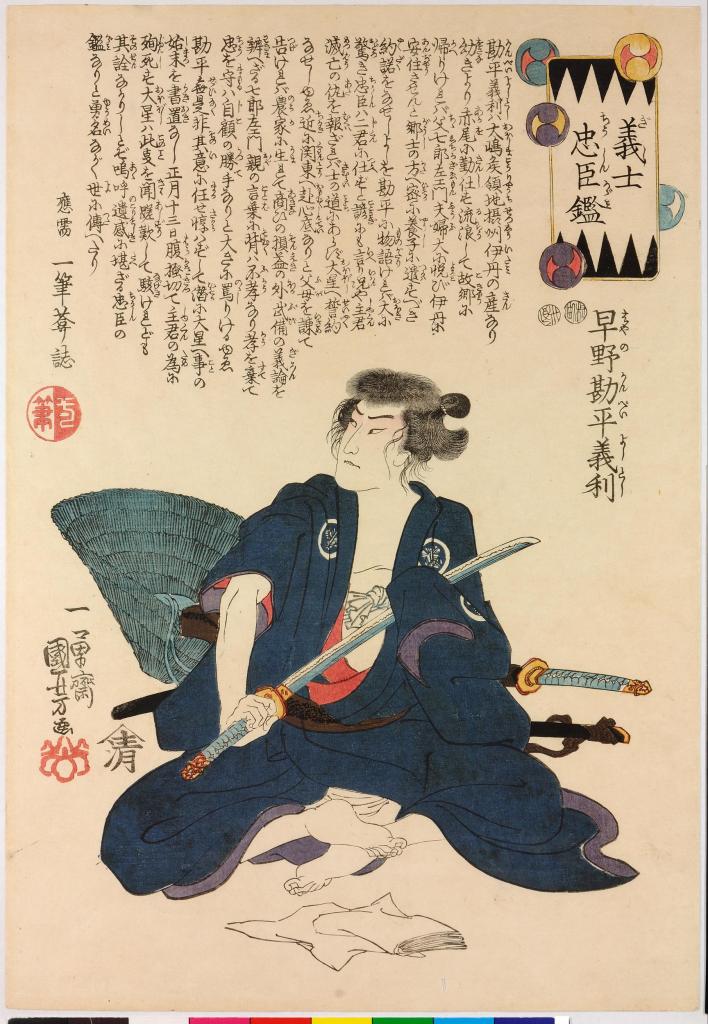
The archetype of the unfortunate young man found in jidaigeki is the tragic Hayano Kanpei, who commits suicide in the Kabuki play Kanadehon Chūshingura. Kanpei is another character who makes me cry. Nothing goes right for him, the poor guy. While the play is a fictionalized account, the 1962 film of Chūshingura is based on historical events so the fictional Kanpei is referred to by his real name Sanpei, although he kills himself for different reasons than in the play.
In a highly dramatic scene at the end of the 1962 movie Sakura hangan (Sakura Official) Chiezō’s character Tōyama no Kin-san, the Edo magistrate whom he portrayed on film eighteen times, decides to kill himself in the presence of the shogun in protest over systemic injustice and corruption which he is powerless to resolve. Chiezō delivers a long intense monologue, furious at first and then deepening into a profound sense of shame. Overwhelmed by disgust, he grabs his sword and aims it at his abdomen. “Behold the end of a real man,” he says. The real man in question cries and wears eyeliner.
- For Kabuki actors’ stage names I use the traditional format, i.e., Surname/First name. For film characters I try to use the format that those characters use or how other characters refer to them, e.g., Saotome Mondonosuke. In most cases I will use First name/Surname. If I have inadvertently got this wrong anywhere, I offer my apologies. ↩︎

 Ukiyo-e Owl
Leave a comment