Directed by Akira Kurosawa / Directed by Tadashi Sawashima
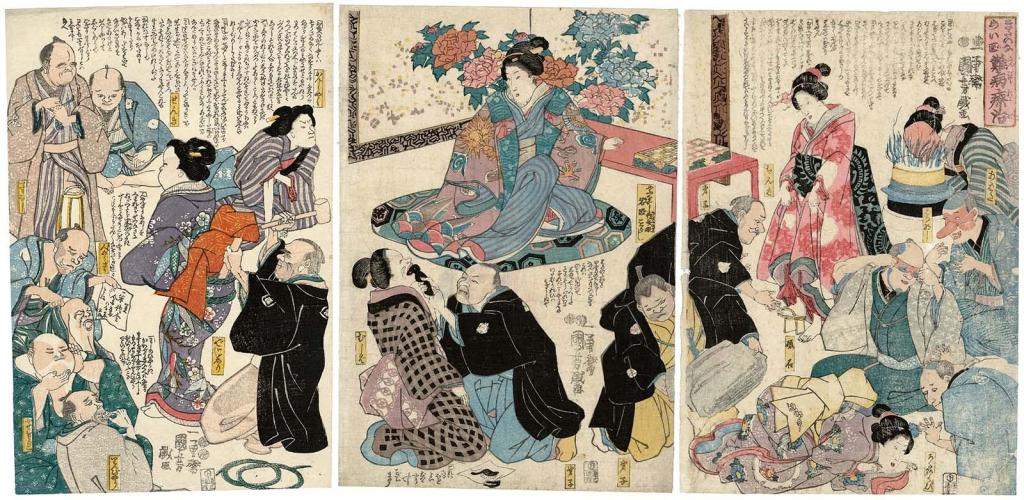
(Kitai na meii nanbyō ryōji)
William Sturgis Bigelow Collection, Museum of Fine
Arts Boston
Both of the films that are the subject of today’s review feature an unorthodox middle-aged doctor and his arrogant young disciple who clash when the younger man joins the older man’s medical practice. One is a celebrated big budget epic directed by Akira Kurosawa in excess of three hours in length. The other film is a relatively obscure fast-moving dramedy starring Utaemon Ichikawa who manages to help a lot of people and kick copious ass in 90 minutes. (Which movie I prefer should already be apparent to regular readers of these pages.)
Red Beard was the final film Toshirō Mifune made with Akira Kurosawa. Mifune plays Dr. Kyojō Niide; the title refers to his nickname. Based upon a collection of short stories by Shūgorō Yamamoto, Red Beard had an elaborately detailed set of an entire town constructed for its production. Props, set dressing, and costumes were designed and manufactured with meticulous attention to historical accuracy even if they never appeared on camera. The film took two years to produce. Yet after spending all that time and money Kurosawa gives Mifune almost nothing to do except look stern and stroke his beard pensively. This is like buying a Ferrari and using it to drive five minutes around the corner to a convenience store.

© Janus Films 1965
Most of the film’s narrative concerns itself with stories of various patients at Dr. Niide’s medical clinic and dominate the film’s interminable run time much to its detriment. Mifune has tons of presence but little dialogue. He and his co-star Yūzō Kayama spend the majority of Red Beard listening to other people talk. This does not make for enthralling cinema. There’s a whole lot of telling rather than showing going on here, inexcusable for a filmmaker of Kurosawa’s experience and stature.

© Janus Films 1965
I’m not alone in my negative assessment of this movie. If you filter the reviews for Red Beard on Letterboxd at two stars or below you get a sense of how frustrated and disappointed viewers are, including Kurosawa fans. I am neither an ardent fan nor a hater, but I can’t help wondering if Kurosawa became a victim of his own success at this point in his career and perhaps had started to believe his own PR, thinking he could do no wrong.
Red Beard is on the Criterion Channel if you have three hours to spare on a glacially paced story that could easily have been told in half that time. I haven’t even mentioned the film’s most egregious misfires like the creepy misogyny of depicting a victim of childhood sexual abuse as a homicidal seductress or the lurid scene featuring a naked female surgical patient bound with ropes which looks like something from a BDSM porn film, but I think I’ve made my point. Kurosawa strikes me as being uninterested in women as dimensional human beings, and Red Beard offers nothing to dissuade me of that opinion. Sympathetic or interesting female characters over the age of 12 are in remarkably short supply. The film’s most vividly etched character is a grotesque child-abusing madam of a brothel (Haruko Sugimura, who makes the most of her limited screen time).
If you want a good movie that really knows how to use Toshirō Mifune I strongly recommend Tsuma no kokoro (A Wife’s Heart). It’s not an historical drama (it’s set in postwar Japan) and therefore outside the scope of this blog, but Mifune looks fine as hell in it and has charisma to burn. Mifune and Hideko Takamine give soulful performances under the expert direction of Mikio Naruse. It reminds me somewhat of Brief Encounter, only without the Rachmaninoff. I thought that Tsuma no kokoro was on Criterion but it isn’t, for reasons unknown. A subtitled version is available here.
It took me four attempts to finish watching Red Beard on Criterion’s streaming platform. (This is a new record for me.) The first three times I fell asleep, and I really had to force myself to stick with it on the fourth. One of the basic requirements for a good movie is that it holds your attention. Drunken Sword has the same set-up and some of the same story elements as Red Beard, but there the similarity ends. The most salient difference is that Drunken Sword is actually entertaining. Did I doze off? Not once!
Utaemon Ichikawa plays Tetsunosuke, an eccentric general practitioner in Edo who treats the city’s poor and elderly citizens for a nominal fee on an in-patient and out-patient basis. In addition to owning and operating a medical clinic he has a dōjō. Chiyonosuke Azuma is the ambitious new intern who’s convinced that working at Tetsunosuke’s low-cost clinic is beneath him. Azuma is typecast as Toei’s default prissy/stick-in-the-mud character but he’s very good as a doctor fresh out of school who learns that he does not in fact know it all. Utaemon made me laugh out loud. He has a goofy quality that I find irresistible. His female clientele in Drunken Sword feel the same way and throw themselves at him shamelessly.
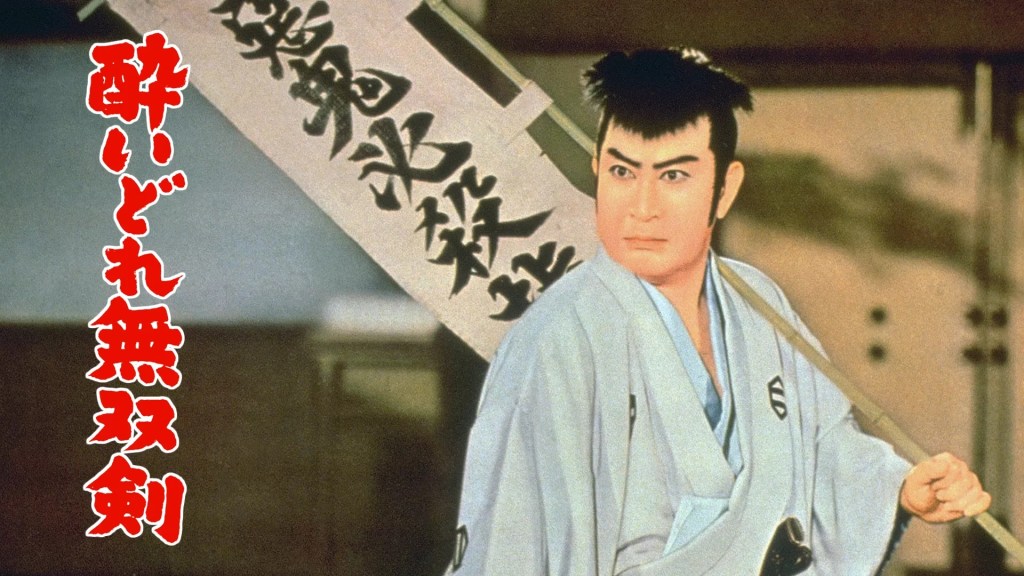
© Toei Company, Ltd.
On top of having to deal with a prickly new apprentice and thirsty female patients Tetsunosuke has also pissed off the local yakuza as well as the hoity-toity palace doctors, who want to force him out of business. They are essentially a cartel, and their services are available only to those who can afford their exorbitant fees. Tetsunosuke threatens their for-profit business model and has to be taken down. The rich doctors and the gangsters are two sides of the same coin, corrupt and driven by greed.

© Toei Company, Ltd.
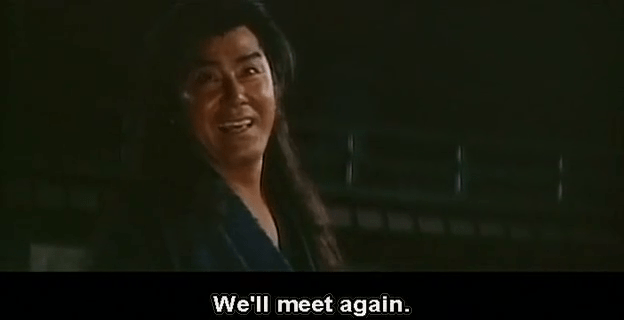
This is an Utaemon Ichikawa vehicle which means there are going to be multiple sword-fighting scenes, and good ones at that. Utaemon faces off against a sinister rōnin played by Jūshirō Konoe, who appears to have been immersed in a vat of industrial-strength bronzer. His fencing is first-class, however, and he’s more than a match for Utaemon, who has a great drunken duel with him.
© Toei Company, Ltd.
The tone is all over the place, ranging from serious to zany. Some of Drunken Sword‘s comedic scenes haven’t worn well since 1962. Even so, everything moves along at a sprightly pace and the unfunny moments don’t last long. Also worth noting is that the character of a young woman in-patient afflicted with mental illness is depicted with greater humanity and sympathy here than in Kurosawa’s film. She appears to be suffering from what we would now recognize as PTSD. Before the end of the movie she is on the road to recovery thanks to Tetsunosuke’s compassionate treatment. He’s one of those ideal physicians who seem to exist solely on film and television, although he’s the first I’ve seen with his own dōjō. Maybe we should get back to that.
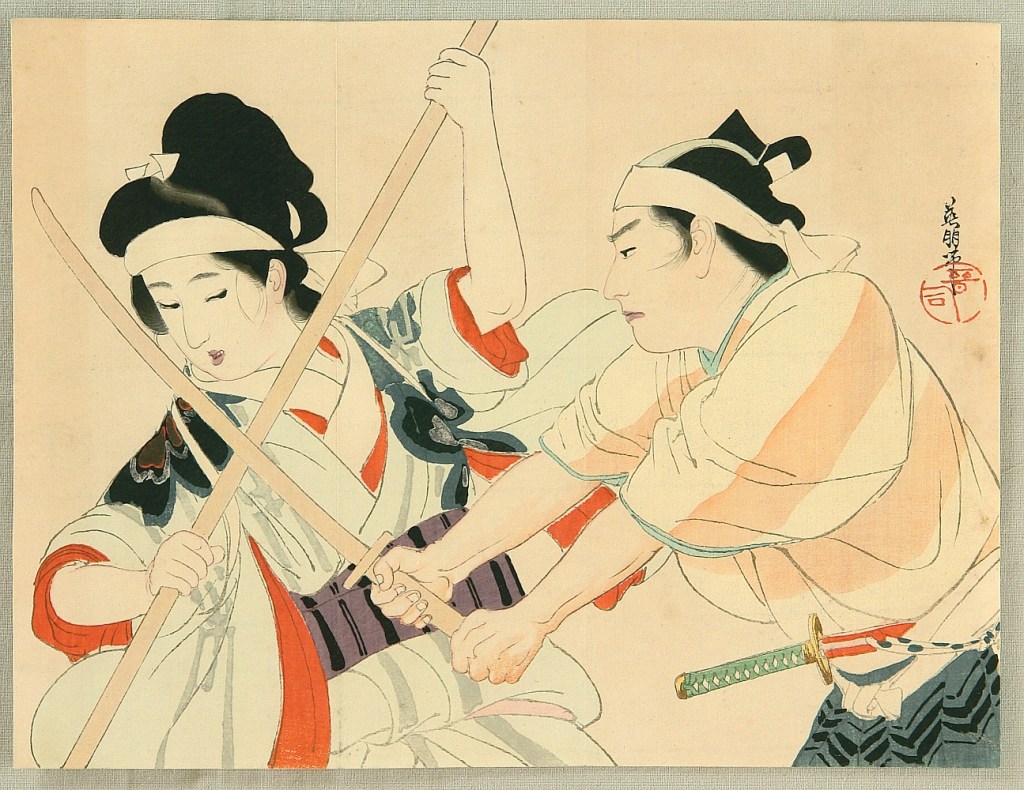
Drunken Sword is not available on DVD. A fairly decent print with English subtitles is here.

 Ukiyo-e Owl
Leave a comment