Directed by Sadatsugu Matsuda

Freer Gallery of Art Study Collection, National Museum of Asian Art,
The Smithsonian Institution
A two-part action/adventure tale with fantasy overtones and faint echoes of the Disney classic 20,000 Leagues Under the Sea: the eponymous ship attacks other vessels and vanishes, retreating to a secret island base which blows up in the last act. Despite the title this isn’t a horror story. The mystery of the ghost ship has a non-supernatural explanation revealed in Part 2. Before that happens there’s some swashbuckling as we follow the adventures of jidaigeki superstar Nakamura Kinnosuke, who has a cute animal companion in the form of Shiro, his loyal dog. Shiro is a good boy (and a good actor, by the way).
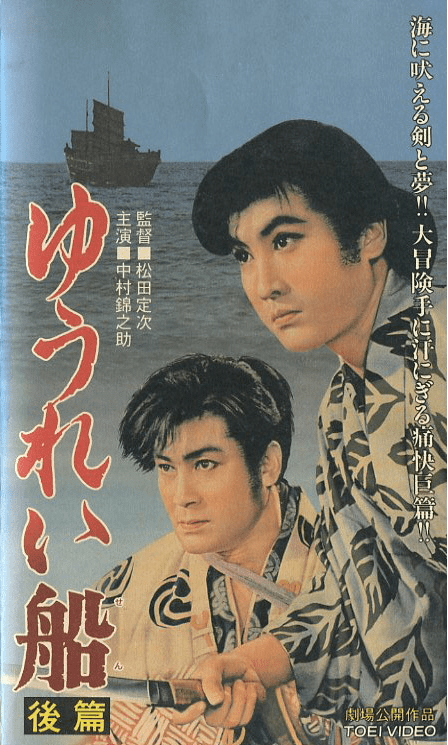
© Toei Company, Ltd.
The prints I saw were very sharp and clear. They looked brand new. I have read that Toei struck new prints after a crowd-funded campaign organized by a group of Nakamura Kinnosuke fans. While I applaud the effort required to make this happen, it points to the fact that studios are reluctant to spend their own money restoring older films from their libraries. In most cases it simply isn’t commercially viable.

Utagawa Kuniyoshi (1798 – 1861): Kuwana: Funanori Tokuzō no den (Kuwana: The Story of the Sailor Tokuzō).
East Asia Collection, The Victoria and Albert Museum
Part 1
Ghost Ship is adapted from a story by Osaragi Jirō, who wrote the book Ship of Outlaws was based upon. At 25 Kinnosuke still looks boyish enough to play a teenager, assisted by his wholesome vibe. He portrays Jiromaru, the bereaved young son of Jubei (Denjirō Ōkōchi), a ship’s captain presumed lost at sea. The film opens with Jubei’s ship the Kannonmaru tossed about in a violent storm off Luzon. Things aren’t looking too good for Jubei and his crew, and the last we see of him he is shouting his son’s name.
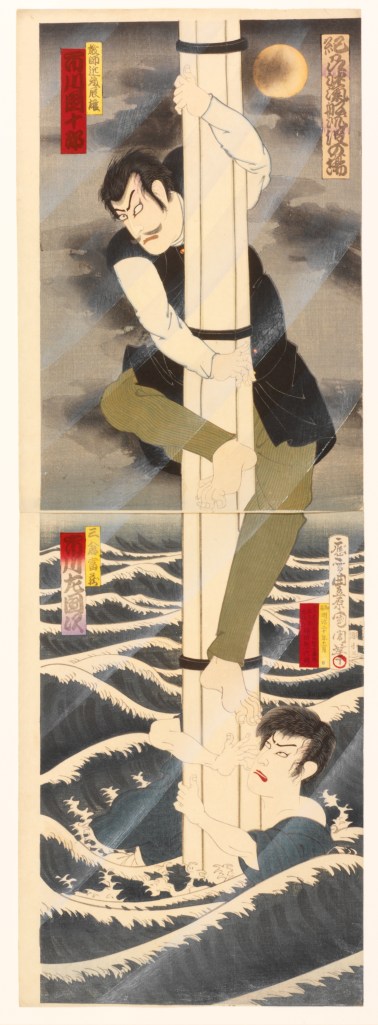
Tatsuo and Ichikawa Sadanji as Mikura Tomizo
The only survivor of the storm is the elderly Shinbei (Ryoei Ito), who urges Jiromaru to take up his father’s profession.
Jiromaru doesn’t want to be a sailor like his father. He wants to go to Kyoto where he plans to enlist his uncle’s help in his ambition to become a samurai and eventually a general. Jiromaru’s timing couldn’t be worse: this is the conflict-ridden Sengoku period, and Kyoto is in turmoil. The villainous daimyō Matsunaga Danjō (Ryūnosuke Tsukigata) has seized power and is terrorizing the city’s populace.
Shinbei warns him against travelling to Kyoto: “Kyoto is filled with corpses and demon-like people. I hear it’s like a living Hell.” (Shinbei should work for Kyoto’s tourism board.)
Jiromaru goes to Kyoto anyway. Upon arriving Jiromaru has a hard time finding his uncle’s house. He is directed to a derelict burnt-out mansion. Princess Yuki (Yumiko Hasegawa) and her maidservant Chacha (Eiko Maruyama) are living there. She is a survivor of the noble family whom Danjō tried to wipe out in his rise to power. He has put a bounty on Princess Yuki, forcing her into hiding. The princess and her companion disguise themselves as demons to ward off the curious.
Jiromaru comes across a group of bandits led by Samanosuke (Ryūtarō Ōtomo), believing them to be samurai.
Jiromaru arrives at his uncle Gorodaiyu’s house. He is shocked to be met with a hostile reception. His uncle isn’t there, and Gorodaiyu’s insufferable son Saemontaro (Kensaku Hara) refuses to meet him. He instructs his servants to get rid of Jiromaru. Gorodaiyu (Eitarō Shindō) arrives and agrees to meet with Jiromaru. Unfortunately Uncle Gorodaiyu is an unsavory character. He is a war profiteer in league with Danjō, whom we see in his palace in Kyoto making some tea as he orders troops to fire upon the crowds of starving citizens gathered outside.
Gorodaiyu has a chat with his nephew and informs him that he is too naive and idealistic to make it as a general. (He’s not wrong.) As for becoming a samurai, he points out that if Jiromaru really wants to be a samurai he would have to accept Danjō as his lord. Jiromaru is a thoroughly decent young man not willing to swear loyalty to someone like Danjō. Disillusioned and ready to abandon his dreams of becoming a samurai, Jiromaru decides to return home to Sakai.
A torch-bearing mob approaches Gorodaiyu’s estate demanding food. Gorodaiyu proves he’s just as wicked as his master Danjō by ordering his men to open fire on the crowd, most of whom appear to be unarmed. Princess Yuki is among them and flees to the countryside, pursued by a detachment of troops sent by Danjō.
Jiromaru’s vile cousin Saemontaro abuses a young servant girl (Satomi Oka). Saemontaro beats and murders her like it’s no big thing. It’s an easy shortcut for the filmmakers to show what a despicable person he is but it feels gratuitous, and the fact that he seems to be getting off on it is out of place in a children’s film.
Princess Yuki agrees to give herself up and is taken prisoner by Danjō’s men. Jiromaru, Samanosuke and the bandits ambush them and recapture the princess.
Jiromaru spots Shinbei piloting a boat. Shinbei has been looking for him. Everyone boards the boat and they make their way to the sea. Shinbei informs Jiromaru that his late father’s ship the Kannonmaru has been seen, rumored to be haunted by the spirits of its drowned crew who have become funayūrei (a sort of maritime vengeful ghost). Right on cue a mysterious ship appears in the distance. Jiromaru recognizes it at once as Jubei’s ship and tells Shinbei to steer the boat towards it. The film ends on a bleak note with a frantic Jiromaru screaming for his father as the Kannonmaru sails out of reach into the mist.
Part 2
Part 2 opens with a brief recap of the first film. We pick up where we left off, with Jiromaru in pursuit of the Kannonmaru. The ensuing scene aboard Jubei’s empty ship is memorably nightmarish. It’s a shame that Sadatsugu Matsuda didn’t make more use of the horror angle implied by the title because this is a genuinely creepy sequence.
Jiromaru wakes up from his nightmare to find that he is back at his house in Sakai being looked after by Samanosuke, Princess Yuki, et al. Two of the bandits from Samanosuke’s gang get drunk at a tavern and foolishly blab about Princess Yuki to the pirate boss Yasanzo (Isao Yamagata) who promptly abducts her and her attendant onto his ship and sails away.
Jiromaru’s dirtbag cousin Saemontaro resurfaces on a boat en route to China in an arms smuggling deal. His ship is boarded by the pirates. Yasanzo kills him and dumps him overboard. (Firmly Team Pirates with this one.)

© The Trustees of the British Museum. Shared under a Creative Commons Attribution – Non-Commercial – ShareAlike 4.0 International (CC BY-NC-SA 4.0) licence.
The Kannonmaru appears and fires a cannon at the pirate ship, breaking its mast. Yasanzo makes for the Ryukyu Islands south of Japan and hears about a mysterious place known as Ghost Island, where a ship that looks like the Kannonmaru has been spotted. The pirates set sail for the island and reach it via a small launch, as the island is surrounded by a coral reef which makes it too dangerous to access by ship.
We discover that Jubei is alive, leading a contemplative life on the selfsame Ghost Island, headquarters of Akuryuo (Kenji Usuda), an ex-pirate determined to make amends for his crimes. Akuryuo saved Jubei from drowning in the storm seen in Part 1. He has enlisted Jubei’s help in fighting the pirate scourge and wants Jubei to be his successor in leading the peaceful idyllic community he has created on the island. Akuryuo also appears to be involved in arms dealing, which presumably funds the luxurious accommodations and fixtures seen everywhere. Maybe I’m missing something but I don’t really understand Jubei’s position in regard to living large on the island like this while his beloved son believes him to be dead and is struggling to cope with the loss.
Jiromaru and Samanosuke sail to Ghost Island in pursuit of the pirate ship. The pirates have commandeered Jubei’s ship and intercept them. Jubei is reunited at last with his son, but there’s no time for them to enjoy it. A messy fight ensues during which Jiromaru and Samanosuke jump overboard and hide on the stern.
Back on the island Jiromaru, Jubei, and Samanosuke engage the pirates in a desperate battle. The island is mined with explosives. Akuryuo pulls a lever to ignite the fuse, sacrificing his own life to take down the pirates. This sequence is very well shot and I love Denjirō’s ‘HOLY SHIT’ expression when he realizes what’s happening. In an apocalyptic scene Jubei, Jiromaru, and the island’s inhabitants watch helplessly from a safe vantage point as the island explodes around them.
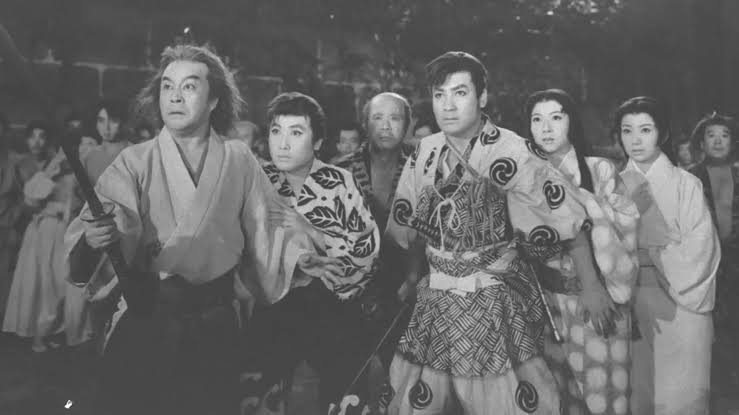
© Toei Company, Ltd.
With the bad guys vanquished everyone sails off in a flotilla led by Jubei and the Kannonmaru. Jubei says that they cannot return to Japan. He will find an island to the south where they can live in peace and build a new society.
At this point alarm bells started going off. I could see Jubei losing his mind and declaring himself god-king of whatever tropical hellhole they end up in. Now that would be a horror film I’d like to see! But this is a kids’ movie, and surely no such tragic fate lies in store for our band of heroes.
So that was a lot.
I wish Ghost Ship were better. All the ingredients are there but it falls short of delivering the sort of rollicking adventure you think it’s going to be. Part 1 takes place almost entirely on land, and the ghost ship doesn’t materialize until the last five minutes. For a children’s film it’s actually pretty dark and takes way too long to get where it’s going. Kinnosuke isn’t given much to do except talk to his dog and appear scared/concerned by the various goings-on. Speaking of the dog, Shiro should have had at least one scene where he gets to rescue Jiromaru or attack a bad guy or something.
The main problem with the story as a whole is that it suffers from the lack of a strong antagonist. What we get instead is a series of villains, none of whom stick around long enough to pose much of a threat. Yasanzo the pirate makes the strongest impression thanks to Isao Yamagata, who seems to be enjoying sinking his teeth into such a colorful part.
Perhaps the most striking thing about both parts of Ghost Ship is the disenchantment with Japan expressed by several of its characters. I get that the Warring States/Sengoku period must have been a miserable time to be alive but it’s unusual to hear characters voice their feelings of anomie so openly to the point that they would rather spend the rest of their lives at sea or on an uncharted island than remain in their homeland.
Finally, I note that Shiro Fukai, who composed the music for both Ghost Ship and Ship of Outlaws, appears to have recycled some of his score from Ship of Outlaws. I liked it better the first time around.

 Ukiyo-e Owl
Leave a comment