Directed by Sadatsugu Matsuda
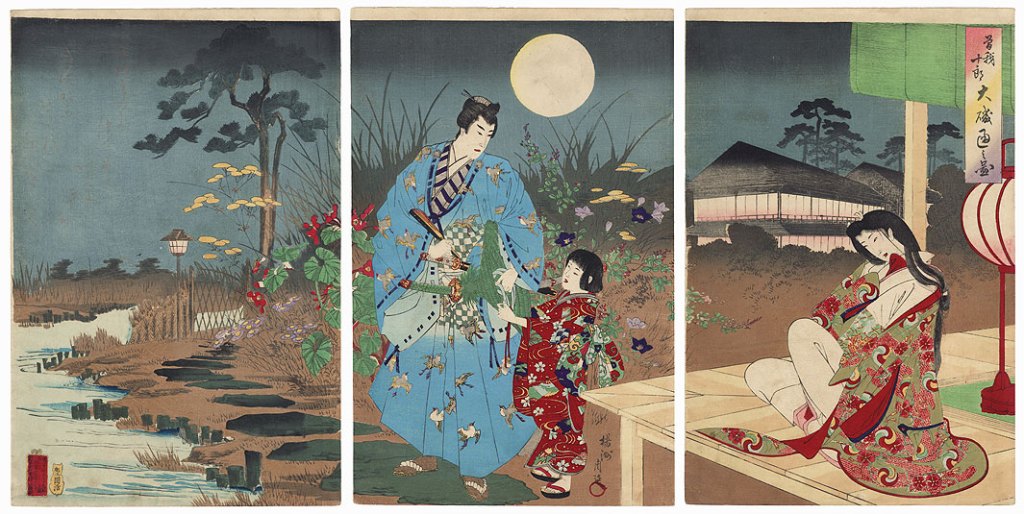
I grew up watching Errol Flynn movies on TV. He was my childhood crush and my personal template for action-adventure heroes. According to this template swordsmen should be equally adept at romance as they are at kicking ass. Errol made this look easy. He was also impossibly handsome, which rather spoiled men for me off-screen. I mean:
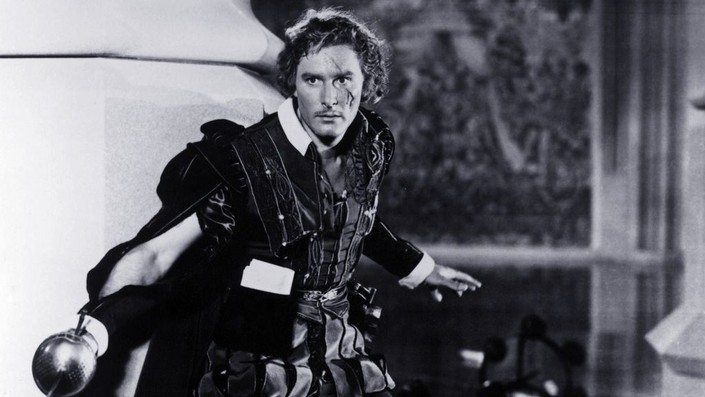
To this day I have a thing for dashing men with bladed weapons. Every man on the planet instantly becomes hotter carrying a sword.
Samurai carry two swords.
Unfortunately samurai movies are not big on romance. Romance in the Hollywood sense is virtually non-existent in the Japanese period films I have seen. In the absence of an explanation I will attribute this omission to cultural differences and leave it at that. I still miss it, though. I don’t wish to be culturally insensitive, but honestly if I could find a film set in feudal Japan in which a man holds a woman’s hand I could die happy.
In the midst of my search for this elusive hypothetical movie I read a review of a 1961 Toei production called Ishin no kagaribi. Set during the turbulent period preceding the downfall of the shogunate in the 19th century, Ishin no kagaribi is an historical drama that takes as its subject the relationship between a man and a woman. Okay, this sounds promising. IMDb doesn’t yield much info apart from listing the cast. Who plays the man?
None other than Chiezō Kataoka.
Sold! I’m watching the hell out of this.
Before he starred in Ishin no kagaribi Kataoka portrayed a literal lady-killer in two separate film trilogies adapted from the immense epic novel Dai-bosatsu tōge. I bought a boxed set of the color version directed by Tomu Uchida and binge-watched it. As the homicidal samurai Ryūnosuke, Chiezō murders his wife in Part 1, and things go downhill from there.
Despite being an ice-cold psychopath with neither job nor money, Ryūnosuke is a babe magnet who has beautiful women falling for him throughout all three parts of the trilogy. I admit I found this funny at first. Here’s this rather stocky samurai who seems to have a lot of down time in between senseless murders— what does he do all day? Hang on, he’s blind now? Like permanently? Who will look after him?
Wait, what’s happening oh no
Like the doomed ladies drawn into fatal orbit around Ryūnosuke’s dark star, I found myself quite taken with Chiezō, who cuts an imposing figure onscreen and has charisma to burn. It would be nice, I thought, to see him play a sane character in a sane consensual relationship and not just a relentless killing machine, which admittedly he is very good at.
In short, I wanted him to get the girl. Preferably without murdering her.
This sort of happens in two of Kataoka’s previous films that I have seen, but he was playing a sorcerer/ninja in both of them and his female co-stars (also portraying sorcerers/ninjas) spend most of the movies’ running time disguised as men. Untangling everyone’s relationship status or indeed sexual identity in this esoteric context is beyond my humble powers.
Ishin no kagaribi is a serious historical drama and not a folkloric fantasy, so matters are more straightforward. Ofusa (Chikage Awashima), an attractive widow in Kyoto with a haberdashery business, returns from a meeting with a client, who warns her to be careful on her way home due to recent civil unrest in the city. As she is walking to her house a young man rushes past her, greets her briefly by name, and then runs off in a hurry. We see him and another man ambush an older man walking by himself (Chiezō). The older man swiftly retaliates with terrifying efficiency, killing one of his assailants outright and leaving the other near death on the ground. When he raises his sword to finish the job Ofusa tries to stop him, explaining that she knows the man. But it’s too late, and the young man dies from his injuries.
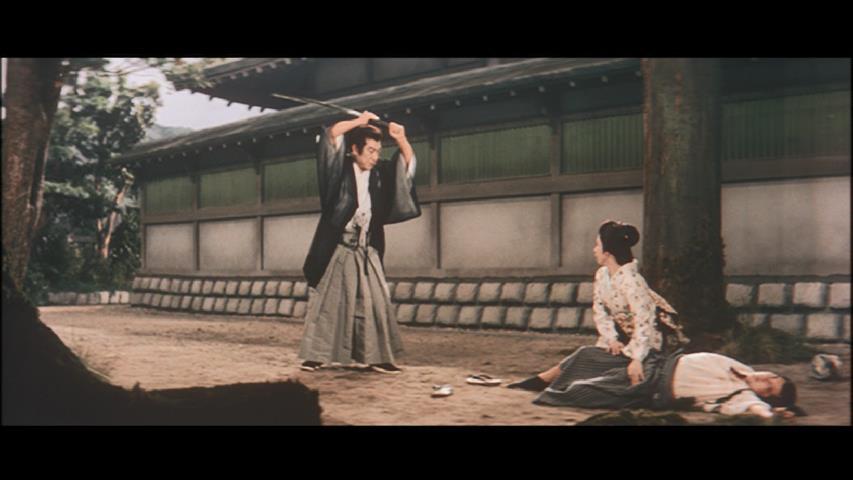
Ofusa is understandably alarmed and fears for her life. The man puts away his sword and introduces himself as Hijikata Toshizō of the Shinsengumi. Ofusa grows pale at this revelation. The Shinsengumi is the secret police organization in Kyoto. Hijikata tells her not to worry about reporting this incident to the authorities and assures her that he will handle it. He urges her to leave. She walks away from him but he calls her back. Ofusa looks absolutely petrified. In an unexpected courtly gesture he hands a basket to her that she had dropped. As she departs the scene she turns to see Hijikata return the dead man’s sword to him and cover his face with a handkerchief.
Ofusa seems shaken by her encounter with Hijikata, who has a fierce reputation amongst not only the locals but also the men under his command. At the house she shares with her married younger sister Ofusa’s gossipy brother-in-law engages in constant fear-mongering. He claims that the Shinsengumi are no better than an execution squad, and their Vice Commander Hijikata a cold-blooded monster capable of killing a man and the horse he rode in on.
Hijikata encounters Ofusa again in the street as she is out and about running errands. He approaches her to say hello but she becomes flustered and makes her exit quickly. Hijikata takes this in his stride and does not pursue her. For a bloodthirsty ogre he is surprisingly affable.
Ofusa and Hijikata meet one another by chance a third time. (Fate, or karma if you prefer, must be playing a hand in bringing them together because three accidental meetings is a lot.) On her way to a wedding Ofusa has taken shelter from a summer thunderstorm at a rural inn. Hijikata arrives on horseback, dismounts, and comes inside the inn to escape the downpour. As he is drying himself off he notices Ofusa. Hijikata greets her warmly. In fact he appears delighted to have run into her. He asks her to dine with him and orders a private room for them. Ofusa is a bit taken aback at this but goes along with him.
In the room she is wary and keeps her distance. Hijikata, who is used to issuing orders and seeing them obeyed, points at the cushion next to him with his fan: “Come over here and join me.” Ofusa approaches him reluctantly and sits down. I can’t tell if her reticence stems from shyness, residual trauma from their first encounter, or the apprehension any woman on her own might experience with a man who is a stranger to her.
A fortuitous lightning strike outside shatters a nearby tree and Ofusa’s reserve with it. She collapses into Hijikata’s arms in fright. He holds her gently until she recovers her composure. Embarrassed, she apologizes. They laugh. He’s captivated by her.
The storm blows over. Hijikata tells Ofusa that he would like to stay but he has to return to his duties. He puts on his coat. He hesitates. There’s something on his mind. “How about meeting me here again, Ofusa— I would like to see you again.” She gives him a surprised look. “When you feel up to it,” he says. “Let me know when.”
After Hijikata departs, a woman who works at the inn remarks that the gentleman has generously paid for everything. Ofusa looks bemused. Her face speaks volumes: what happened here? And what am I going to do about it?
Later that night at her house in Kyoto, Ofusa is restless and unable to sleep. She lies awake and listens to the distant thunder. The film cuts to a shot of Hijikata at his residence. He can’t sleep either and gazes out his window as the summer thunder echoes in the distance.
Summer turns to autumn. Hijikata and Ofusa reunite in a private suite of rooms at the idyllic inn deep in the countryside. He confesses that he didn’t think that he would ever hear from her. There’s an easy rapport between them now, and they share some sake and the pleasure of getting to know one another.
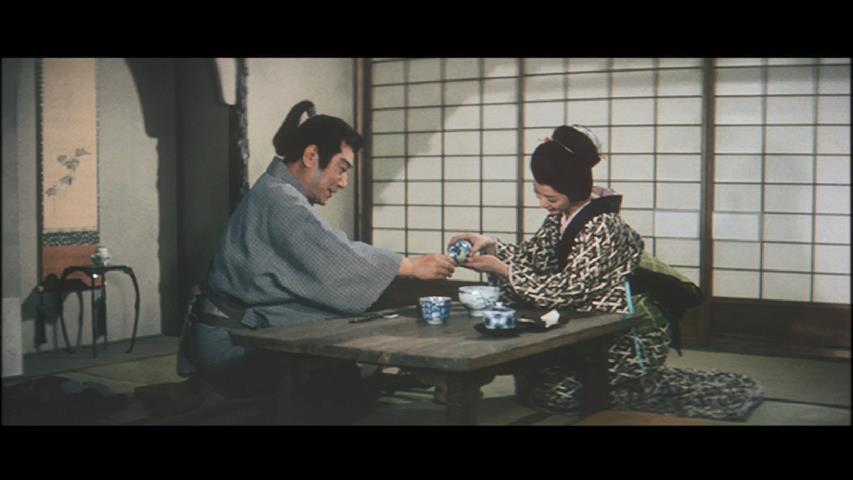
“You’re not at all the way folks say you are,” Ofusa says. Hijikata laughs and says he doesn’t care what other people say about him. They agree not to mention the stresses of the world outside when they are here together.
A discreet dissolve. The sun is setting. Hijikata relaxes on the veranda and admires the view. He asks her gently if she has any regrets. A lovely reverse shot shows Ofusa fixing her hair, a look of serenity on her face. She tells him that she belongs to him; he asks when he can see her again. As secluded as this special place is, it cannot shelter them from a storm that will soon engulf them both.
I didn’t expect this story to have a happy Hollywood-style ending, and it doesn’t. An early sign of trouble is that Hijikata and Ofusa’s relationship is a secret one. Nobody in Ofusa’s life knows about it, and when the woman who works at the inn where the lovers conduct their clandestine assignations asks Ofusa why she and her gentleman friend haven’t made it official and gotten married yet, Ofusa doesn’t have an answer. The answer is that Hijikata is already married to the Shinsengumi.
I should point out that my knowledge of this period in Japanese history is limited. I have deliberately avoided wading into who really did what when with whom. I care about what makes a film work. Not knowing much about the historical backdrop doesn’t detract from the central story of Ofusa and Hijikata’s affair, which is handled with superb restraint and subtlety.
The movie’s only weakness is that bane of Japanese historical dramas: Men Having Meetings. These talky scenes always slow the pace down to a dead stop. If the Men Having Meetings bring out maps and building plans depicting secret passageways, you’re in deep samurai cinema territory and should proceed accordingly. If the building plans depicting secret passageways have been stolen, you are watching Chūshingura and could probably use some coffee right about now because you’ve got more than an hour to go before the big raid.
There is another issue. I hesitate to mention it as I do not see it as a flaw, but I am mindful that it presents a problem for some. Chiezō Kataoka appears to be at least 20 years older than his co-star Chikage Awashima. That’s a substantial age difference, and will no doubt give many viewers pause. But this is not Last Tango in Kyoto. Ofusa is a woman in her thirties with a child, not a troubled ingénue. Ishin no kagaribi is not about an abusive relationship. It’s about two people who find refuge in one another before events beyond their control tear them apart.
In his excellent and encyclopedic blog Japanonfilm David Grote quite rightly praises Chiezō Kataoka’s performance but gets hung up on the age factor. Grote goes on to say rather tactlessly that at nearly 60 Kataoka was no longer a “handsome devil”.
To which I say: so what? Sexy and pretty are two different things. Ofusa’s attraction to Hijikata is not based solely on his looks. He is a thoughtful and mature man, a leader who is capable of handling any situation life throws at him. He’s also an authentic badass, which a lot of women find attractive. At the same time Chiezō shows real vulnerability and depth of feeling as a man torn between the dictates of his heart and his sense of duty. He’s not Errol Flynn. This is not a Hollywood romance. I loved it. (And yes, he held her hand.)

 Ukiyo-e Owl
Leave a reply to Tenpō Rokkasen – Jigoku no Hanamichi (Passage to Hell / Runway to Hell) (1960) – Ukiyo-e Owl Cancel reply