
Directed by Masahiro Makino (1937) and Sadatsugu Matsuda (1956)
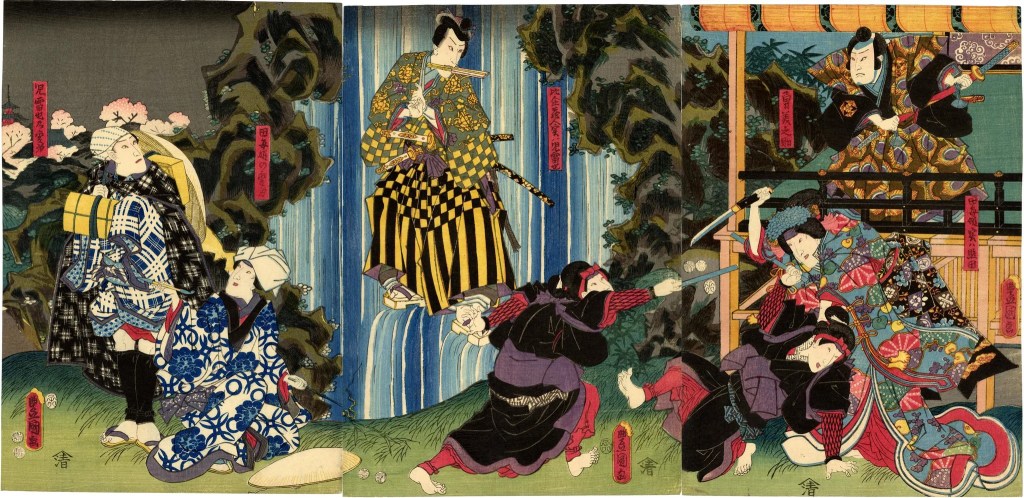
Are ninja/sorcerer movies samurai films? Or are they fantasy films that are samurai-adjacent? There’s lots of sword fighting, to be sure, but why use conventional means of combat when you can simply cast a spell to shape-shift, ascend into the air, or walk on water?
Whatever genre these movies properly belong to, the best way to enjoy them is to surrender to the experience. Do not try to make sense of everything. There’s no point asking where these sorcerers get their extravagant outfits when they don’t appear to have jobs or income, and forget about trying to figure out who does their hair. It’s magic, okay?
The two films that are the subject of this review are adapted from a Japanese folktale. The plots are roughly similar for both movies. Jiraiya is a young man who seeks revenge against the treacherous noblemen who betrayed his father and killed his family when he was a child. Jiraiya is rescued by a shaman who raises the boy to become a sorcerer. When Jiraiya reaches maturity he sets out on a journey to avenge their deaths. He meets a princess who has a similar tragic backstory and magical powers. They join forces to defeat their enemies.
By way of a disclaimer I should say that the only copy of the 1937 version of Jiraiya to which I have access is a not very good print on YouTube without English subtitles. (YouTube does have auto-generated Japanese subtitles that translate to English, but they don’t seem to work consistently.) Fortunately there’s not much dialogue, so the film is easy to follow.
Jiraiya’s star, Chiezō Kataoka, is in his early 30s here and a total smokeshow. At times he looks like a figure in an antique ukiyo-e print come to life. His co-star Reiko Hoshi who plays Princess Tsunade has a delicate doll-like face, and the film gives her a beautiful musical theme full of yearning. In keeping with his name which translates as ‘Young Thunder’ Jiraiya’s fight scenes are underscored with rumbling sound effects.
It’s interesting to see the varied performance styles Chiezō employs. In his scenes with Tsunade he’s very naturalistic. When he confronts his foes he’s more stylized and uses his voice in a completely different way.
Jiraiya’s special effects are not sophisticated, but this is part of its appeal. In one scene Jiraiya and Tsunade run into trouble in a village. They dematerialize and re-materialize atop a roof, a visual effect harkening back to the days of silent cinema. There are numerous shots of Jiraiya fading away into invisibility like a ghost. When Tsunade is reluctant to change her clothes in front of Jiraiya he casts a spell to manifest a huge screen as a room divider. My favorite effect shows Jiraiya and Tsunade walking on water.
Ninja’s Weapon has a larger budget than the earlier film and a longer running time. This is not always to its advantage. Occasionally it strays perilously close to the sort of imported oddity that used to wash up on Mystery Science Theater 3000. In contrast to the fairytale charm of the 1937 production there’s something creepy about it, and I can’t help wondering who its intended audience was. In the first act Jiraiya’s parents are crucified and stabbed to death with spears in front of him. While this horrific spectacle lends weight to Jiraiya’s later quest for revenge, it’s too gruesome and intense a scene for children.
Jiraiya’s relationship with Tsunade has also changed dramatically. In the older film Jiraiya and the princess bicker back and forth and slap each other. In 1930s movie terms this means they have Chemistry, and you can take it to the bank that they’re going to end up together.
In Ninja’s Weapon Chiezō Kataoka is in his 50s. I love him but it is stretching credulity somewhat to call him ‘Young Thunder’ at this point. (Jiraiya is supposed to be 22!) This more mature incarnation of Jiraiya treats his companion Princess Tsunade (Yumiko Hasegawa) in a gentler almost paternal fashion. There’s no face slapping this time around, for example, which is a good thing.
When Jiraiya first meets Princess Tsunade in Ninja’s Weapon she is dressed in masculine attire and introduces herself to him as Sir Tsukikage. Jiraiya remarks drily that her voice does not match her appearance. Tsunade is travelling incognito because like Jiraiya, she is on a mission to track down her father’s murderer. What neither Jiraiya nor Tsunade realize yet is that the same man is responsible for these crimes, an evil nobleman named Danjo (Isao Yamagata, a long way from Seven Samurai), whom we met in the film’s opening gleefully supervising the murder of Jiraiya’s parents.
The princess looks pretty fetching in drag and attracts the unwanted attentions of an evil reptilian shape-shifting sorcerer named Orochimaru (Ryūnosuke Tsukigata). Unbeknownst to Tsunade and Jiraiya, Orochimaru is in league with their enemies and has been spying on them. If our intrepid heroes had been paying a bit more attention they would have spotted this immediately as Orochimaru’s eye makeup indicates that he’s a bad guy. 1
Orochimaru foils Jiraiya’s attempt to assassinate Danjo in Kyoto and returns to the temple where the princess has been hiding out. He tells her falsely that Jiraiya died during a failed attempt on Danjo’s life. As Tsunade tries to come to terms with this shocking news Orochimaru confesses his desire for her and assaults her. Jiraiya appears in the nick of time. He asks Orochimaru what he’s doing. The evil sorcerer replies sarcastically to the effect of ‘What does it look like I’m doing?’ and expresses incredulity that Jiraiya hasn’t realized that the young man who has been accompanying him on his travels is a woman.
Jiraiya warns Tsunade to flee and clashes with Orochimaru. This being a ninja/sorcery movie there are a few supernatural elements thrown into their fight scene: Jiraiya flies up to the ceiling, and Orochimaru escapes from the temple by shape-shifting into a snake and slithering away. The most impressive special effect is Chiezō himself. He may not be the dashing young blade he was in 1937, but he can still bring it.
The finales of the two films feature Chiezō and his tomboyish leading ladies killing their sworn enemies together. The final battle in Jiraiya has an innocent cartoonish feel. Jiraiya conjures a giant smoke-emitting toad that consumes dozens of bad guys while he and Princess Tsunade fight the rest. I love their coordinated ninja outfits in this scene. Jiraiya wears his hair long so that it flows down his back. Princess Tsunade has undergone a similar makeover and looks très chic and androgynous. When they are together in the same shot the effect is striking:
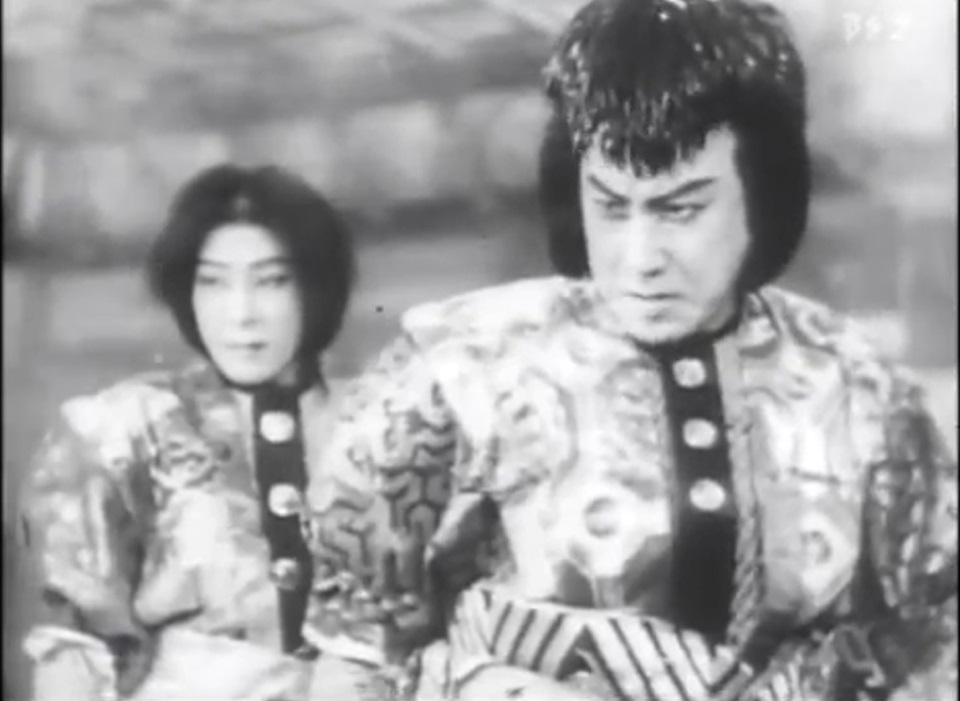
The film ends abruptly with Jiraiya laughing as he sees all his enemies perish.
The atmosphere in Ninja’s Weapon is much darker. The movie climaxes in a feverish orgy of violence, creating the irresistible impression that this is the closest thing to having sex that the characters of Jiraiya and Tsunade are allowed. They duel Orochimaru on a rooftop from which the wicked sorcerer falls to his death. The action reaches its frenzied peak as Jiraiya casts a spell to draw Danjo close to the princess so she can execute him in revenge for murdering her father. In a scene bristling with macabre energy Jiraiya thrusts the terrified Danjo at her like a lion giving a hyena to his mate: “Tsunade,” Jiraiya growls, “realize your long cherished desire!” She runs Danjo through with her sword, and Jiraiya ends him with a slashing blow.
Like I said, this is not a kids’ movie.
If Ninja’s Weapon had been made in the US or the UK it would be a total camp-fest. Kataoka and the rest of the cast play it dead straight. I love it when actors fully commit to their roles like this— no matter how bizarre or improbable the scenario, they’re all in, selling the hell out of it. This approach is precisely what’s needed in fantasy, horror, and science fiction films. Look at The Demon of Mount Oe (1960) starring Kazuo Hasegawa. He’s acting his ass off in a movie with a demonic flying ox. If the actors don’t believe it, how do you expect the audience to buy it?
Having settled all scores and vanquished all villains, Jiraiya and Princess Tsunade travel on horseback through a sunlit landscape. She invites him to come visit her at her estate, which is just over the next mountain. Her flirtatious attitude towards Jiraiya makes it 100 percent crystal clear that this is a done deal: he’s got this one in the bag. Jiraiya apologizes and announces that he has to visit his master. He promises to return and rides off into the distance. Roll credits.
Wait, what?
This is not how I wanted this to end.
The folktale upon which Jiraiya and Ninja’s Weapon are based has many variations. In one of them Princess Tsunade and Jiraiya marry, and at the end of their adventures go on to lead a long peaceful life together. Happily ever after, as the saying goes. I wonder if they retired from sorcery or whether they used it occasionally to do laundry. Those ninja costumes must require a ton of maintenance.
- I would be interested to know whether this is a legacy of Kabuki dramas, in which the villains are made up in specific ways so the audience knows who’s who. You have to admit it’s terribly convenient. ↩︎

 Ukiyo-e Owl
Leave a reply to Ishin no kagaribi (Signal Fire of Restoration / Restoration Fire) 1961 – Ukiyo-e Owl Cancel reply