Directed by Tatsuo Ōsone

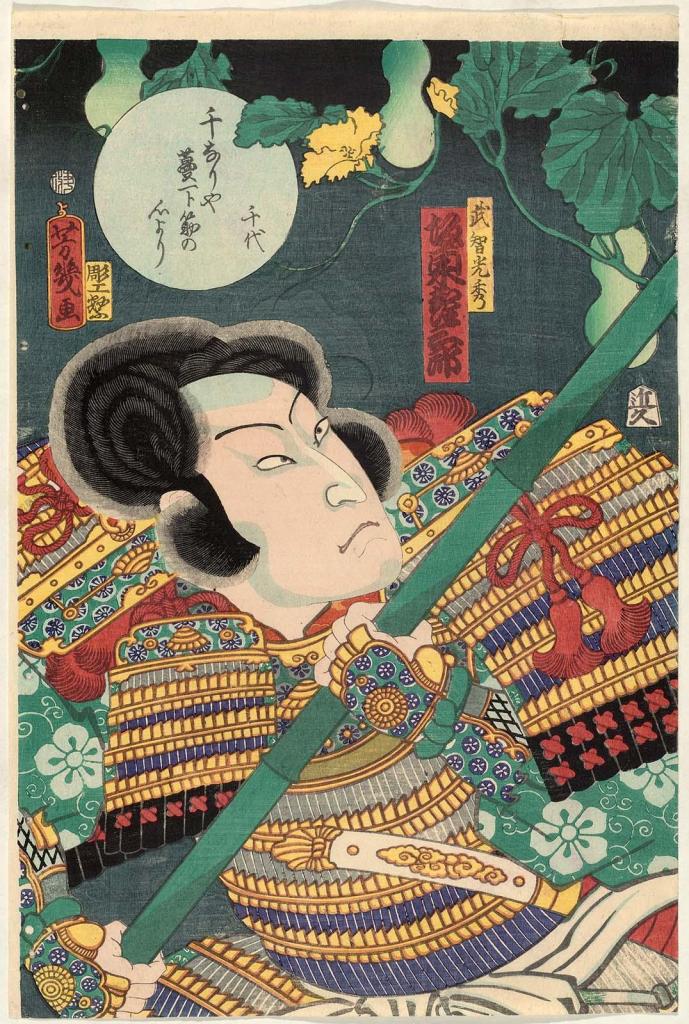
Arthur M. Sackler Gallery, Smithsonian Institution, Washington, D.C.: Robert O. Muller Collection, Accession Number S2003.8.2719a-c
This should be all the incentive you need to watch Teki wa Honnō-ji ni ari immediately:
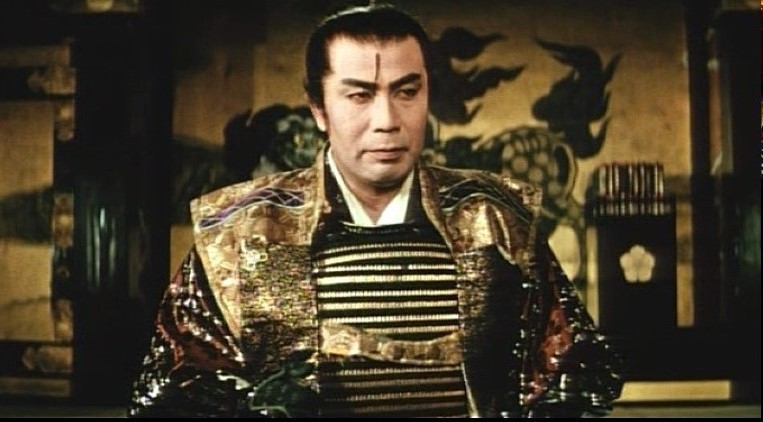
© 1960 Shochiku Co., Ltd.
That is the great Kabuki actor Matsumoto Kōshirō VIII. I’ve mentioned him before, and will no doubt be mentioning him again. I’m a huge fan.
What do you do when your feudal overlord is a psychopath? You could assemble an elite team of samurai and take him out, 13 Assassins style. But sometimes you need an entire army. An alternate title in English for Teki wa Honnō-ji ni ari is My Master, My Enemy which sums up the plot nicely. In the 16th century Akechi Mitsuhide rebelled against his lord Oda Nobunaga. Mitsuhide’s motives for doing so remain a mystery, one which playwrights, novelists, and filmmakers have been trying to solve ever since.
You don’t need to know anything about Japanese history to enjoy Teki wa Honnō-ji ni ari, though. Like the other films I write about it’s very accessible. The usual disclaimers apply, namely: I’m not an historian. I’m not qualified to discuss the accuracy of how various historical figures are depicted or what actually happened. I’m just here to talk about the movie.
The screenplay was written by Shōtarō Ikenami, author of the Onihei Hankachō series of novels.1 There are some scenes in the film that will be familiar to anyone who has seen the Kabuki play Badarai no Mitsuhide; otherwise the story is original.

16th century Japan is embroiled in civil wars and power struggles. The film opens with ruthless warlord Oda Nobunaga (Takahiro Tamura) criticizing his general Mitsuhide for his failure to take Yagami Castle as ordered. Nobunaga calls him lazy and asks him why he’s dressed in finery. Mitsuhide replies that it would be disrespectful to appear before him covered in the dust of battle. Nobunaga is furious and tells one of the other generals to take over Mitsuhide’s command.

© 1960 Shochiku Co., Ltd.
Stung by this rebuke, Mitsuhide promises to renew his efforts in the siege and take the castle. “Will you bet your life on it?” Nobunaga asks him. Mitsuhide requests that if he defeats the Hatano clan at Yagami, he would like to add their army to his. He asks Nobunaga to spare the lives of the Hatano brothers Hideharu (Hiroshi Ogasawara) and Hidehisa (Shōji Yasui), who would be an asset to Nobunaga’s forces. “Enough!” Nobunaga snaps, and storms off.
One of Mitsuhide’s men asks him later how his meeting went with Lord Nobunaga. Mitsuhide replies: “He’s a hard man to please.” You got that right.
Mitsuhide holds a family meeting at his castle. Mitsuhide tells his wife Kitsuki (Chikage Awashima) that he plans to send his elderly mother Sonoe (Sachiko Murase) as a hostage to the Hatano clan. With such a hostage the Hatano will be more inclined to trust him. Kitsuki volunteers herself as hostage instead. Mitsuhide informs her that Nobunaga has already agreed to his plan, and reassures Kitsuki that his mother will be safe. Mitsuhide’s mother enters and tells him that she is honored to help him.
When Mitsuhide’s retainer and prospective son-in-law Samanosuke (Miki Mori) objects, Mitsuhide says that Nobunaga elevated him from an ordinary samurai to a daimyō: “Why wouldn’t I trust and obey such a lord?”
Mitsuhide’s two daughters have been listening to this conversation outside and are horrified. They try to intervene, to no avail. Mitsuhide hands over his mother to the Hatano brothers, who promise to treat her well.

© 1960 Shochiku Co., Ltd.
Cut to:

© 1960 Shochiku Co., Ltd.
Nobunaga decides to execute the Hatano brothers anyway. A panic-stricken Mitsuhide pleads to spare their lives, knowing that his mother’s life hangs in the balance: “She is hostage to their clan right now!”
Nobunaga couldn’t care less. He orders the execution to proceed: “Kill the bastards!”
Soldiers enter the room where Mitsuhide’s mother Sonoe is being held hostage and start to drag her out by force. That won’t be necessary. She’s from a samurai family and knows what’s expected of her: “I am ready for any fate you choose.” She goes to her death with her head held high.
Nobunaga thanks Mitsuhide for his sacrifice and tells him he’ll never forget what Mitsuhide had to go through. The other generals present aren’t pleased at the prospect of Mitsuhide gaining favor over them, but they know it’s only temporary. Like abusive bosses throughout history, Nobunaga is capricious and extremely manipulative. Sowing discord amongst his vassals is his idea of fun.
Nobunaga hands out rewards to everyone but they come with strings attached. After awarding a vast estate to Mitsuhide he tells him that he’s arranged a marriage for his daughter Tama (Keiko Kishi). Tama has no say in the matter. Nobunaga also wants to arrange a marriage for Mitsuhide’s other daughter Kikyo (Kikuko Hojo) to his retainer Ranmaru (Nakamura Mannosuke).2 Kikyo is already betrothed to Samanosuke, and Mitsuhide is forced to decline.
This incenses Nobunaga. In the next scene he revokes Mitsuhide’s Saigoku command from him in front of the other generals. Mitsuhide’s men are outraged over this humiliating demotion, but there’s nothing they can do.
Nobunaga twists the knife further and demands that Mitsuhide dismiss his loyal samurai retainer Kuranosuke, whom Nobunaga suspects is a spy. Kuranosuke leaves but promises to do whatever he can to help his master Mitsuhide, to whom he is devoted.
Mitsuhide’s relationship with his boss goes straight to Hell. I don’t want to spoil the rest of the movie. All I will say is that Mitsuhide really goes through it. It’s bad, y’all. At one point I was screaming at my monitor: “KILL HIM! YOU’RE GOING TO HAVE TO KILL HIM!” like William Holden at the end of The Bridge on the River Kwai.
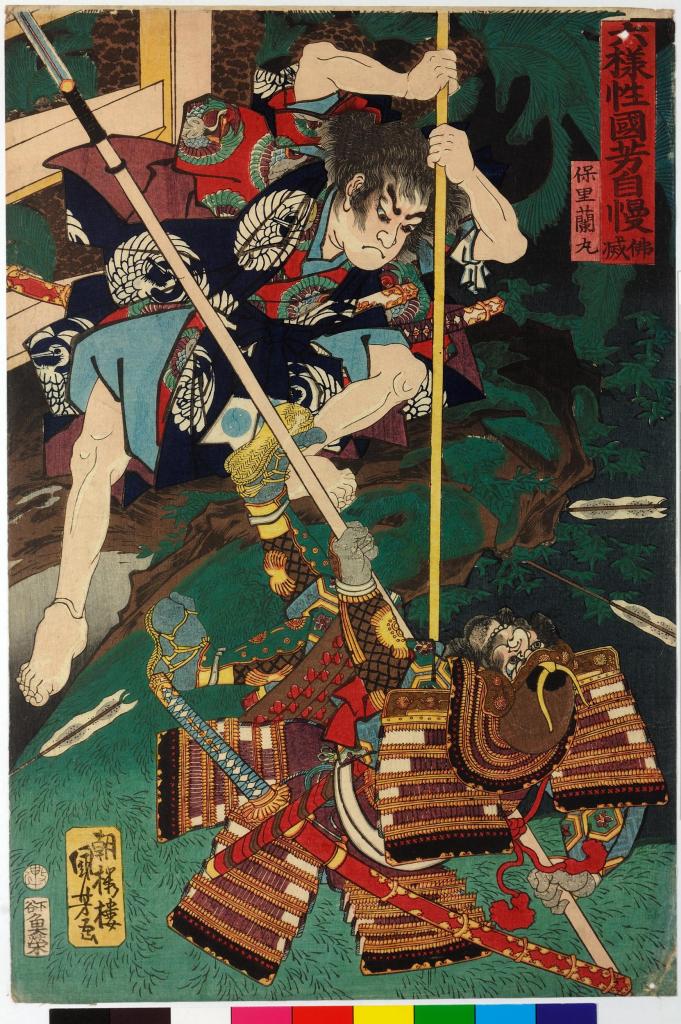
Nobunaga may be a monster, but in common with many such monsters he’s a shrewd judge of character. He says that Mitsuhide’s decency is his weakness, and he’s absolutely right. Mitsuhide and his family are simply too decent to survive in a world where the likes of Oda Nobunaga can rise to the top.

© 1960 Shochiku Co., Ltd.
There’s lots to enjoy here: theatrical effects, like lights dimming to a single spotlight on Mitsuhide, and some impressive Henry V-style tracking shots of mounted troops charging into battle. The climactic fight inside the burning temple is very well done. Takahiro Tamura invests Nobunaga with the perfect amount of psychopathic verve. Kōshirō excelled at playing dignified men in bad situations, so he’s in his element in this. He’s wonderful, and I hope you will like him as much as I do. Kōshirō also makes a frightening villain, but that must wait for a future post. Meanwhile here’s a sneak preview:

© Shochiku Co., Ltd. / NHK Enterprises
Note: Letterboxd, The Movie Database (TMDB), and other sites contain some misinformation about Teki wa Honnō-ji ni ari. It is not based upon Akechi Samanosuke no koi, the historical novel by Hiroshi Katō (1930 – 2018). That book was adapted into a 2007 television production of Teki wa Honnō-ji ni ari starring Matsumoto Kōshirō VIII’s grandson, Kabuki actor Matsumoto Kōshirō X (b. 1973). I suspect that this confusion is due in part to Kabuki stage names.
While I’m on that subject, I should be referring to Matsumoto Kōshirō VIII as Matsumoto Hakuō I, which is the name he adopted after his eldest son took the name Matsumoto Kōshirō IX. I refer to him as Matsumoto Kōshirō VIII or simply Matsumoto Kōshirō because that is the name by which he appears in film credits of the period concerned. Also, I like the name Kōshirō.
- The books’ protagonist Hasegawa Heizō has been portrayed by Matsumoto Kōshirō VIII, his son Nakamura Kichiemon II, and his grandson Matsumoto Kōshirō X. ↩︎
- Kōshirō’s younger son Nakamura Kichiemon II (1944 – 2021), a great Kabuki actor in his own right who had a long successful career in television and film as well. ↩︎

 Ukiyo-e Owl
Leave a comment