Directed by Kazuo Mori

I discovered this action-packed gem from Daiei hidden in the depths of YouTube. The YouTube copy has no English subtitles and is a low-resolution transfer of a poor quality print. You know it’s a good movie when none of that matters.
There’s not a chance in hell that Gorotsuki-bune will ever get a subtitled release, so I availed myself of AI-generated subtitles. I also ordered the DVD from Japan. It doesn’t have English subtitles, but I was hoping that the image quality would be better. Unfortunately the print used to make the DVD looks as if it’s been run over by a truck so the screenshots you see here are as good as it gets. (If I win the lottery I would be happy to fund a full restoration.) As is often the case with movies I write about, there’s virtually no information about Gorotsuki-bune available in English online apart from a cast and crew list on IMDb and a brief review on Letterboxd.
Gorotsuki-bune (Google translates this as ‘Thug Ship’) is pulp, but it’s very well made pulp. Ryūzō Kikushima’s script adapted from Osaragi Jirō’s novel is top-notch, as you might expect from the screenwriter responsible for The Hidden Fortress, Yojimbo, Sanjuro, and High and Low. Denjirō Ōkōchi plays a 19th century samurai secret agent and displays his extraordinary sword-fighting prowess in multiple fight scenes. (I have no idea how the filmmakers got away with this: in 1950 the Civil Censorship Detachment-imposed ban on sword-fighting scenes was still in place.) The ladies (Chieko Sōma and Kieko Wakasugi) are gorgeous. Even better, the characters are more fleshed-out than usual. The hero is not infallible. We actually get to know the villain (Ryūnosuke Tsukigata) and find out what motivates him. The setting is unusual, and the film depicts the historically marginalized indigenous inhabitants of that setting with a degree of sympathy.

© The Trustees of the British Museum. Shared under a Creative Commons Attribution – Non-Commercial – ShareAlike 4.0 International (CC BY-NC-SA 4.0) licence.
Gorotsuki-bune is set in 1820 Hokkaidō (then known as Ezo), the northernmost main island in Japan. The film opens with a group of smugglers unloading goods from a ship under the cover of night and taking them onshore. A samurai appears to be supervising the operation. Whoever he is, he’s taking a big risk: smuggling contraband goods and materials is in violation of the strict isolationist policies of the Tokugawa shogunate. The smugglers are being observed by an Ainu man on the beach. The Ainu are the indigenous people of Hokkaidō. The samurai spots him and orders his henchmen to beat him as punishment for spying on them. The man does not resist. The smugglers dismiss him as a simple-minded peasant and resume their nefarious activities.
Cut to a close-up of the Ainu man glaring raptor-like at his assailants. This shot tells us two important things:
- Ainu man is Denjirō Ōkōchi in disguise
- It’s a safe bet that before the end of the movie Denjirō will render every single one of the dirtbags who attacked him into chunks of thug-flavored cat food.

Relatedly, the sword fights in this don’t look like choreographed movie duels. They have a messy feel to them as if the actors are fighting for their lives. This may be closer to the truth than we realize: Denjirō apparently suffered from severe myopia and liked to use an actual sword as opposed to a blunt prop sword. That’s a scary combination.
The plot is somewhat convoluted, so let’s get into it. Kakizaki (Ryōnosuke Azuma), a corrupt aristocrat behind the smuggling ring, frames Yawataya (Kōichi Katsuragi), an innocent merchant, for the crimes of which he himself is guilty. Kakizaki meets with inspector Iori Mikihara (Kentaro Honma) to persuade him that there’s more than enough evidence to convict Yawataya on smuggling charges. In a subsequent scene we see a thief (Daisuke Katō) in the process of robbing Lord Kakizaki’s house. He overhears details of a plot to murder Yawataya and frame Mikihara on top of it. The thief happens to be Yawataya’s ex-servant, and he makes a hasty exit to warn his former master.
Mikihara comes to Yawataya’s house to detain him for questioning. Yawataya protests his innocence. The sketchy samurai from the opening scene is present and makes a signal to his henchmen. They murder Yawataya and his wife on the spot. Mikihara is horrified and tries to intervene. The samurai orders his men to burn the house to the ground.
A chaotic fight ensues. The set is actually on fire and the actors are right in the middle of it. Denjirō (still wearing his Ainu disguise which makes him look rather like a scaled-down version of Hagrid from Harry Potter) appears and fights his way through the flames to rescue Yawataya’s daughter Ito (Kieko Wakasugi) and the injured Mikihara. They are joined by the thief Sōkichi.
The mysterious Ainu man leads them to a cave in the countryside. Once inside the cave he removes his shaggy beard and reveals that he is Mondonoshō Tsuchiya, a samurai working as a spy in the service of the shogun. He is in Hokkaidō to investigate smuggling. Tsuchiya needs Mikihara and Ito as witnesses and intends to bring them to Edo. He recounts via flashback how he came to this remote and lawless place.
Tsuchiya visits the estate of Lord Kakizaki, whom he suspects is involved in criminal activities. After searching Kakizaki’s house and pocketing some evidence he travels by boat. On the boat ride he becomes unwell and is approached by Omitsu (Chieko Sōma), a beautiful young woman who offers her assistance. By a remarkable coincidence, Omitsu is not only staying in the same inn as Tsuchiya, but she has been assigned to the same room as well.
Now this is where Tsuchiya’s secret agent skills could use some work. He is not suspicious of this turn of events at all. (James Bond would never!) At the inn he flirts shyly with Omitsu and gives her the carved bear ornament from his inrō1 to thank her for helping him on the boat. In the course of their conversation Omitsu tells him that her mother was Ainu. She seems uneasy. He retires for the night and asks her to bring him some water. Omitsu hands him a cup. Unbeknownst to him, Omitsu is the mistress of one of the leaders of the smuggling ring, and she has poisoned the cup.
In a last-minute attack of remorse she knocks the cup out of his hand before he can finish drinking it and runs out of the room. Tsuchiya follows her, staggering into the street. Still in pursuit he is attacked by a hooded man on the beach and apparently left for dead. The hooded man removes his disguise, revealing himself to be Ryūnosuke Tsukigata. He plays Lord Kakizaki’s illegitimate brother Kiritarō. Kiritarō’s in charge of the dirty work required to keep the smuggling ring going. The flashback concludes with Tsuchiya explaining that his life was saved by an Ainu fisherman.
Omitsu meets with Kiritarō. That is one messed-up relationship. He is passionately in love with her; she cannot stand him. Not surprisingly, he hates the world and everything in it. He descends further and further into crime which only alienates Omitsu more. He also makes demeaning comments about Omitsu’s Ainu ancestry and social class, which doesn’t exactly endear him to her.
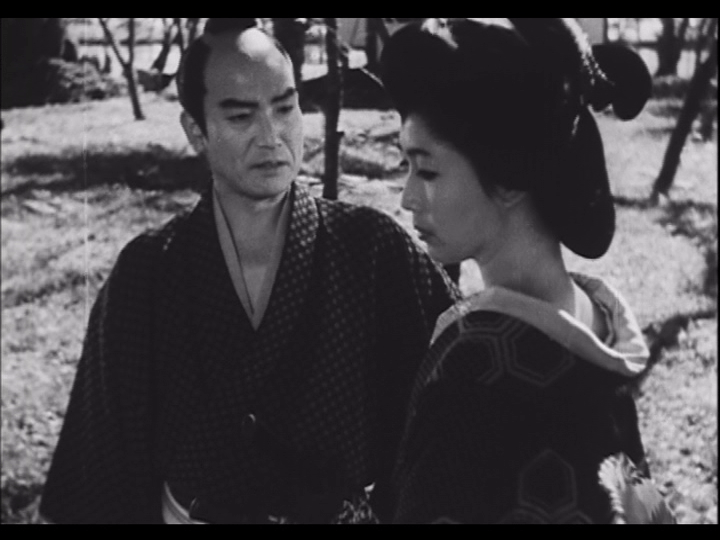
Sōkichi returns to the hideout to find it ransacked. While Tsuchiya was out trying to charter a boat, Ito and Mikihara were taken captive.
(Sōkichi’s a thief from Edo. Why is he in the back of beyond in Hokkaidō? How many rich people can there be for him to rob in such a sparsely populated region? Also, why are there so many sassy yet kind-hearted thieves in Japanese historical dramas?)
Tsuchiya breaks into Lord Kakizaki’s house, frees Mikihara, and sets off to find Ito. He sees Omitsu in the garden and draws his sword. In a tense scene he points the sword at her throat and questions her. Omitsu is so overcome with emotion to discover that Tsuchiya is still alive that she is unable to explain why she’s at Kakizaki’s house.
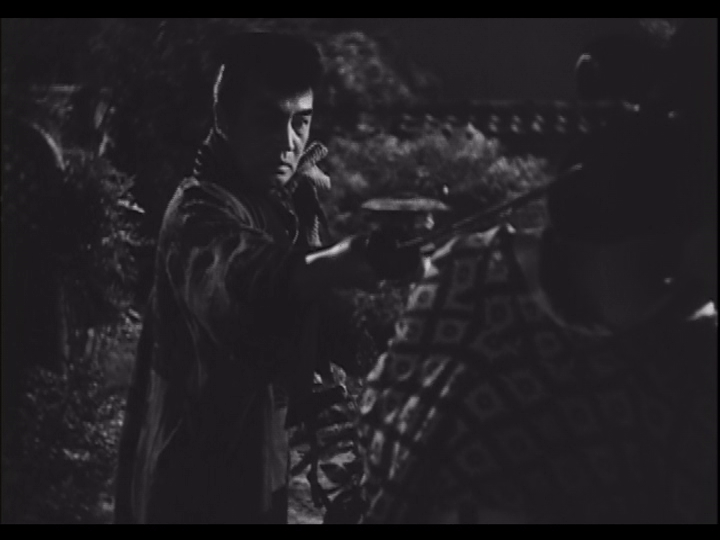
Not only is Omitsu shocked to learn that Tsuchiya didn’t die, but we see that she is harboring definite feelings for him. Given that she tried to kill him earlier, these feelings would seem to have no chance of being returned.
Ito is being held prisoner at Kiritarō’s residence. Tsuchiya, Mikihara, and Sōkichi regroup at a run-down temple in the countryside where they try to find a way to rescue her. Sōkichi volunteers to infiltrate Kiritarō’s place as breaking and entering is his line of work. He manages to free Ito. Kiritarō’s men are one step ahead and murder him.
Omitsu and Ito escape from Kiritarō’s clutches. Kiritarō and his gang head out to the temple to kill Tsuchiya et al. Tsuchiya hides inside a well. After Kiritarō leaves Omitsu appears and apologizes to Tsuchiya. She asks him to forgive her. He’s still angry: “What is it you’re scheming this time?” She offers to help him escape the island. He refuses.
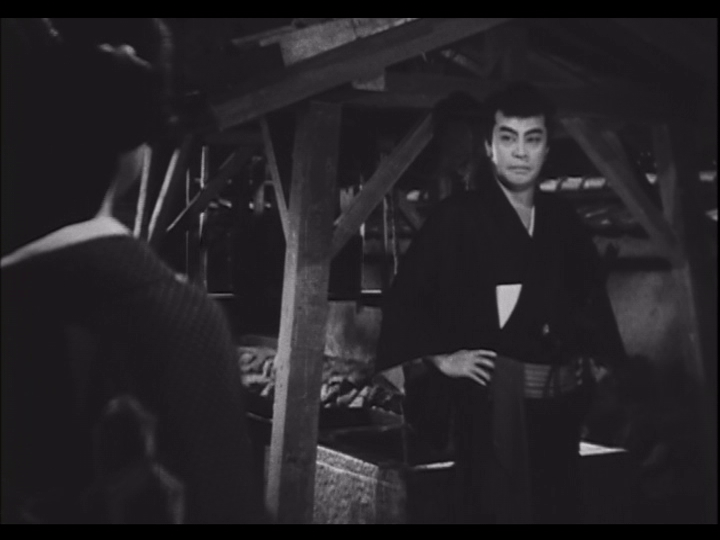
Tsuchiya sneaks into Lord Kakizaki’s house and confronts him at gunpoint. He demands that Kakizaki take him to Ito. Omitsu defends herself and Ito in a nocturnal scuffle on the beach with Kiritarō’s henchmen during which she is injured. Tsuchiya comes to the rescue and takes both ladies to his hideout where he tends to Omitsu, who has fainted. He fans her gently with his fan. It’s a subtle clue that Tsuchiya’s feelings towards her may run deeper than they appear.

Omitsu regains consciousness. Ito pleads with him to take Omitsu with them to Edo: if Omitsu remains on the island Kiritarō will kill her. Mikihara beckons Ito to come with him outside so Tsuchiya can discuss matters with Omitsu in private. Once they are alone Omitsu asks him again for his forgiveness. Tsuchiya is visibly moved and struggles to contain his emotions. “Let’s go to Edo together,” he says. Omitsu bows her head and weeps. She takes his hand, pressing it to her cheek. An ornament falls from her kimono. Tsuchiya picks it up and sees that it is the little bear he gave her when they first met.
With Kiritarō tightening the net around them this is their last chance to leave Hokkaidō. They concoct a bizarre scheme involving barrel-shaped coffins and a phony funeral procession ending at the beach where the barrels will be loaded onto a ship that is set to sail to Edo. Their plan almost succeeds but Kiritarō suspects something is up and arrives mob-handed to intercept them. He strikes one of the barrels and is enraged to discover Omitsu inside it. Tsuchiya explodes out of the barrel and goes into attack mode.
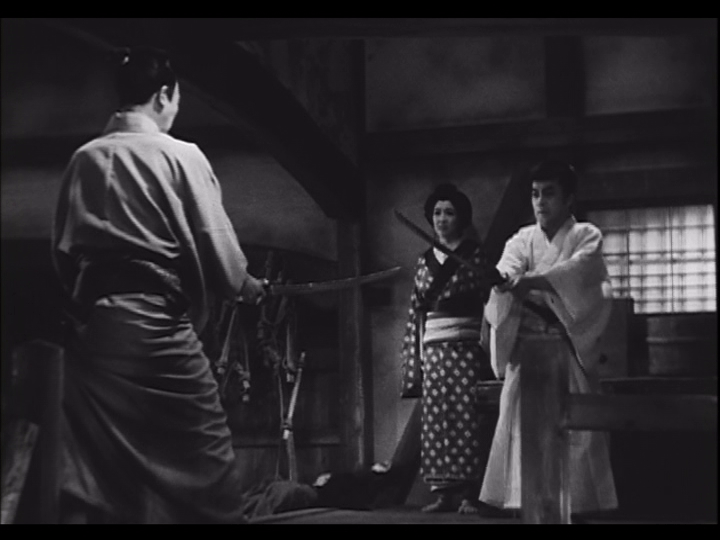
A frantic fight unfolds. Tsuchiya takes them all on in furious style. He jumps, leaps, and sprints like a dude half his age. (It was difficult getting a good screenshot of Denjirō because he moves so fast.) Omitsu summons help from the local Ainu tribe. Tsuchiya faces off against Kiritarō. Kiritarō locks the door and ignites a fuse. The shack is loaded with gunpowder. Denjirō doesn’t flinch:
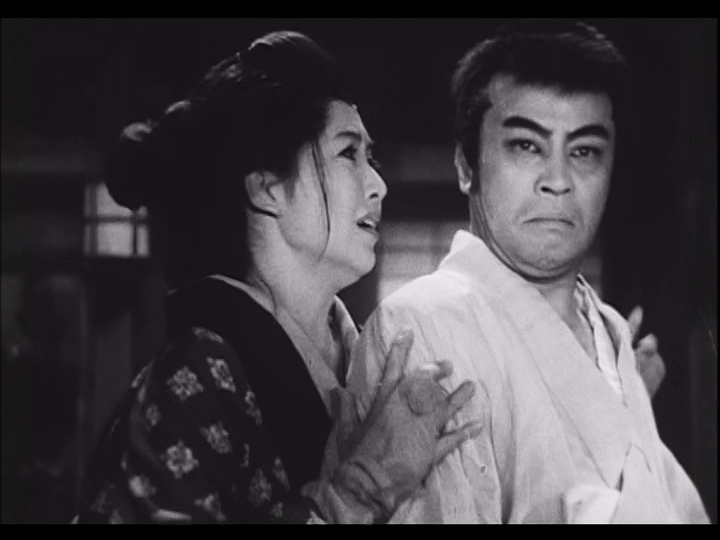
Will Omitsu and Tsuchiya escape or will they be blown to smithereens? Head on over to YouTube!
I enjoyed the heck out of this. Denjirō Ōkōchi is in splendid form throughout. Of all the great jidaigeki stars who appear in these pages he’s hands down the best fighter and the actor with the most range. It’s a pity that Daiei didn’t follow up with a sequel2 because I liked Denjirō’s character, who is fairly atypical as far as cinematic spies go. He’s not glamorous or witty. He’s a decent man trying to bring justice to a fallen world. He and Chieko Sōma have some chemistry going on too.3 Even when Tsuchiya is angry with Omitsu he’s never cruel or misogynistic, and he risks his own life to save hers. You get the sense that he’s pretty much in awe of her and doesn’t know how to cope with it. That makes for a very refreshing change from films featuring women fawning over emotionally unavailable men who either ignore them or abuse them, a phenomenon which I regret to say is not exclusive to Japanese historical dramas.
Finally, I enjoyed seeing Ryūnosuke Tsukigata portray a more nuanced bad guy this time around instead of his usual straightforward villain killed by Chiezō Kataoka or Utaemon Ichikawa in the last reel of a Toei movie. Kiritarō is a tragic character. There’s an entire film to be made lurking inside this using the same elements told from his point of view. Gorotsuki-bune is shot in monochrome, but its story is far from black and white.
- An inrō is a small portable case worn round the waist used to hold medication and personal items. They are often elaborately decorated. ↩︎
- Since we didn’t get a sequel, I amuse myself imagining scenes in which Tsuchiya teases Omitsu: “Remember when you tried to kill me? That was fun.” ↩︎
- Before anyone asks: yes, there’s a massive age difference, and no, I no longer care (LOL). Denjirō’s 52 here. He’s so awesome that it doesn’t matter. ↩︎

 Ukiyo-e Owl
Leave a reply to Ugetsu (1953) – Ukiyo-e Owl Cancel reply