Directed by Tomu Uchida
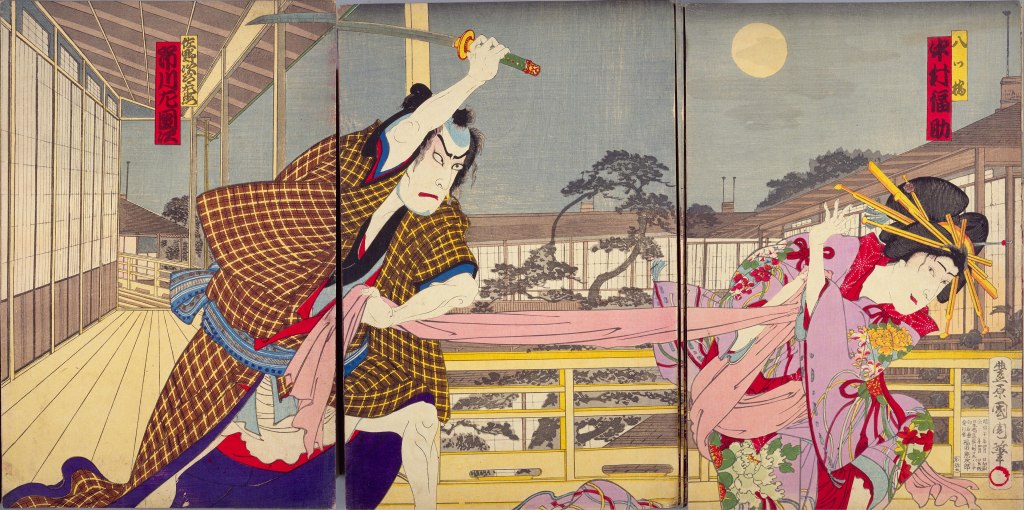
National Diet Library Japan
Digital Collections: Persistent ID 1301844
I’m back!
Let’s celebrate by reviewing a film I swore I wouldn’t watch again because it was too upsetting. Toei didn’t release it on DVD until this year. Why the heck did it take so long? I have no idea! The important thing is that we’re both back in action. (At least I wasn’t gone for 66 years.)
The Japanese title is somewhat unwieldy, as a result of which we have multiple English titles. For the sake of convenience let’s pick the shortest one, Killing in Yoshiwara.

Chiezō Kataoka is not in samurai mode this time. He plays Sano Jirō, an affluent yet lonely silk merchant who is trying to find a wife. He’s been unsuccessful (despite being, you know, Chiezō) because he has a prominent birthmark on his face, which is apparently bad enough to sideline him permanently when it comes to dating in 19th century Japan. Jirō’s not an angry incel, however. He’s a kind and decent man beloved by his workers, whom he treats as the family he longs to have.
The young lady kneeling next to him is Yoshie Mizutani. She plays a prostitute whom Chiezō’s character meets in Yoshiwara, Edo’s licensed pleasure quarter. A more accurate rendering of their relationship dynamic would be an image of a besotted Chiezō backing up a truck full of cash and dumping it in her lap because that’s what happens, with tragic results. ‘No Romance Without Finance’ is the name of the game in Yoshiwara.
The plot derives loosely from a Kabuki play. The protagonist in the play, Sano Jirōzaemon, has a face disfigured by smallpox scars rather than a birthmark. The following blunt synopsis from a Japanese review made me laugh:
In a completely unexpected turn of events, Chiezō Kataoka plays an ugly man with a birthmark on his face who falls genuinely in love with the only third-rate prostitute who will have sex with him. It was a movie that made me want to die and feel ashamed of myself . . .
First off, how very dare you call Chiezō Kataoka ugly! LOL
Seriously, though: how improbable is it that a rich dude can’t find anyone willing to marry him? 19th century or 21st century, East or West, if you’ve got money you’ve got options. People are acting like he’s the damned Phantom of the Opera or something. THIS IS CHIEZŌ. (Yes, I’m biased as hell but I don’t care.)
Jirō’s best client Echigoya (Kensaku Hara) tries to set him up with a relative. She demurs when she catches a glimpse of him during a pleasure boat ride. The lady wants more time to think about his proposal. Jirō already knows the answer will be no.
Jirō and his faithful assistant Jiroku (Eijirō Kataoka) make a business trip to Edo. Some acquaintances suggest a visit to Yoshiwara. Jirō wants to go back to his house in the country straight away, but he is persuaded to accompany them to the pleasure quarter, just this once.
None of the ladies at the brothel they attend is willing to so much as sit next to him because of his appearance. It hurts to see Jirō’s shamed look in this scene, and those guys who invited him to Yoshiwara are jerks for putting him in this situation.
Echigoya is annoyed at the disrespect shown to his friend. This is an expensive soirée. Ignoring a customer is very bad form. The brothel’s madam (Sadako Sawamura) orders a new hire downstairs to help out. Her name is Otsuru (she’s also called Tamatsuru). Otsuru is a former street prostitute who following her recent criminal conviction has to serve her sentence in Yoshiwara. Prostitution outside of officially licensed quarters was illegal. The fact that she has to serve her sentence inside a brothel where she will continue to ply her trade may strike you as illogical, but it makes sense once you realize that selling women and punishing women are two sides of the same coin.
Otsuru fixes her hair, puts on some makeup, and changes into a more formal kimono. She doesn’t look too enthused about her new client. The obasan with her tries to cheer her up: “A stain, it’s nothing. Look at the other cheek!”
Upstairs Otsuru immediately commits a huge faux-pas by walking in front of the tayū instead of approaching from the back. Tayū were an elite type of courtesan. They were the aristocrats of Yoshiwara, recognizable via their distinctive appearance including platform sandals, elaborate hairstyles, and their retinue of little girls who accompany them everywhere. The little girls are called kamuro. Their families sold them to brothels to work as servants. They are trained to become courtesans themselves.
Otsuru didn’t grow up inside a brothel and doesn’t know her place in the Yoshiwara pecking order. We see Jirō and Otsuru conversing in a private room. She tells Jirō to pour her a drink (it is she who should be serving him, but he doesn’t seem to mind). Jirō asks her if his face bothers her. As a prostitute on the mean streets of Edo, Otsuru has had to deal with much worse than a nice older man with a birthmark. She laughs. “Of course not! It’s not your heart which is stained.”
She kisses him on his disfigured cheek. The expression on Chiezō’s face at that moment lets us know that he is doomed.

Jirō and his assistant return home. They bring back ukiyo-e as a souvenir of their visit and give them to the girls at the textile mill. Yoshiwara and its courtesans were a popular subject for ukiyo-e, which translated into English means ‘pictures of the floating world’.

Wadsworth Atheneum Museum of Art

in Yoshiwara
Metropolitan Museum of Art
Gift of Estate of Samuel Isham

© The Trustees of the British Museum
Shared under a Creative Commons Attribution – NonCommercial – ShareAlike 4.0 International (CC BY-NC-SA 4.0) licence
The factory girls are dazzled by the pictures. Ukiyo-e were rather like the Instagram of their time, a medium for promoting celebrities and fashion trends. Woodblock prints were an affordable way to give people outside the ‘Floating World’ of Yoshiwara a glimpse into its ephemeral pleasures. People who had never been to Edo could see the luxurious clothes, hair styles, and makeup sported by geisha and oiran. The reality behind this glamorous facade was not so pretty.

Ukiyo-e Ota Memorial Museum of Art, Tokyo
The other women at the brothel despise Otsuru because she’s a convict. They sneer at her and call her a trollop. Otsuru snaps back at them that they’re in the same boat as she is. Otsuru may be uneducated, but she’s not stupid. Quarrelling over hierarchy and who has precedence over whom in a brothel is like crabs fighting inside a bucket. They’re all destined for the same pot in the end.
Jirō becomes Otsuru’s regular customer. Customers are allowed exclusive access to specific girls, a privilege for which they pay handsomely. Jirō proposes to redeem Otsuru (buy out her contract) but gets pushback from the madam. Otsuru is one of the boss’s favorites, she says. It’s not true and just one more lie that’s being peddled to Jirō to extract money from him.
If Chiezō’s character had been a bit more savvy he should have negotiated better terms at that point or found another girl. Either option would have been better than the path he ends up choosing. Unfortunately the brothel’s management are all too aware that he has fallen for Otsuru. They put on an affable front and make a fuss over Jirō. Such a charming couple! You look so good together. She will make you happy, we promise. None of it is real.
Otsuru is not who he thinks she is either. She seethes with resentment and wants to avenge herself against everyone who has ever looked down on her. To achieve this end she decides that she wants to be tayū. This is quite a steep hill for her to climb as she is unrefined and untrained. Learning how to be tayū will be time-consuming and costly. Jirō promises to help her and pay for her training as well as the parade to celebrate her new status. Otsuru tells him she will be his wife after she becomes tayū.
The odds are against their relationship surviving. As often happens in the movies I review, there is a significant age difference. (Chiezō Kataoka was in his late 50s here; Yoshie Mizutani was only 20 or 21 when this was shot.) With a different young woman it might have worked despite the age gap. The insurmountable problem is that they have entirely divergent goals. Jirō wants a wife and children; Otsuru wants wealth and prestige. Their temperaments are not a good match either. Jirō is evidently a gentle and patient person, while Otsuru has a sharp tongue and a defiant streak.
There’s another complication. Otsuru already has a boyfriend. He’s her former pimp Eiji (Isao Kimura). He shows up at the brothel where she works and makes a nuisance of himself. He foolishly tries to extort money from the brothel’s boss Hyogoya (Masao Mishima). Hyogoya is a total bastard and has no difficulty whatsoever making sure that Eiji never bothers him again.
Meanwhile word has gotten out about Jirō’s extravagant spending in Yoshiwara. His assistant is worried, and his client Echigoya confronts him: “Think about your reputation.”
After a downturn in his financial fortunes Jirō decides to sell the sword his parents left him when they abandoned him as an infant. It must be worth a thousand ryō or more. Until he can get the proceeds from the sale he will need a loan. He approaches Echigoya. He agrees to raise the money if Jirō stops his visits to Yoshiwara. Asking for a loan while spending money on whores is a bad look for a business owner.
Jirō meets with the brothel proprietor to try to negotiate a delay on paying the money he promised to underwrite Otsuru’s training. It doesn’t go well. Frustrated, he turns to Otsuru and asks her what she wants. “I want a rich man to buy me,” she says coldly. “It doesn’t matter which one.”
Jirō is devastated. Hyogoya laughs at him. He has Jirō thrown out of the brothel onto the street.
Jiroku has more bad news: the sword Jirō asked him to sell turns out to be unsellable. Its provenance is unlucky, and the superstitious dealers in Edo won’t touch it.
It’s all too much. Jirō returns home in despair.
Otsuru’s day of triumph has arrived. She has achieved her dream and has become tayū. She walks in formal procession through Yoshiwara in towering platform shoes. Eerie music plays. The mood is sombre, almost funereal.
Jirō is in the crowd of onlookers, his face disguised by a sedge hat. As he watches the procession he overhears someone mention that Jirō the silk merchant covered the exorbitant cost of Otsuru’s training even though the brothel proprietor usually pays for it. Another person describes the unfortunate silk merchant as ‘vacuous’ and a ‘monster’. At this Jirō forces his way through the crowd towards the procession. He yanks his hat off, revealing his furious face to Otsuru, Hyogoya, and Oken the brothel madam, all of whom regard him with horror.
I’m not gonna lie, I got a surge of adrenaline. When the hat comes off, it’s about to go down.
Jirō draws his sword and kills Oken and Hyogoya on the spot. He proceeds to run wild on an anguished rampage inside the locked Yoshiwara compound, fighting off brothel guards and the police at the same time. Otsuru’s platform shoes render her helpless as it is almost impossible for her to walk in them unaided. She crawls on the ground towards the locked rear gate. Jirō pursues her, lunging his sword madly. Unlike Chiezō’s sword play in his samurai films he’s messy and misses easy shots. As disturbing as the sequence is, I was shouting, “Come on, Chiezō! You could have got her there!”

The brothel’s boss and the woman who manages it are two of the vilest characters in Japanese cinema. I’m glad Jirō-sama killed them.
[SPOILER]
Otsuru didn’t deserve the same fate. She’s a young woman trapped in an inhumane and abusive system. Okay, so she’s shallow and greedy and unfeeling. She could hardly be anything else. Yoshiwara was a meat grinder.
[END SPOILER]
Jirō’s error was looking for love in a place where human beings are no more than a commodity. When those commodities were used up, their corpses were dumped without ceremony onto the grounds of a temple, Jokanji, nicknamed the ‘Throw Away Temple’. This was the final resting place for thousands of anonymous women and girls.
Is the mysterious cursed sword to blame for turning Jirō into a spree killer? There’s a suggestion of this in the chilling finale of the Kabuki play. The situation is more ambiguous in Uchida’s film, which ends with a breathtaking crane shot of Chiezō versus Everyone as masses of cherry blossoms fall onto the ground. Uchida often strays into the surreal, and this celebrated sequence is no exception. Is it really happening? The last act has a nightmarish atmosphere, and I note with interest that Google describes this film as ‘action/fantasy’.
The 1888 Kabuki play is based upon an actual incident in 1696. Since that time an entire genre of fictionalized dramas has arisen involving the murders committed by Sano Jirōzaemon. I haven’t had the opportunity to check those out and I’m not in a position to explain why this story resonates with Japanese audiences, but I can tell you that the Kabuki play Kagotsurube Sato no Eizame is a must-see. The magnificent Matsumoto Kōshirō VIII played the lead in this and absolutely kills it, as expected. You can watch an excellent video recording of his 1980 performance on the Chinese platform Bilibili.

© Shochiku Co., Ltd.
While Jirō is ultimately responsible for the tragic events that unfold in the film’s climax, in my opinion those dudes at the beginning of the movie share part of the blame for failing to read the room and realizing that Jirō is too unworldly and vulnerable a person to send to Yoshiwara. That was never going to end well. There’s a masochistic edge to the demeaning experiences Chiezō’s character undergoes, and you can imagine the effect this spectacle might have upon a misogynist viewer.

© The Trustees of the British Museum.
Shared under a Creative Commons Attribution – NonCommercial – ShareAlike 4.0 International (CC BY-NC-SA 4.0) licence.
As for me, I need a palate cleanser after watching this. Don’t get me wrong— I recommend the film. The sets are lavish, the camera work is astonishing, and Yoshie Mizutani gives an incredibly self-assured performance for such a young actress. It’s a tough watch even so. I prefer Chiezō Kataoka in heroic roles. I want to see him win. He suffers so much in this movie that it breaks my heart.
Yoshie Mizutani and Chiezō Kataoka would reunite two years later in Sakura Official, a more conventional jidaigeki film in which he appears in his famous recurring role as Edo’s North Magistrate Tōyama no Kin-san. Mizutani’s a rather shady lady in that one as well, and the film makes effective use of her down-to-earth sexiness. Thanks to the unforgettable climax of Killing in Yoshiwara, there’s a sinister undercurrent in their scenes together. Chiezō’s got her number, though, and sees right through her vampy shenanigans.
Killing in Yoshiwara is available on DVD from Amazon Japan and other Japanese retailers.


Leave a Reply