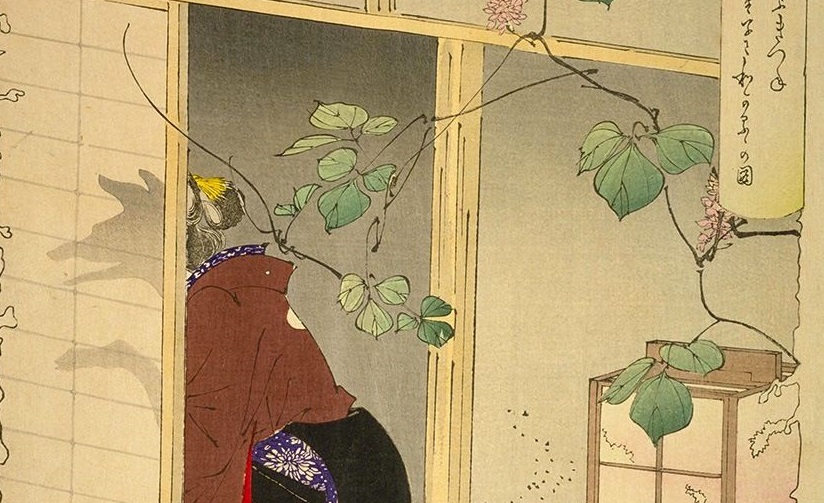
Directed by Tomu Uchida
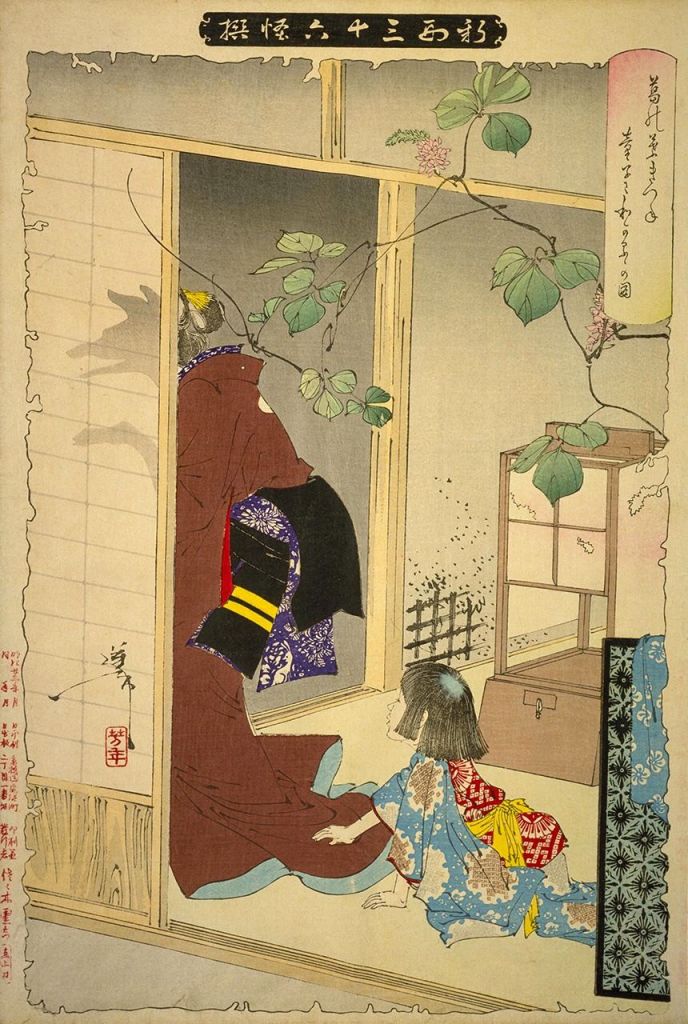
(The Fox-Woman Kuzunoha Leaving Her Child)
National Diet Library Japan
Summer is here, and many of you will be on holiday right now. Have you ever wanted to REALLY get away from it all? Let’s take a vacation from what is politely called consensus reality as we explore the enchanted world of The Mad Fox.
This film has a reputation for being extremely surreal and hard to follow. It is neither. The Mad Fox is based on a classic Japanese folktale, and it’s highly Kabuki-inflected. In other words, it’s my cup of tea. You can appreciate The Mad Fox without knowing anything about Kabuki, but a little bit of background always helps.
I am curious how The Mad Fox got greenlit as it is not your average Toei period drama. Uchida can be strange sometimes. There are several scenes in his three-part adaptation of Dai-bosatsu tōge where I think Toto, I’ve a feeling we’re not in Kansai anymore. When Ryūnosuke (Chiezō Kataoka) meets Otoyo who is the exact double of his late wife whom he murdered I get chills that are hard to shake off. Eerie moments like this are why Uchida is one of my favorite filmmakers.
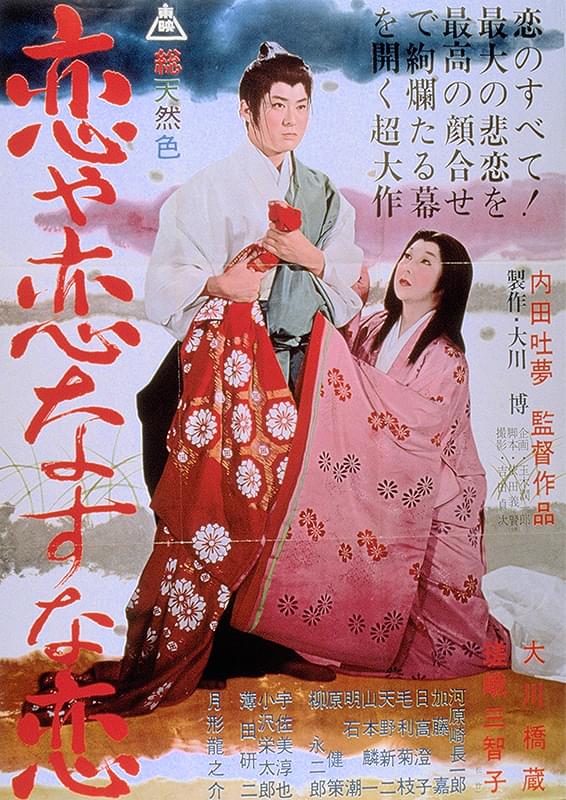
The star of The Mad Fox is a Kabuki actor who transitioned to jidaigeki roles at Toei to great acclaim, eventually becoming the studio’s most popular star. Hashizō Ōkawa (1929 – 1984) was an onnagata, a male actor specializing in playing female roles. His slight frame and pretty face were major assets in that regard. In The Mad Fox Ōkawa plays the protagonist Abe no Yasuna, a male role. I have seen Hashizō Ōkawa in a few other films he made for Toei, and he is particularly adept at portraying vulnerable people. He is excellent in Akō Rōshi, a 1961 Chūshingura film in which he plays a very fragile Lord Asano.
Yasuna spends the majority of The Mad Fox in a profoundly disturbed state. We see what he sees. This destabilizes our own sense of what is real and what is not. Perhaps the optimal approach for experiencing the film is simply to walk with him on his journey. If you are fine with this, then you will find much to enjoy.
The first act of The Mad Fox is deceptive. I thought it was going to be a typical historical drama. (Ryūnosuke Tsukigata’s in it! Usually that means someone somewhere is getting their ass kicked, but not this time.) I could not have been more wrong, and when things go left in the second act it’s a ride into the unknown.
The film opens during the reign of Emperor Suzaku in the 10th century. Kyoto is plagued by ominous phenomena: a white rainbow, a mysterious red light. These events have led to unrest in the city. The Golden Crow, an ancient Chinese scroll that only the imperial astrologer Yasunori (Junya Usami) can interpret, must be consulted. Yasunori is alarmed by the recent portents and sees disaster in the forecast, apocalyptic visions of the state split asunder.
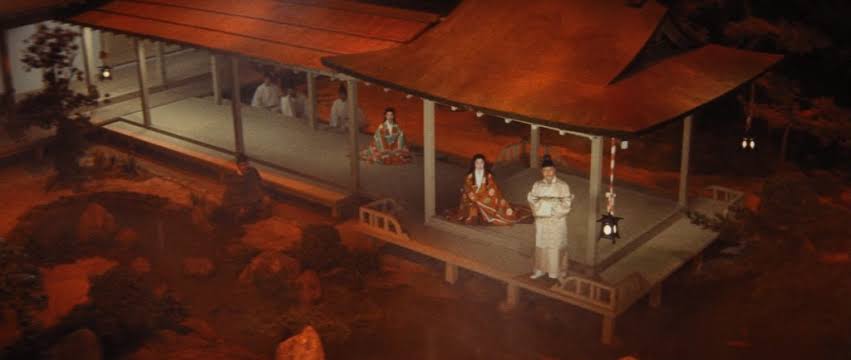
Yasunori has two disciples, one of them good and the other evil, who compete against one another to succeed him as astrologer to the imperial court. Yasuna is the good disciple and Dōman (Shinji Amano) is his unscrupulous rival. Yasuna is betrothed to Yasunori’s adopted daughter Sakaki (Michiko Saga).
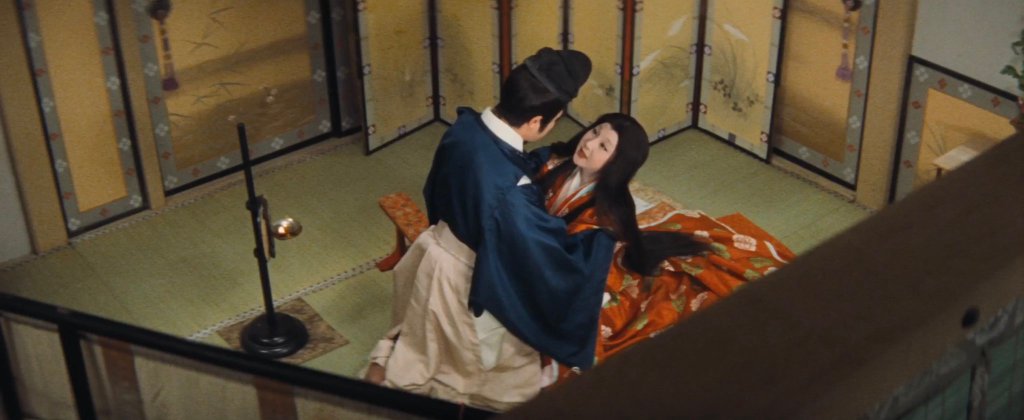
Dōman is having an affair with Yasunori’s wife (Sumiko Hidaka).
Yasunori’s diabolical wife betrays him and has him killed so Dōman can become astrologer to the imperial court. Sakaki and Yasuna are arrested in connection with the unexplained disappearance of the Golden Crow scroll. Akuemon (Rinichi Yamamoto), Yasunori’s wife’s henchman, tortures Sakaki so that she will divulge the scroll’s whereabouts. Yasuna is forced to witness the horrific scene from a cell where he is held captive. Sakaki dies protesting her innocence.
Yasuna escapes from custody and overhears Yasunori’s wife and Dōman plotting. She confides to Dōman that she stole the Golden Crow scroll. A fight ensues during which an oil lantern is knocked over and the house goes up in flames. Yasunori’s wife is killed. Yasuna flees clutching the precious scroll and Sakaki’s kimono. He calls her name, believing that she is still alive. His trauma is so severe that he has lost contact with reality.
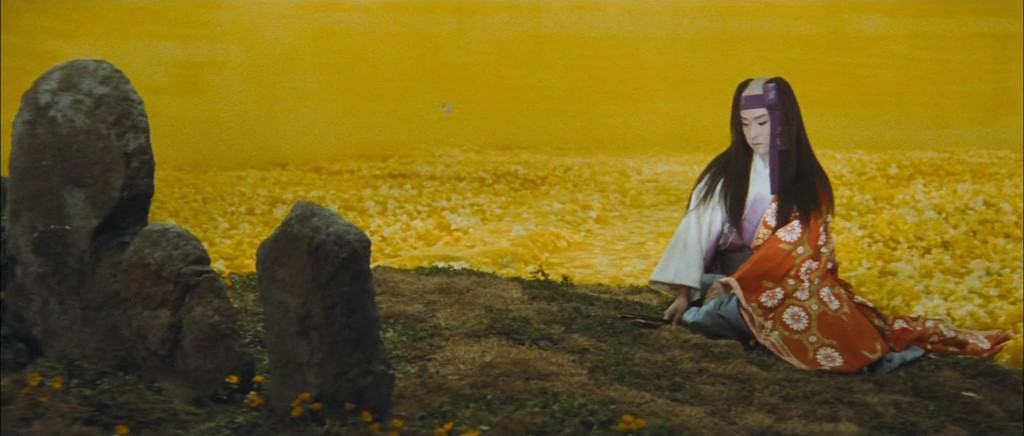
For the first time in over 40 minutes we see a sunny naturally lit exterior shot. Yasuna has gone mad and wanders aimlessly in the countryside. He is wearing Sakaki’s kimono. He stops in a field of golden flowers and falls to his knees to pray beside a weathered shrine of small stones. “If her spirit is still in this world,” Yasuna pleads, “let me see her once more. Or one just like her.” He faints in front of the stones.
The gods are about to answer his prayer. Yasuna awakens in a glowing dreamlike landscape without a horizon. Everything is suffused in golden yellow light. His costume and wig have changed. He is now dressed as Yasuna appears in Kabuki, wearing his murdered fiancée’s clothes and a purple cloth tied round his head. In Kabuki this purple headband (yamai hachimaki) signifies that the wearer is ill (mentally and/or physically) or suffering from unrequited love. A joruri, the narrator in a bunraku play, recites a mournful verse: Love, O love, inside is only emptiness.
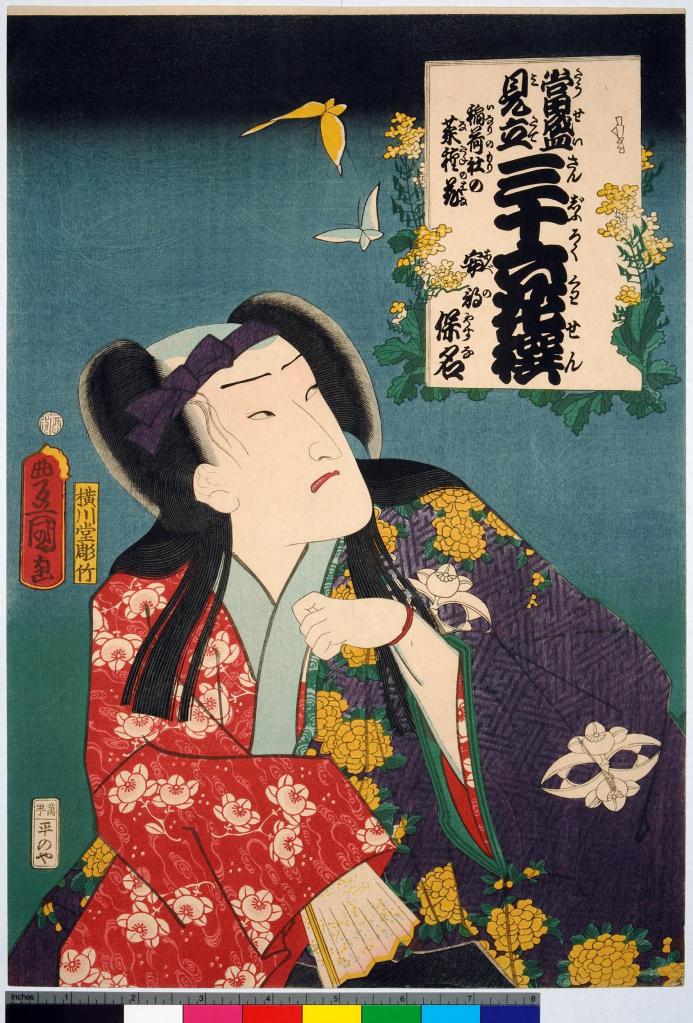
© The Trustees of the British Museum. Shared under a Creative Commons Attribution – NonCommercial – ShareAlike 4.0 International (CC BY-NC-SA 4.0) licence.
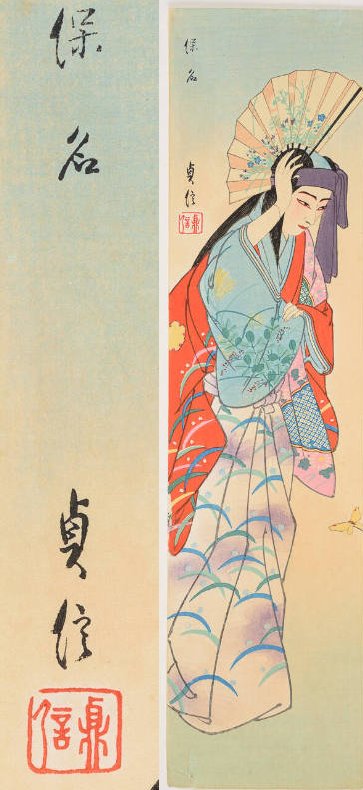
Honolulu Museum of Art
Accession 32271
In his grief Yasuna dances. The golden meadow begins to spin. Sakaki appears before him. Glimpsed through a curtain of falling leaves, the image of the one he loved so long ago. He collapses once more, draped in Sakaki’s kimono.
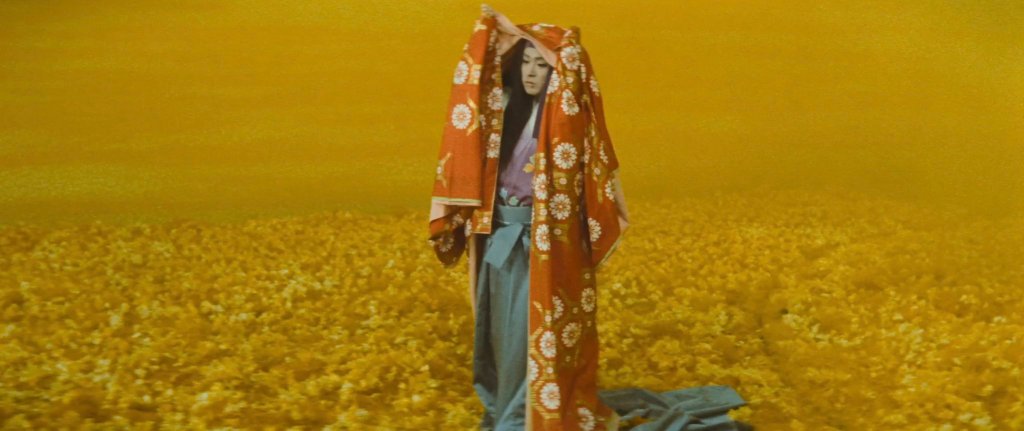
A gold curtain behind him falls to reveal a natural setting. Yasuna regains consciousness. He sees a woman who is the image of his late beloved picking flowers. He approaches her. Yasuna recognizes the group of people accompanying her as Sakaki’s birth family who live in Izumi. The lady who looks like her is her twin sister Kuzunoha (also played by Michiko Saga). Yasuna believes her to be Sakaki. He collapses again. Perceiving that he is unwell, Kuzunoha’s father Lord Shoji (Yoshi Katō) takes him to his house where he can rest and recover.
Meanwhile at the imperial palace in Kyoto the Crown Prince (Kawarasaki Choichiro) commands his ministers to find the Golden Crow scroll. Before her death Sakaki gave testimony at the palace that the scroll foretold disaster affecting the imperial line of succession. If the Crown Prince does not beget an heir soon the nation could descend into chaos. Dōman informs his uncle Iwakura (Eitarō Ozawa) that before the scroll disappeared he saw a potential remedy therein. The blood of a white vixen must be used in a spell to produce an heir to the imperial throne. A white vixen has been seen in Izumi province. Dōman organizes a hunting party to find her.
In Izumi we see Yasuna looking much healthier with Kuzunoha. He continues to believe that she is her dead twin sister Sakaki. When her lady-in-waiting corrects him, Kuzunoha gently explains that Yasuna seems happier in his mistaken belief, so she allows it to continue.
Akuemon and the hunting party from Kyoto arrive in Izumi. Yasuna and Kuzunoha flee into the forest. Something rustles in the leaves towards them. An elderly woman (Kikue Mōri, whom you may recall from Ugetsu and Jigokumon) emerges from the undergrowth. She has an arrow in her back. Yasuna removes it and bandages her wound with fabric from his sleeve. Members of the hunting party appear and ask Yasuna if he has seen a white fox. Yasuna reproaches them for their carelessness: “Can’t you tell a fox from a human being?”
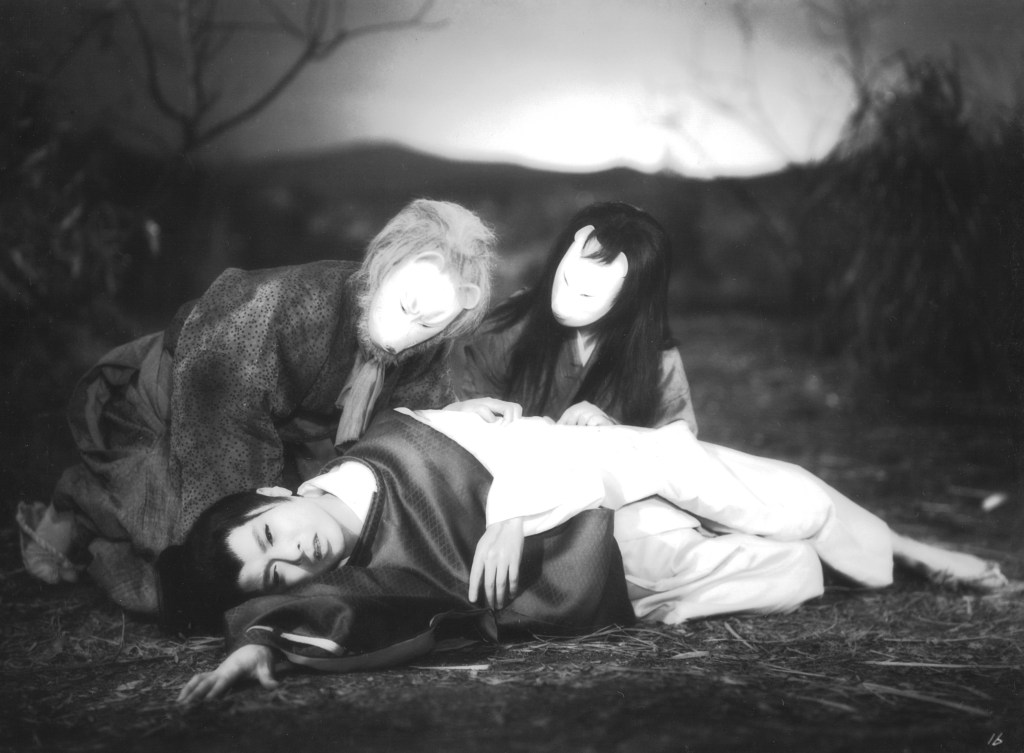
Yasuna and Kuzunoha take the woman to her house in the forest, which is surrounded by an eerie mist. An old man (Kenji Usuda) emerges from the house. Inside the house the injured woman crouches on the floor in agony. When she lifts her face she is wearing a white fox mask. She calls out to her granddaughter Kon. A young woman enters, also wearing a white fox mask. They are kitsune, fox spirits.
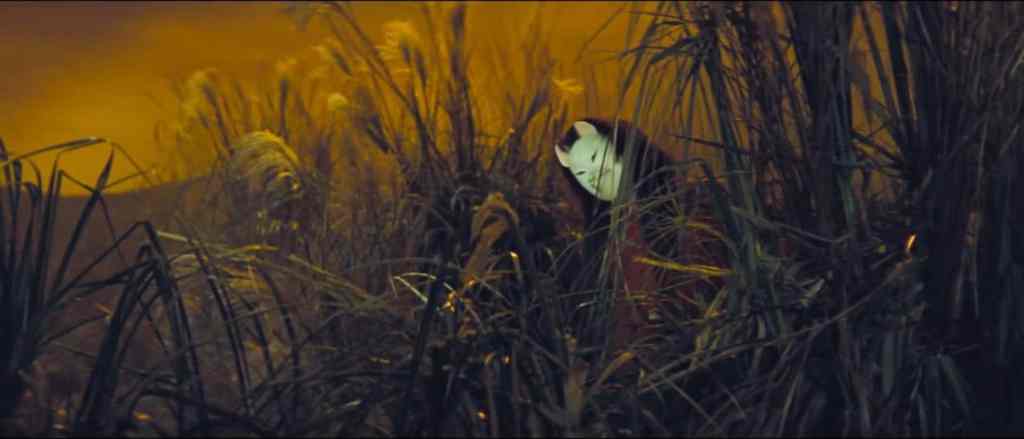
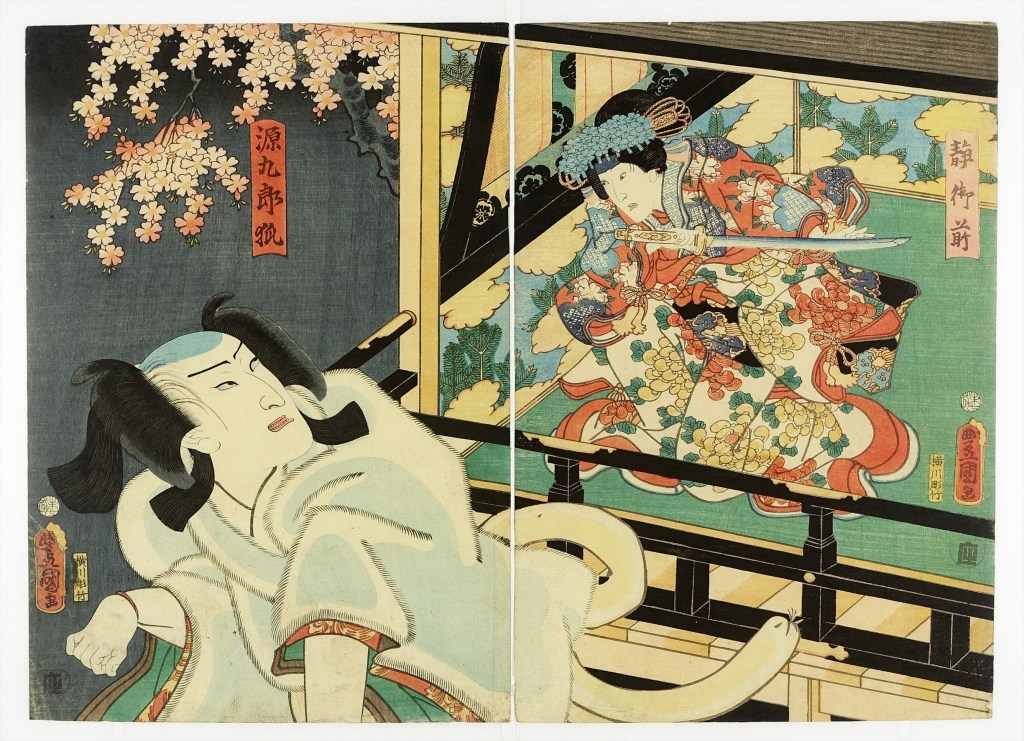
These foxy characters are always a welcome presence wherever they pop up. Apart from Ashiya Dōman Ōuchi Kagami the most well-known Kabuki play featuring kitsune is Yoshitsune Senbon Zakura (Yoshitsune and the Thousand Cherry Trees):
Akuemon lurks outside in the woods. The grandfather, now in fox form as well, scents trouble and directs Kon to watch over Yasuna. Akuemon and his men ambush Yasuna, Kuzunoha, and her lady-in-waiting. They seize Yasuna and demand the return of the Golden Crow scroll. Seeing this Kon summons her grandfather. Kitsune-bi (fox fire) appears in the distance. The flames transform to leaping foxes. Kitsune to the rescue!
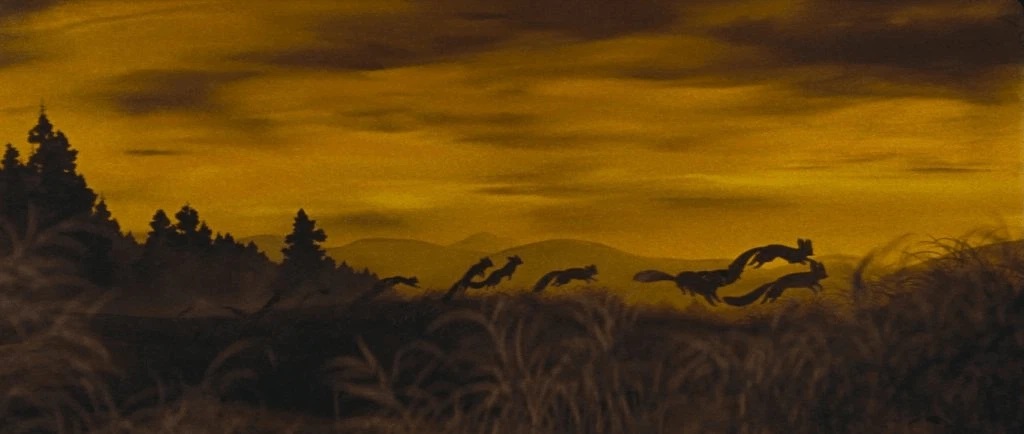
The kitsune appear as an army of peasants wearing fox masks. They defeat Akuemon and his men. Yasuna is injured in the fray. Kon and her grandfather transport him to a remote spot in the mountains. Kon’s grandfather tells her to nurse him back to health and to let the humans who care about him know that Yasuna has been “spirited away”.
Kon is now in possession of the Golden Crow scroll. To disguise her kitsune identity Kon agrees to assume the form of Lord Shoji’s daughter Kuzunoha. Her grandfather cautions her not to fall in love with Yasuna: “We are born enemies of man. The moment he returns to his senses, he will abandon you.”
Kon takes Yasuna with her to a hut in the forest. She transforms into Kuzunoha. Kon’s magical onscreen transformation from fox to human is achieved with a Kabuki-style quick-change technique (hayagawari). She tends to his wounds. Yasuna awakens. He believes that Kon is Sakaki. They kiss. Kon flees outside and transforms back into a fox.
It’s around about the third act that things get rather weird.
A black, orange, and green striped curtain opens: we are in a Kabuki theatre. The action is taking place onstage in a traditional set. There is no audience. The effect is ineffably sinister.
Kon is now Yasuna’s kitsune nyōbo, fox wife. We see her inside a small house onstage, working at a loom. Yasuna enters and plays fondly with a baby. The child is a doll, a stage prop. Kon sends Yasuna out to cut some firewood. As he exits the stage a group of rough characters enter. Kon closes the gate from a distance with a wave of her hand. A drum rumbles on the soundtrack, a Kabuki music cue indicating the presence of the supernatural. The men make a hasty exit.
Kuzunoha and her parents enter via the hanamichi (a raised runway connected to the stage that passes through the audience). They have come in search of Yasuna, but why would Yasuna be living in such a humble shack? Lord Shoji walks up to the window where he sees Kon weaving at her loom and is astonished to see that she could be his daughter’s twin. Has Sakaki returned from the dead?
Yasuna returns. Upon seeing Kazunoha he laughs, believing that it’s some sort of trick. The stage set rotates and the spooky drum sounds again. An anguished Kon realizes that her time with Yasuna has come to an end. Now the truth is revealed. Mother and child are sundered.
Kon finally reveals her identity to Yasuna: “I am the granddaughter of the fox whose life you saved.” She leaves the child with Yasuna for him to raise. She writes a farewell poem on the shōji screen door.
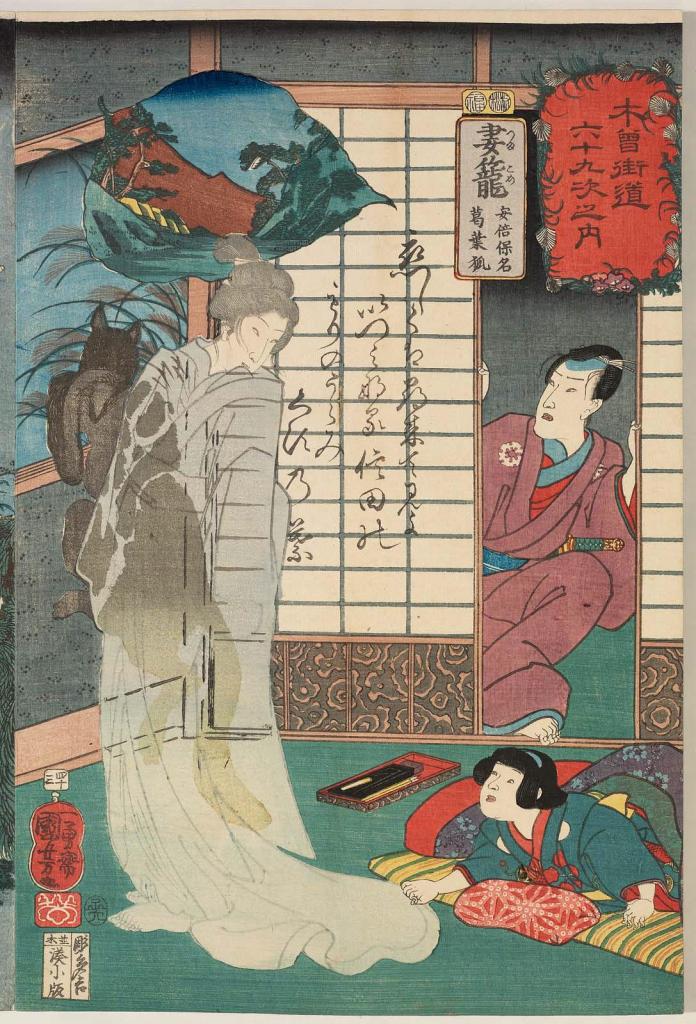
Fox Kuzunoha, from the series Sixty-nine Stations of the Kisokaidō Road
(Kisokaidō rokujūkyū tsugi no uchi)
MFA Boston
William Sturgis Bigelow Collection
Accession Number 11.38972.44
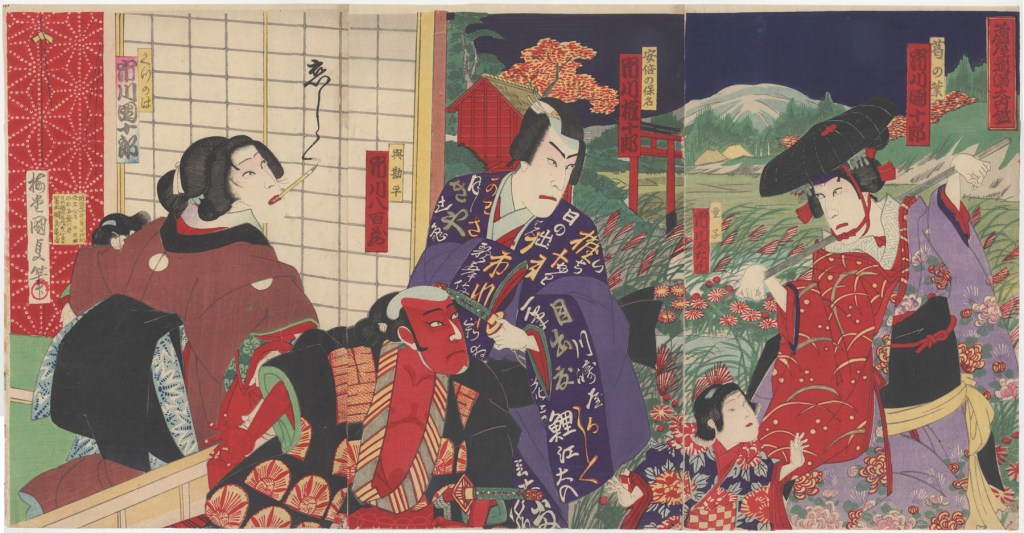
(A Courtly Mirror of Ashiya Dōman), 1891
Lavenberg Collection of Japanese Prints
The house collapses and vanishes in a cloud of smoke. A white fox flies into the air. Yasuna appears to have regained his senses at last. He sees Kazunoha for who she is. He takes his baby into his arms. Kon has left the Golden Crow scroll behind too. Yasuna weeps in despair.
Yasuna is back in the golden meadow as before. He wraps Sukaki’s kimono around him and falls to the ground. We cut to a shot of a stone on stage that is roughly the same size and shape as Yasuna’s body. Kitsune-bi hover and dance round it.
The End.
No really, that’s the ending.
(Hey, I never said I could explain everything.)
Toei restored The Mad Fox and it looks splendid. It’s available on Amazon Prime, Apple TV, YouTube, and on Blu-ray from Arrow Video.
YouTube has the trailer:
Most of the ukiyo-e I have used for this post depict scenes from the play Ashiya Dōman Ōuchi Kagami which was originally written for the puppet theatre in Osaka in 1734 and staged as a Kabuki play for the first time the following year in Kyoto. The Yoshitoshi ukiyo-e at the top of this page is one of my favorite prints ever.
Yasuna’s beautiful dance after he has gone mad with grief is very popular in Kabuki. Learn more about it here:


Leave a Reply