Directed by Yasushi Sasaki
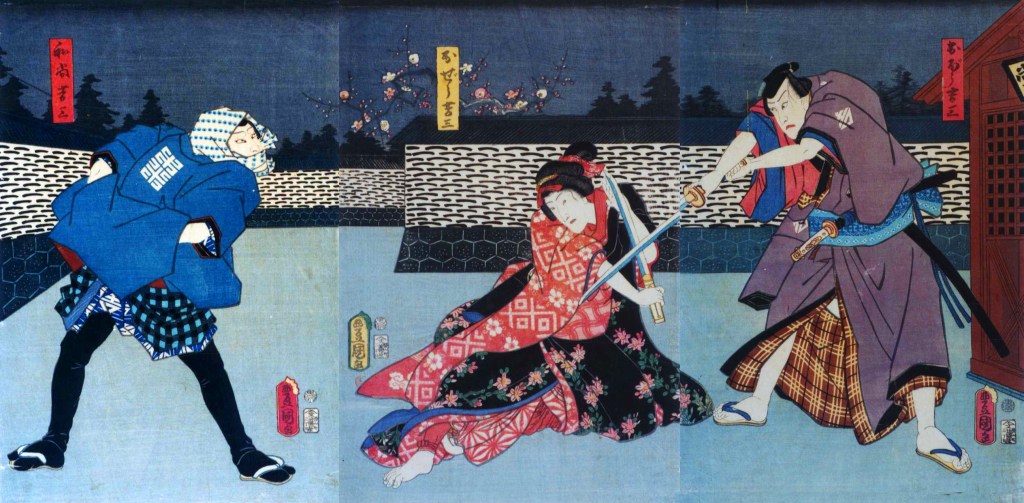
From left: Kodanji Ichikawa IV as Oshō Kichisa, Kumesaburō Iwai III as Ojō Kichisa, and Kawarazaki Gonjuro I as Obō Kichisa
The title refers to the protagonist’s nickname. Based on the novel by Kan Shimozawa, this is fairly formulaic stuff in terms of plot. Nevertheless it offers a number of things that make it worth a watch. Chiezō Kataoka is absolutely on fire in his fight scenes. There are multiple great Chiezō versus Everybody sequences. If that isn’t enough to tempt you, it has a strong female lead played by the fabulous Hibari Misora.
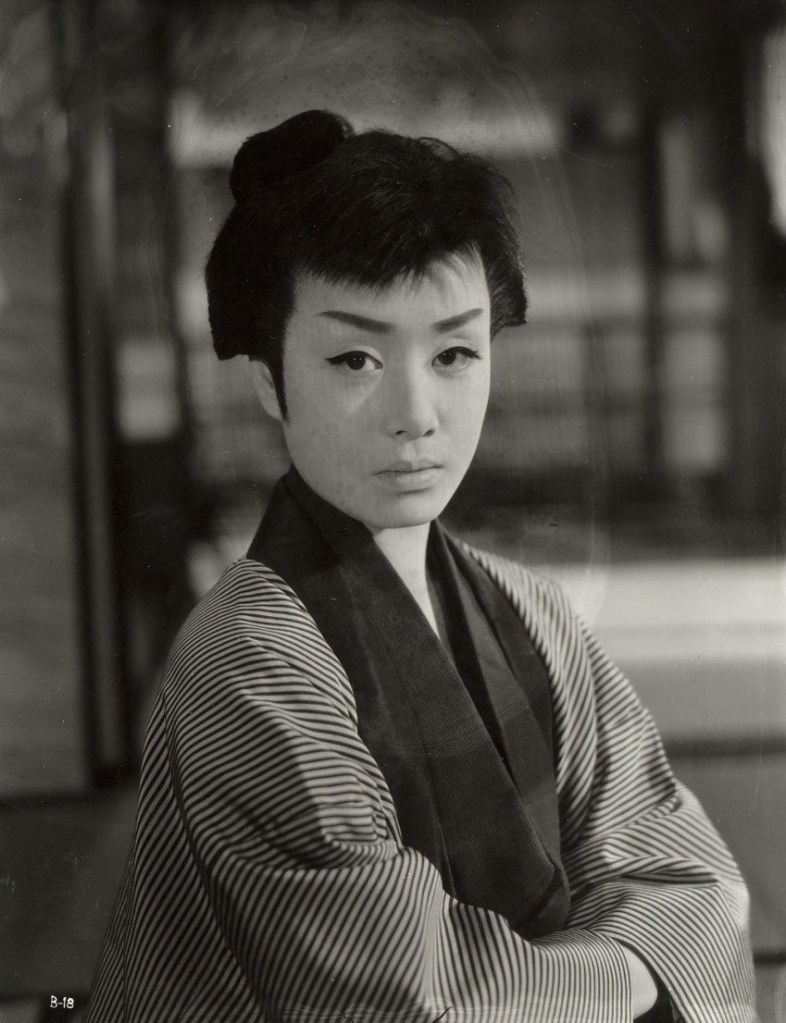
(1937 – 1989)
The most popular recording star of Japan’s postwar era, Hibari Misora was also a talented actress who made many jidaigeki films. Hibari is not just a passive damsel in distress in those movies: she’s a scrappy fighter in some very physically demanding roles. She can break your heart too. Hibari appears in the final Bored Hatamoto film that Utaemon Ichikawa made, playing a beautiful tragic heroine, the only character in a Bored Hatamoto movie who has made me cry.1
Hibari defies a lot of conventions surrounding what a leading lady should be. She had an androgynous quality and was often cast as male characters, playing samurai, yakuza, and even Kabuki actors. Since Hibari Misora was very petite you might assume that she could never pull this off. And you’d be wrong, because she is fierce! Her low voice and tomboy vibe make her a good fit for ladies disguised as men, and she often adopts disguises on top of that, appearing in Kabuki roles where she shows off her dance skills.
Hibari made a series of films called Hibari Torimonochō (Hibari Detective). Her performance as princess-turned-detective Oshichi is a delight — she plays Jiraiya in a Kabuki play in one of these movies and levitates atop a giant toad. That scene alone renders it a classic in my book.
In 1957 Hibari Misora starred in an adaptation of Yukinojō henge (An Actor’s Revenge) in which she plays an onnagata, a male Kabuki actor specializing in female roles. A woman playing a man playing a woman is an ‘only in Japan’ situation:
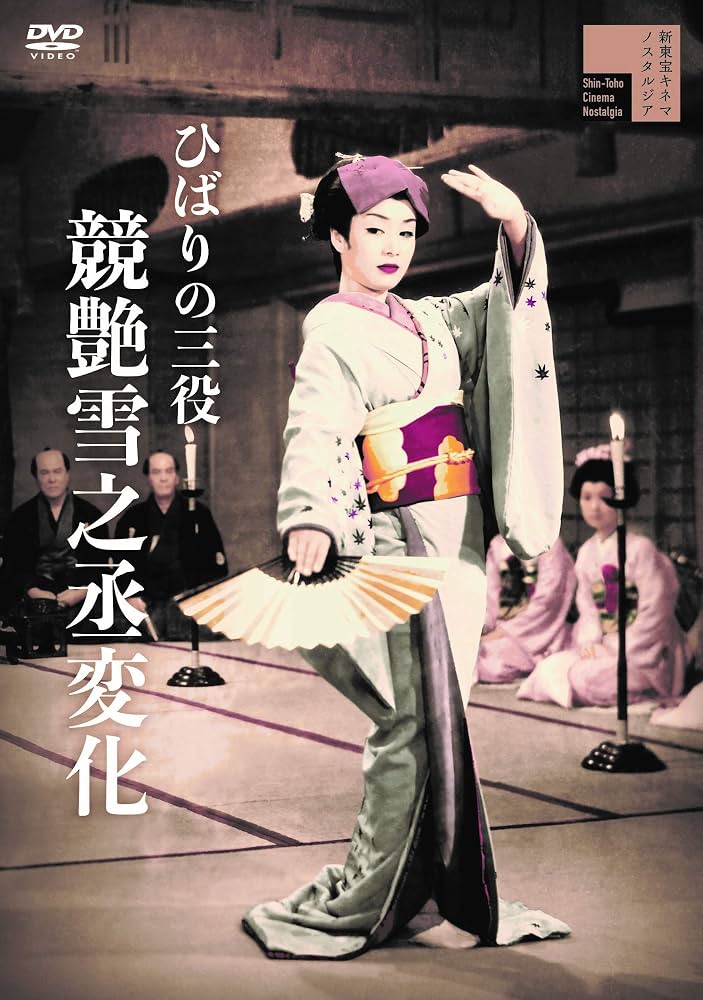
(Hibari’s Triple Role: The Dazzling Transformation of Yukinojō)
The purple silk cloth Hibari wears atop her head here is called murasaki-bōshi. Whenever you see a character wearing one of these in a play, a film, or indeed ukiyo-e it usually signifies that the wearer is an onnagata. Not all onnagata wear it, however. Kabuki theatres used to be rather louche places, and a lot of seamy (or steamy, depending upon your point of view) activities went on behind the scenes. Murasaki-bōshi came about as a stylish way for onnagata to disguise their shaved forelocks, a masculine hairstyle enforced by legislation that attempted to clamp down upon what the authorities regarded as scandalous behavior on the part of actors, some of whom had side gigs as prostitutes.
Both Yukinojō henge and Obōzu Tengu share DNA with a Kabuki play, Sannin Kichisa (The Three Kichisas) by Kawatake Mokuami. Sannin Kichisa relates the exploits of three criminals who all share the same name: Ojō Kichizō: a young cross-dressing thief; Obō Kichizō, a samurai who became a rōnin; and Oshō Kichizō, a former priest.
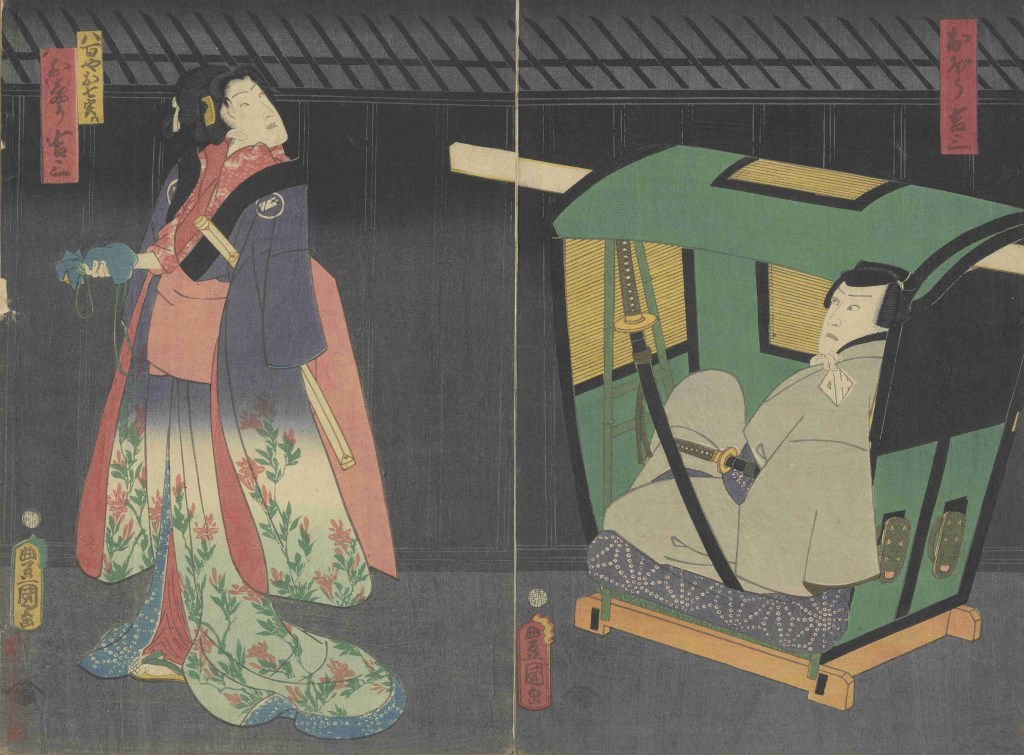
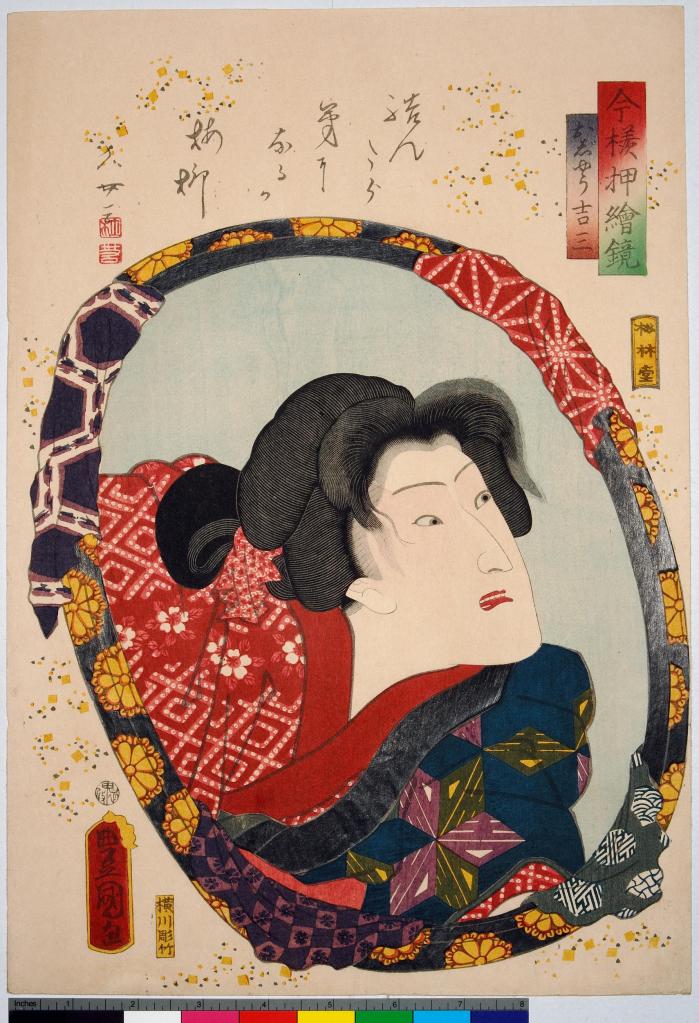
(Mirror of Fashionable Relief-Pictures)
© The Trustees of the British Museum. Shared under a Creative Commons Attribution – Non-Commercial – ShareAlike 4.0 International (CC BY-NC-SA 4.0) licence.
In common with Sannin Kichisa, Obōzu Tengu depicts people living on the margins of Edo society. In Obōzu Tengu the main character is also a rōnin, but he’s not a criminal. Banshoya Kichisaburō is an ex-hatamoto who lives in a rambling house in Honjo with what the film calls ‘vagrants’. They’re not so much vagrants as people who don’t fit with the strictly regimented world outside Kichisaburō’s house. They include a couple of gender non-conforming people, an effeminate man and a young woman with a loud voice and hoydenish manner. Ostracized by society, these outcasts have found refuge with the former samurai. Kichisaburō looks after them while keeping order in Edo, where he occupies a liminal space between commoners and the criminal class of the city’s underworld. Despite the fact that he’s no longer a high-ranking samurai folks still defer to him, and his tenants call him Danna (Master).
Kichisaburō has no master but himself. He became a rōnin deliberately. It’s all part of his plan to seek revenge against the deranged Lord Honda, a provincial governor who murdered Kichisaburō’s father.
Chiezō has a fantastic entrance in this. Ruffians disrupt a Kabuki performance and are harassing geisha in the audience. A geisha in a pale green kimono (Hibari Misora) is as cool as a cucumber despite the distressing circumstances. She isn’t intimidated one jot by the men’s obnoxious behavior. When a man threatens to strip her clothes off she dismisses him with the contempt he deserves: “Just try it.”
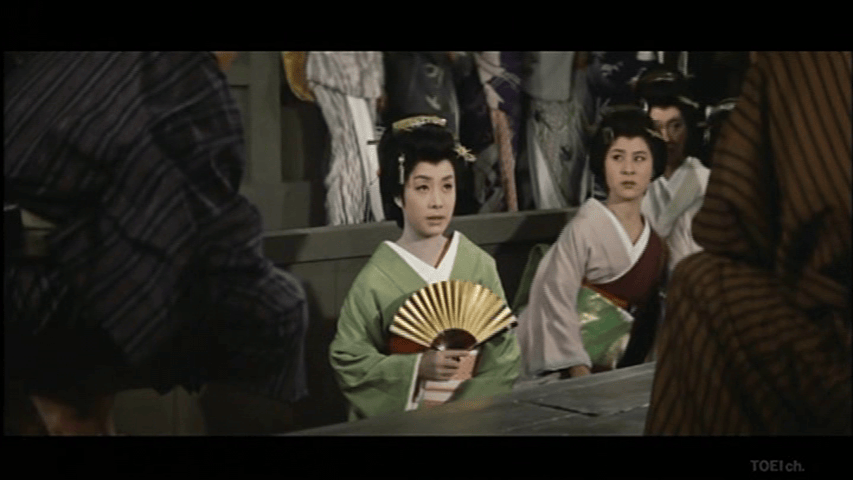
The situation appears to be deteriorating when a murmur ripples through the theatre: Kichisaburō has arrived.
Chiezō walks in like he owns the place. One of the thugs bows and greets him. He delivers a massive slap and knocks the man off his feet. The thugs protest that they couldn’t help themselves because the girls are just too pretty. Kichisaburō is having none of their victim-blaming nonsense and tells them to get the hell out.
Kichisaburō checks on the ladies to make sure they’re all right. He’s impressed with Hibari’s sang-froid in the face of danger. He also suspects that this particular geisha is not quite what she seems.
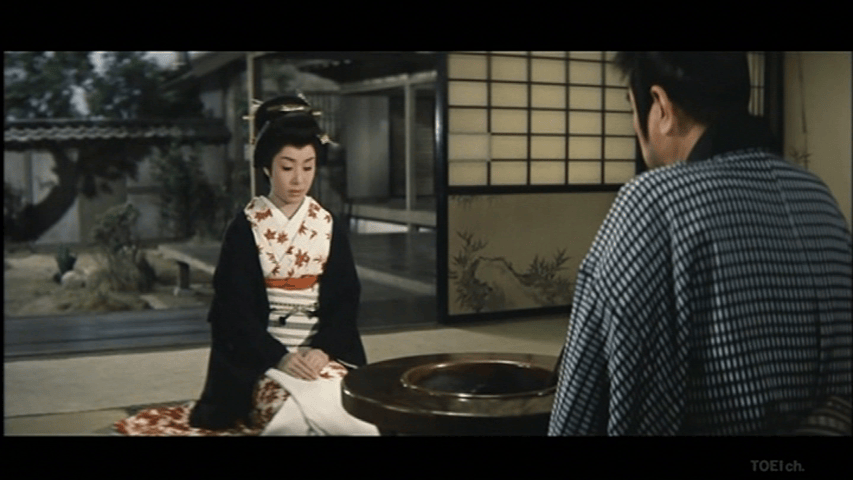
The cool geisha visits Kichisaburō at his house. Her name is Kozome, and she has come to request his help in pursuing a vendetta against the man who killed her father.
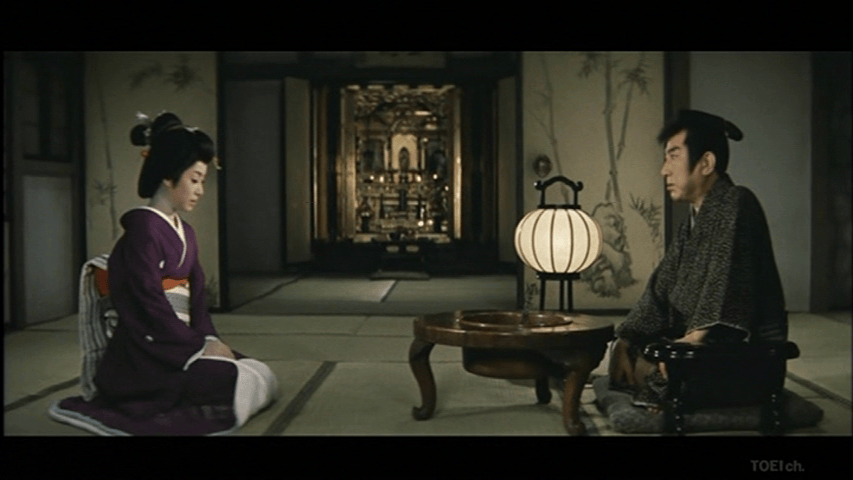
Kichisaburō’s suspicions about the young lady turn out to be correct: she is the daughter of a samurai. Kozome has adopted a disguise in order to enact her revenge. Her assumed identity as a geisha is well chosen because as we shall see she is an expert singer and dancer.
Kozome does not know who killed her father. The only clue Kozome has to identify the perpetrator is her family sword, which the murderer stole. Kichisaburō enlists Edo’s foremost sword expert Akibaya Shinzaburō (Hashizō Ōkawa) to find it and trace it to its current owner.
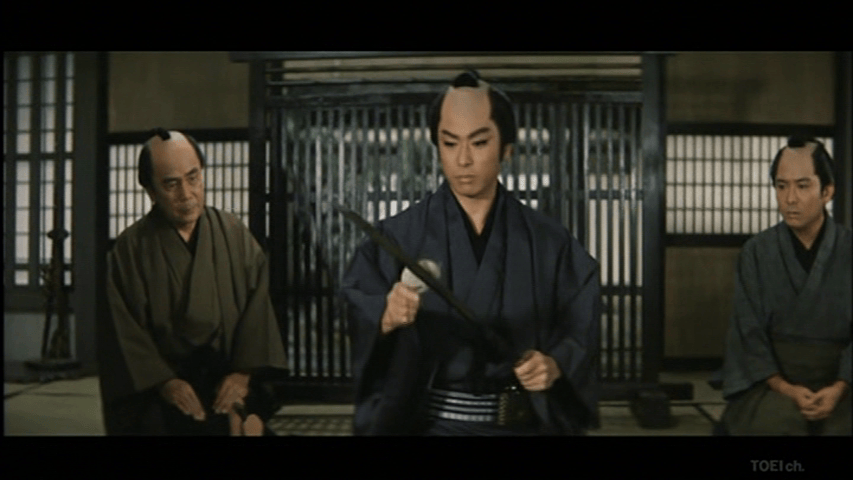
Casting young actors like Hashizō Ōkawa alongside established mature stars was intended to attract more youthful audiences to a genre of films which by the early 1960s was perhaps starting to show signs of age. I like it when Chiezō teams up with a younger man as his protégé. Hashizō is not the most dazzling swordsman I’ve ever seen but he is very cute and likeable, which goes a long way. He’s also funny. In Obōzu Tengu whenever armed conflict flares up Shinzaburō vacillates between reckless bravado and total panic while Kichisaburō gets to work demolishing the opposition.
The film’s other comedic elements are less successful. This is virtually inevitable in a movie more than 60 years old. Comedy doesn’t age well, as anyone who watches TCM on a regular basis will attest.
Ryūtarō Ōtomo plays the chief retainer of the Honda clan, Araki Kinpei. His job is an unenviable one: he tries to protect his insane boss from himself and from other people, not unlike the situation we see with the despicable daimyō in 13 Assassins. Every revenge drama needs a compelling villain, and Obōzu Tengu serves up a particularly scary one. When we first meet Lord Honda he has just killed an innocent woman in a fit of psychotic rage. He is played by Masao Mishima, the brothel owner from Killing in Yoshiwara. He’s so terrifying that even Ryūtarō manages to look scared, and that guy’s pretty much a big ol’ block of wood in every movie I’ve seen him in: proof that a gifted actor can elevate everyone’s performance in a scene.
Kinpei meets with Kichisaburō to ask what Kichisaburō plans to do about his boss Lord Honda.
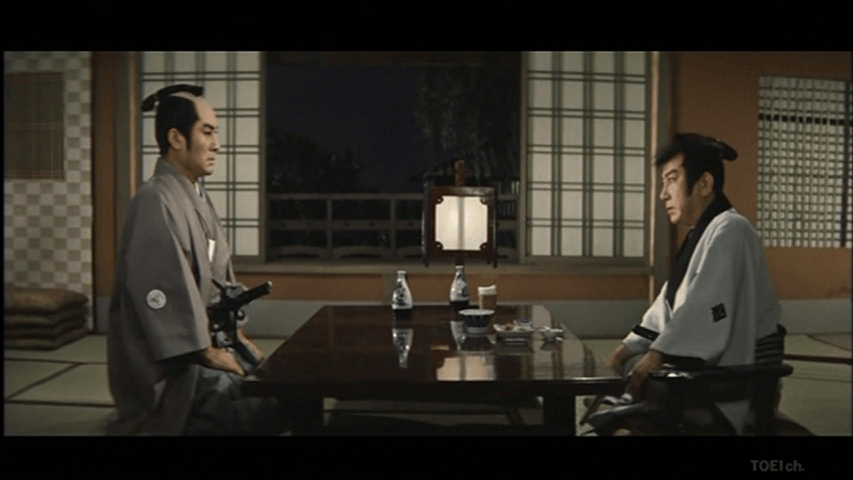
Kichisaburō:
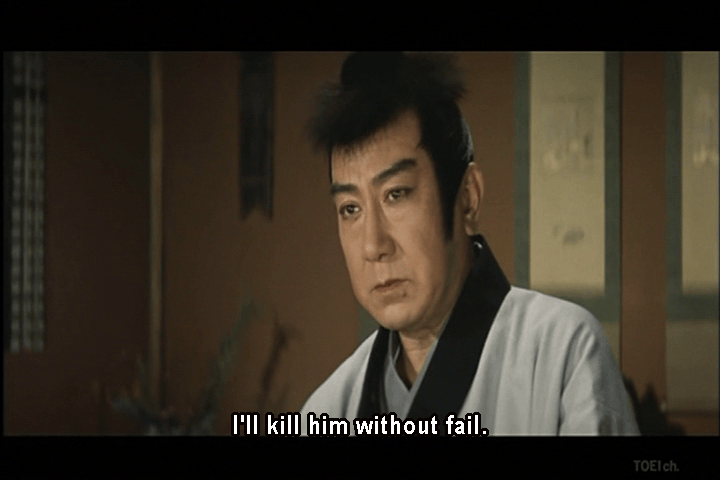
Kinpei’s not having it: “Even if he is a madman, he is still my lord.” If a mere rōnin like Kichisaburō kills the head of the Honda clan, the clan will be abolished, and thousands of samurai who are Lord Honda’s vassals will be left without positions. Kinpei doesn’t intend to let that happen.
Kozure, a geisha who used to work as a lady-in-waiting for Kichisaburō’s household when he was a rich hatamoto, is in love with him. Kozure spies on clients and sends the intelligence she gathers back to Kichisaburō to assist him with his vendetta. She has learned that Lord Honda is scheduled to depart Edo soon in a procession, presenting Kichisaburō with an ideal opportunity to strike. Kozure addresses Kichisaburō as Tonosama (Lord) and pleads with him to let her accompany him on his mission to avenge his father.
“I’m not a lord anymore,” he says. “I’m a degenerate gokenin and you’re a geisha.” Gokenin was the lowest rank of direct vassal to the shogun. Unlike hatamoto they did not have the right to an audience with the shogun. The other residents of the house overhear the conversation and say that they want to come with him too. Kichisaburō says he appreciates the sentiment, but he cannot let them do that.
Shinzaburō surprises Kichisaburō at the location where he is waiting to ambush Honda. Kichisaburō doesn’t look too happy about it. Shinzaburō placates him: “I’m already here so don’t say anything.”
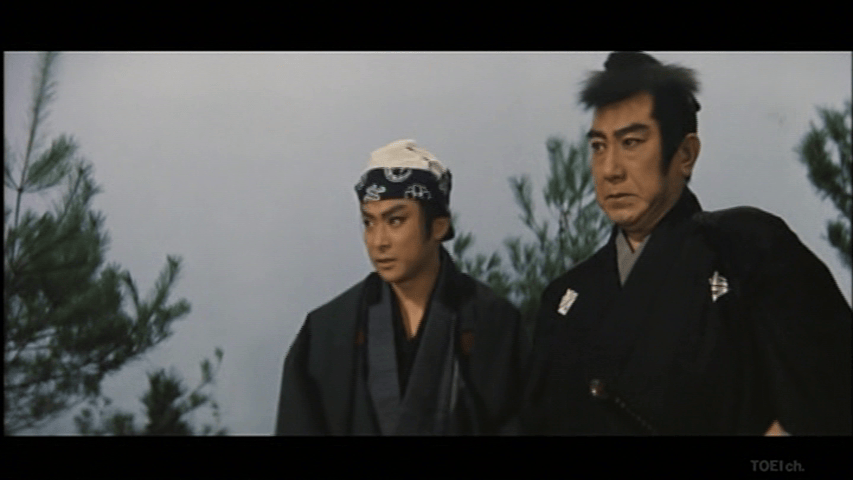
They’ve walked into a trap. Kinpei is inside the palanquin, not Lord Honda. “If you want to avenge your father, then kill me,” Kinpei tells Kichisaburō. “But you’ll have to die here too.”
Kichisaburō has no quarrel with Kinpei and retreats with Shinzaburō.
We return to Edo at a koto recital inside Lord Honda’s mansion. Honda is hitting the booze hard.
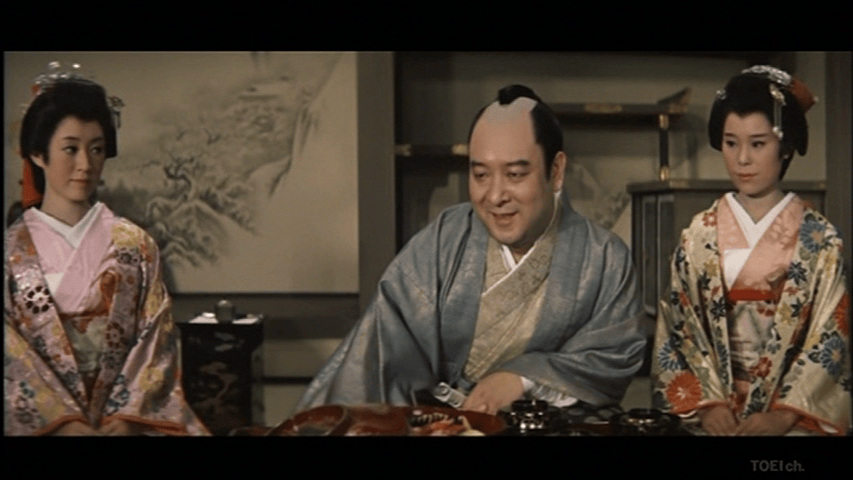
(Waiting for him to die, that is)
One of the musicians snaps the string on her instrument. Lord Honda flips out, says that it’s a bad omen, and tries to kill her with his sword. Kinpei intervenes and saves her life.
Whenever you see these guys in a Toei film malfeasance is afoot:
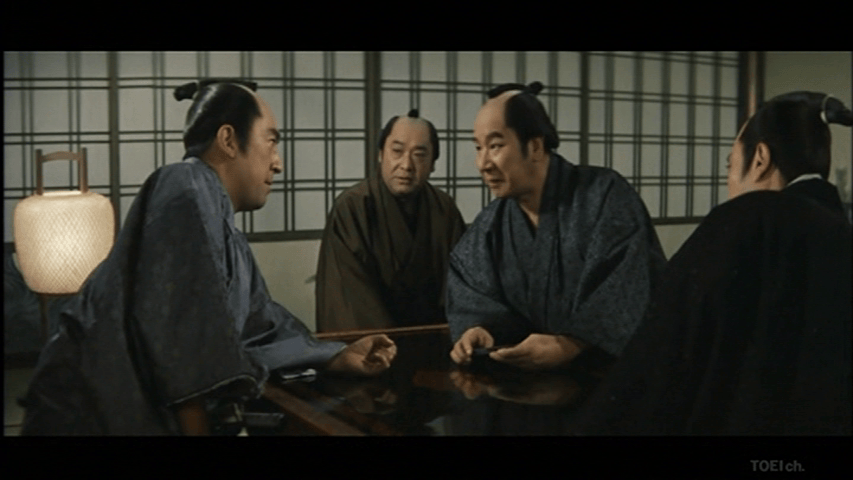
From left: Isao Yamagata, Kusuo Abe, Eitarō Shindō, and Kensaku Hara
The crooked merchant Tokaiya Manbei (Eitarō Shindō) is preparing a lavish party for Lord Honda. He plans to invite all the beauties of Edo there, presumably to give Honda as many potential victims as he can dig with a shovel.
Kinpei does not approve of his lord attending this function: “An Elder of the shogunate shouldn’t visit a merchant’s home.” Honda reacts as you might expect. He looks and acts like an enraged toddler armed with a katana.
Kozome’s father’s sword has turned up at Shinzaburō’s shop for servicing. Shinzaburō has the men who dropped it off followed. The sword’s owner is Tokaiya Manbei.
Kichisaburō sends for Kozome to let her know that the identity of her father’s murderer has been confirmed at last. Kichisaburō tells her that he will help her kill him. Kozome is aware that he has his own vendetta planned: “I can’t have you risk your life for my sake.” She says that she is prepared to die.
“You are a samurai’s daughter after all,” Kichisaburō says.
Tokaiya is hosting the party for Lord Honda at his estate. With every villain in the film conveniently gathered at the same location, this gives Kozome and Kichisaburō the break they’ve been waiting for.
At Kichisaburō’s house the vagrants are ready to go to war. Tokaiya murdered one of their own, a young man who moved out to get a job as a clerk at Tokaiya’s business. The young woman with the loud voice shouts, “We were abandoned by society. We’ll follow you to the end!” Shinzaburō is on board too. He’s brought swords with him and distributes them to everyone.
Kozome is the star attraction amongst the assembly of geisha performing for Tokaiya and his guests. The music for this scene is very cool.
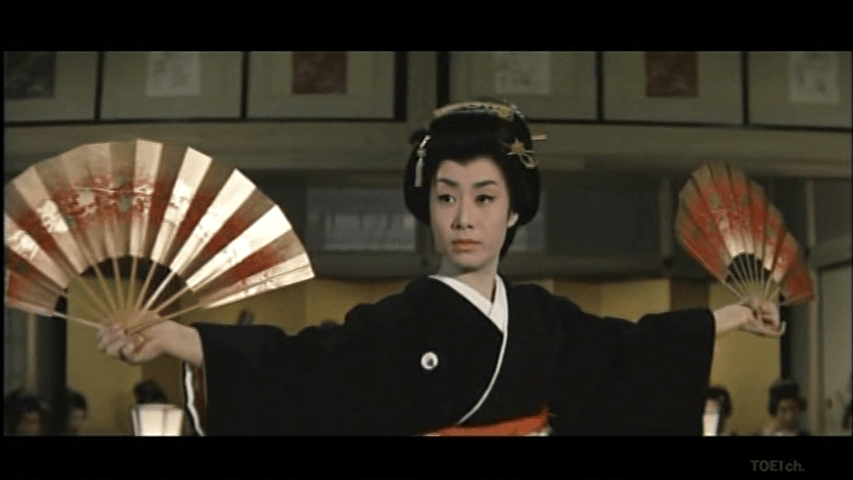
Kichisaburō infiltrates Tokaiya’s mansion. He walks in and faces the man who killed his father: “I, Banshoya Kichisaburō, am here to kill Honda Etchu in revenge for my father.” He dispatches Lord Honda without too much trouble. Having achieved his goal, Kichisaburō announces that he does not wish to take any more lives if he doesn’t have to. He introduces Kozome and says that she has come to challenge Tokaiya. She draws a dagger and tells Tokaiya to his face that she intends to kill him.
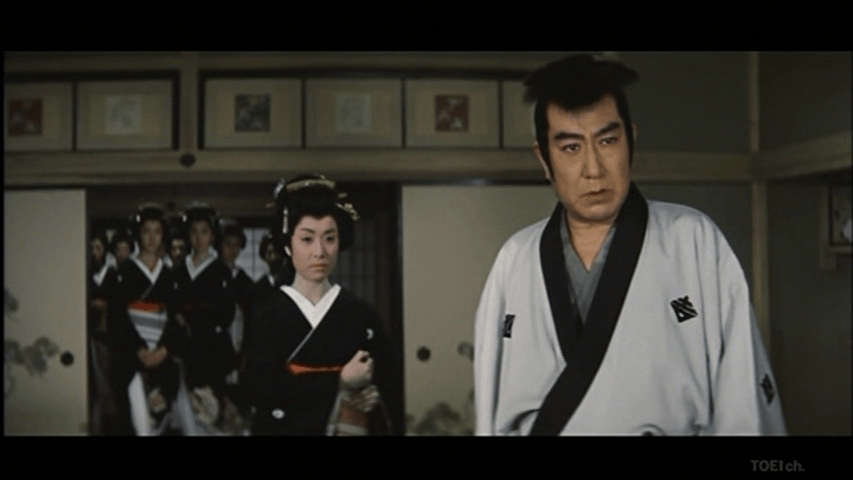
A chaotic fight breaks out. Chiezō is unstoppable— he’s really crushing it! In the heat of the action he turns to Hibari and smiles at her like ‘We got this’.
It’s a shame that Hibari Misora’s character didn’t get to achieve her objective without a man’s help. (It’s still 1962, don’t get your hopes up.) Two years before her appearance in Obōzu Tengu Hibari played the dashing outlaws Benten Kozō and Ojō Kichizō in separate films, roles typically played by male actors. (Her portrayal of Benten Kozō really warrants its own post, so watch this space.) In these and other jidaigeki movies Hibari proved herself to be very capable in action scenes, although the boys do a lot of the heavy lifting. This time around she has Chiezō and Hashizō lending a hand. Elsewhere in Hibari’s filmography Tomisaburō Wakayama and Chiyonosuke Azuma provide expert backup. Which, you know, is not too shabby.
Another missed opportunity concerns Kichisaburō’s ménage of misfits. That’s an unusual set-up with lots of potential. I was hoping that the film would make more of this, but his eccentric tenants simply pitch in with the vendettas and that’s that. Narrative in these movies drives everything relentlessly along. Subsidiary characters are there to keep the plot moving or to provide comic relief. We don’t get to know them.
What we do know is that the whole feudal socioeconomic system is rotten to the core, rife with corruption and cruelty. (See The Ghost of Yotsuya for an even darker take on this subject.) Before the end of Obōzu Tengu another samurai has abandoned his position and become a rōnin. It’s a lot less stressful than working for a batshit crazy drunk.
At this point I should mention that Obōzu Tengu is a remake of a 1954 film released in two parts (Obōzu Tengu: Zenpen and Obōzu Tengu: Kōhen) in which Chiezō Kataoka also played the lead character Kichisaburō. Appearing with Chiezō for the first time ever was Nakamura Kinnosuke. He plays Hibari Misora’s part, Kozome. The promotional materials for this make it look like a movie about a sexy rōnin and his gorgeous twink onnagata boyfriend:
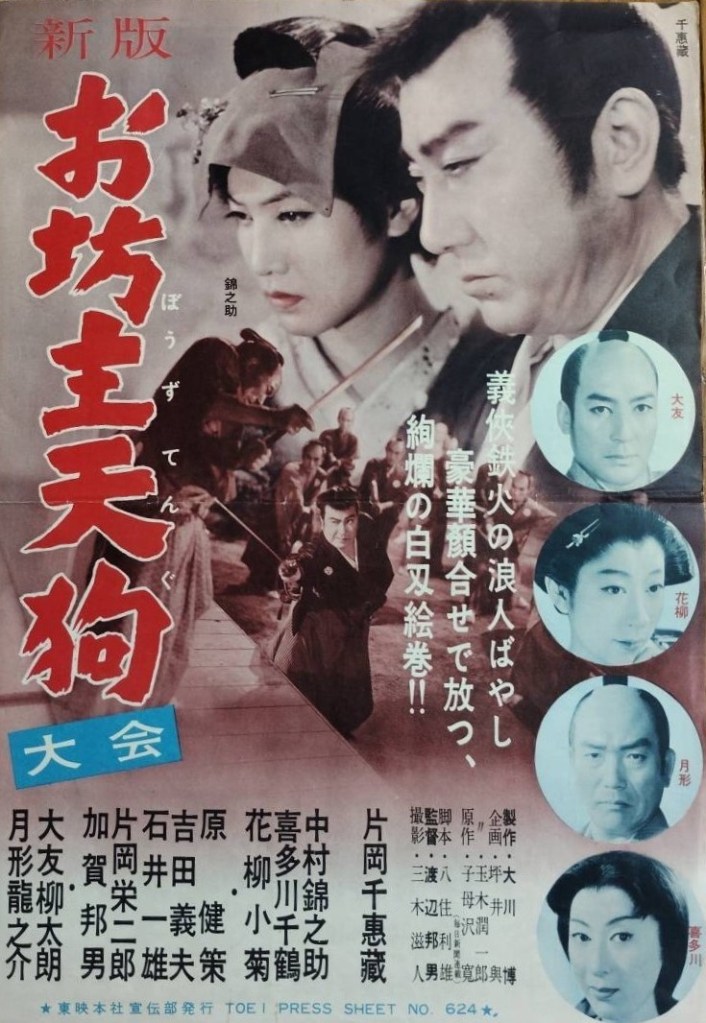
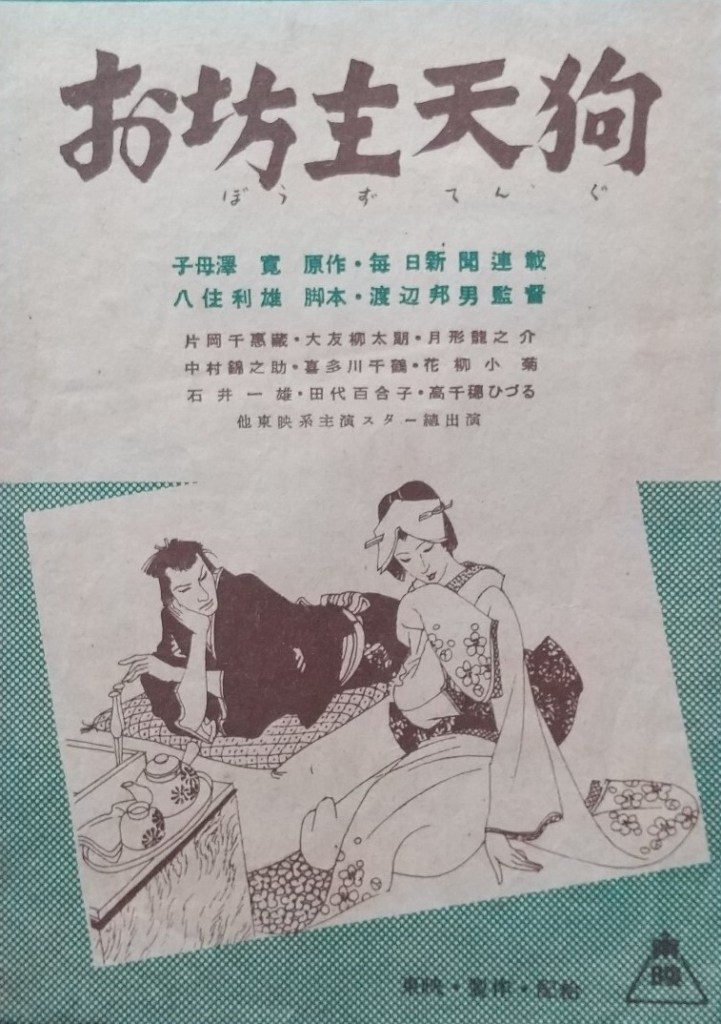
While that is a movie I would pay to see, the actual plot is a conventional revenge drama and not a same-sex romance. No one in the period in which Obōzu Tengu was set would have batted an eyelash at that, by the way: in pre-Meiji Japan intimate relationships between boys/young men (wakashū) and adult males were accepted, even celebrated. Depicting such a relationship in a Japanese film in 1954? Not happening. The heat death of the universe would occur before Toei would produce a movie with Chiezō Kataoka taking a walk on the wild side.
Kinnosuke’s character is actually a samurai in disguise as an onnagata and he collaborates with Chiezō’s character in pursuing their respective vendettas. I’m sure everyone maintains impeccably hetero-normative standards throughout. Kinnosuke can’t help being pretty.
That’s still a film I would like to watch, but I can’t. You can’t either. The master, the original camera negative from which all the prints are made, was destroyed. The only extant print is a 16mm version cut together from parts one and two that has multiple scenes missing, and it resides in Toei’s vault. It is not currently available to view online or via any other format.
At least we still have key art like this:
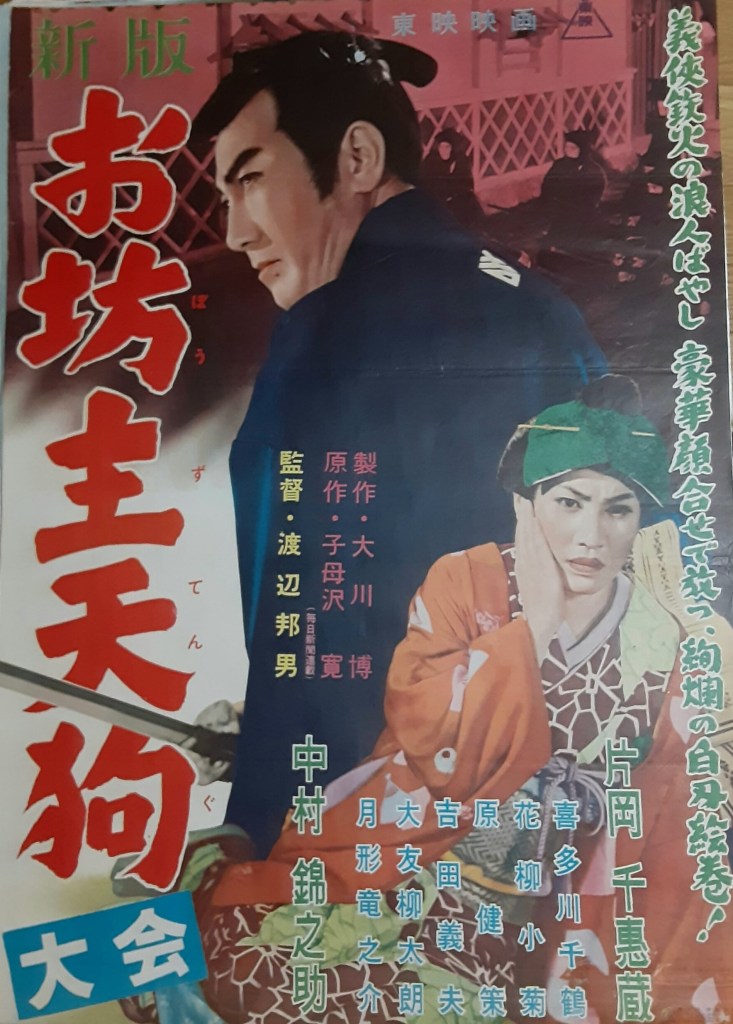
It really captures his appeal.
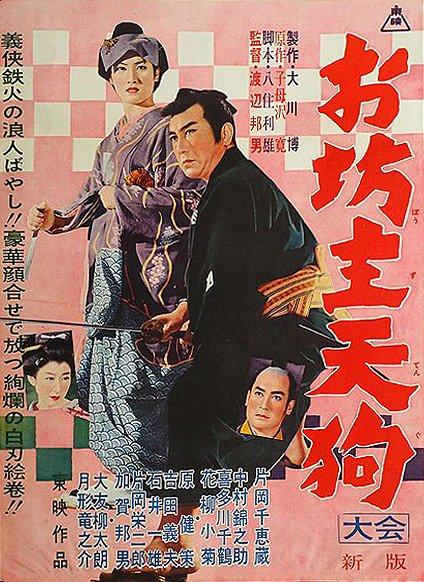
I’m not sure how or why such a dire fate befell these two movies. Sadly there are many Japanese films that share a similar tragic trajectory. A staggering percentage of Japan’s pre-war films — estimated at upwards of 90 percent— are classified as lost or no longer extant. For many years this included Hiroshi Inagaki’s 1935 – 1936 adaptation of Dai-bosatsu tōge starring Denjirō Ōkōchi. Originally released in three chapters, the entire film was believed lost for decades until a print of Part 1 was found in Russia comprising nearly 80 minutes of footage. I have seen a very brief snippet of Denjirō’s performance in this, and it looks like a vision of Hell. I can’t wait to see more.
Obōzu Tengu with English subtitles is currently on sale at Samurai DVD.
- The film is The Mysterious Cape (1963) ↩︎


Leave a Reply