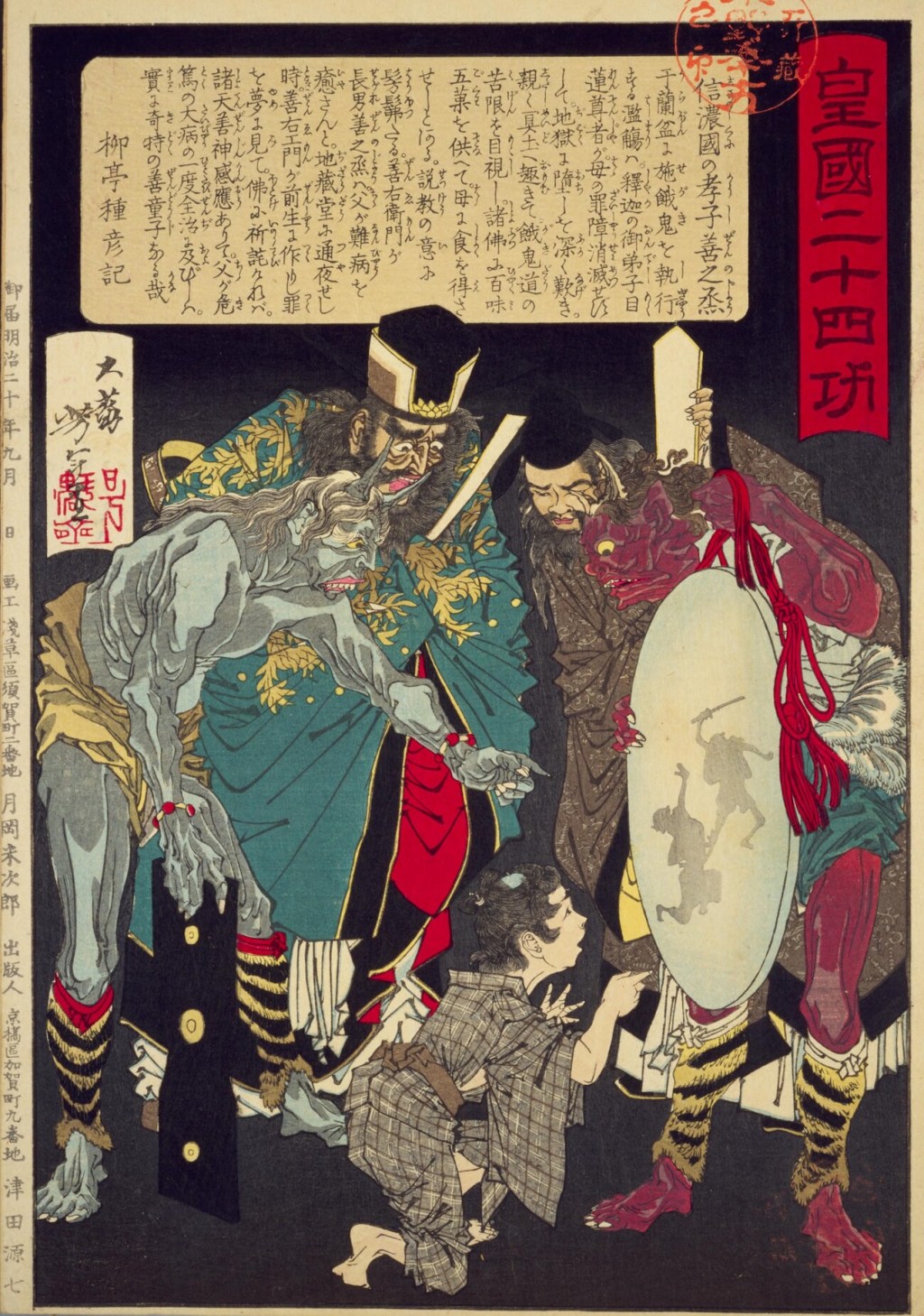
Directed by Tomu Uchida
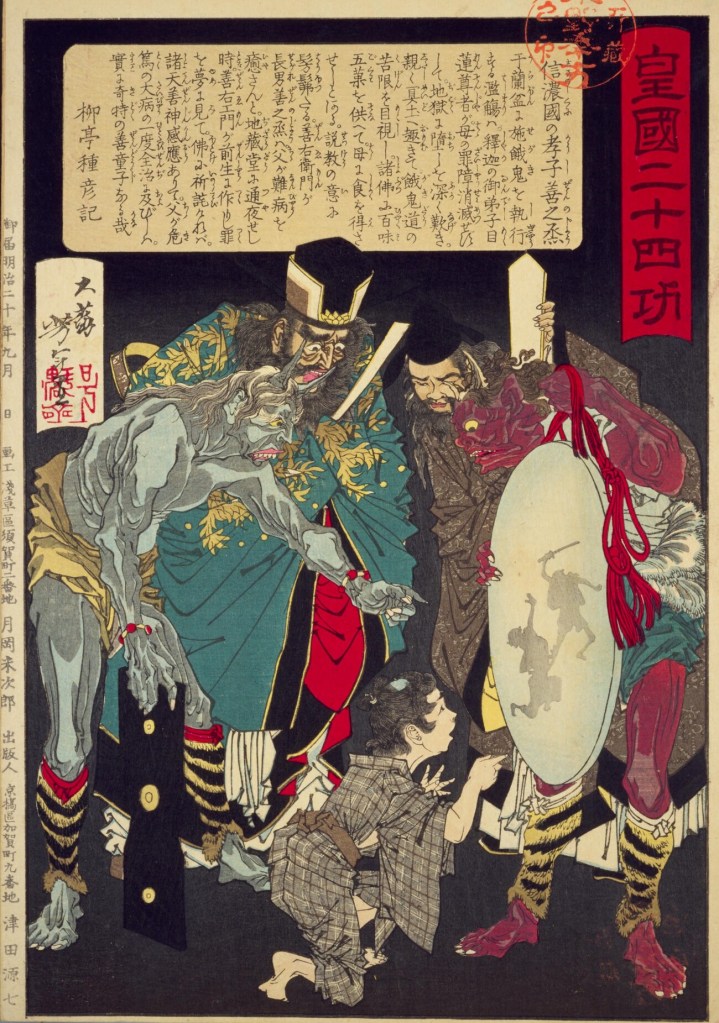
Dreams of His Father’s Crimes (1887)
From the series Twenty-Four Accomplishments in Imperial Japan.
The little boy is gazing into a magic mirror which reveals his father’s crimes. The figure in the tall hat is Enma, the Buddhist King of Hell. Enma and his demonic retinue look more compassionate than scary here.
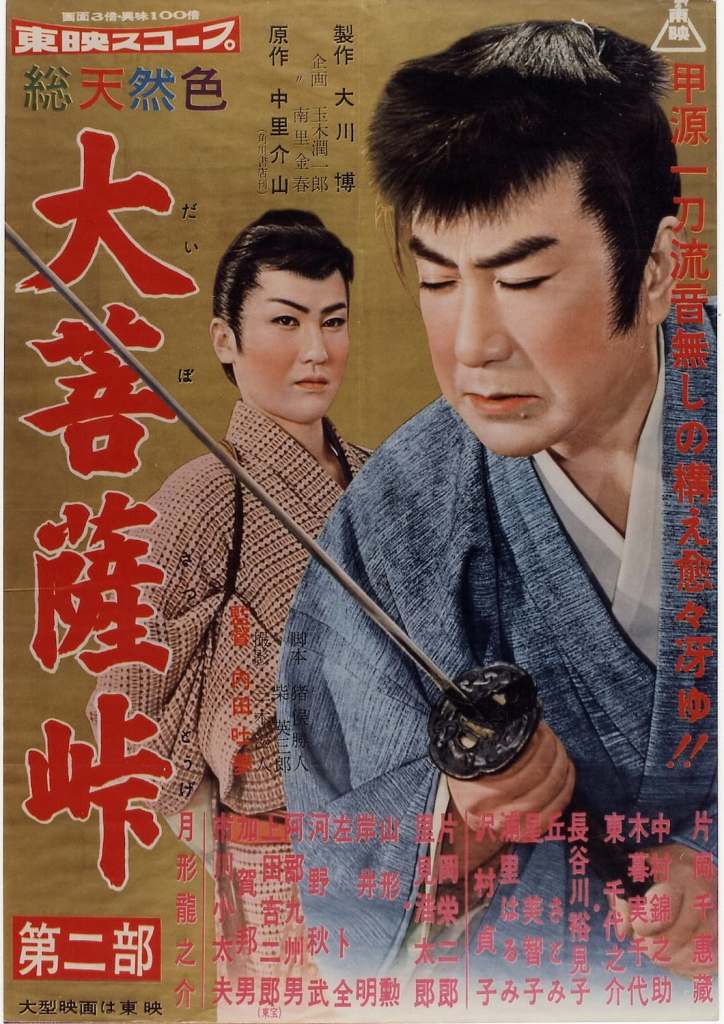
After a brief recap of Part 1 we’re back in action.
Ryūnosuke has fled to Ryūjin Village in the Kishu Domain. Otoyo finds him there at the waterfall where she has been praying. She has never stopped loving him. Otoyo attributes their reunion to divine intervention by Ryūjin, the Dragon God.
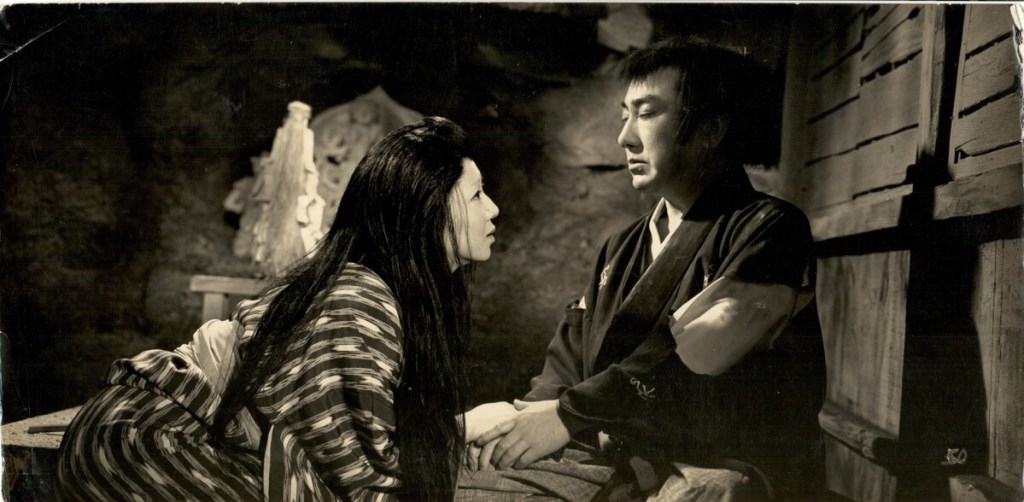
Production still from Dai-bosatsu tōge: Dainibu (1958)
Courtesy of the author’s personal collection.
Ryūnosuke warns Otoyo that it is too dangerous for her to associate with him as he is being pursued by pro-shogunate forces who are mopping up the last remnants of the Tenchugumi. Otoyo expresses concern that he is unable to care for himself in his current condition. Ryūnosuke seems less troubled by this than she does, and stoically accepts it as his fate. She pleads with Ryūnosuke to allow her to help him.
We see Otoyo carrying a bundle of supplies. She takes down a wanted poster for Ryūnosuke but is interrupted by her husband Kinzō. He accuses her of consorting with the fugitive samurai behind his back: “You’re still thinking about that rōnin!”
Kinzō beats her and pursues her throughout his house, the camera following them as he goes on the rampage. “I told you that if you betrayed me I’d kill you!” He throws a lantern at her. Otoyo takes advantage of the chaos caused by the resulting fire and escapes to Ryūnosuke’s hiding place in a hut near the waterfall. She warns him that they must flee together.
They step outside. Kinzō confronts her with a knife: “Otoyo! You can’t escape from me!”
Ryūnosuke ventilates him with his sword. Kinzō plummets to the bottom of the falls.
Maybe the Dragon God is looking out for them after all.
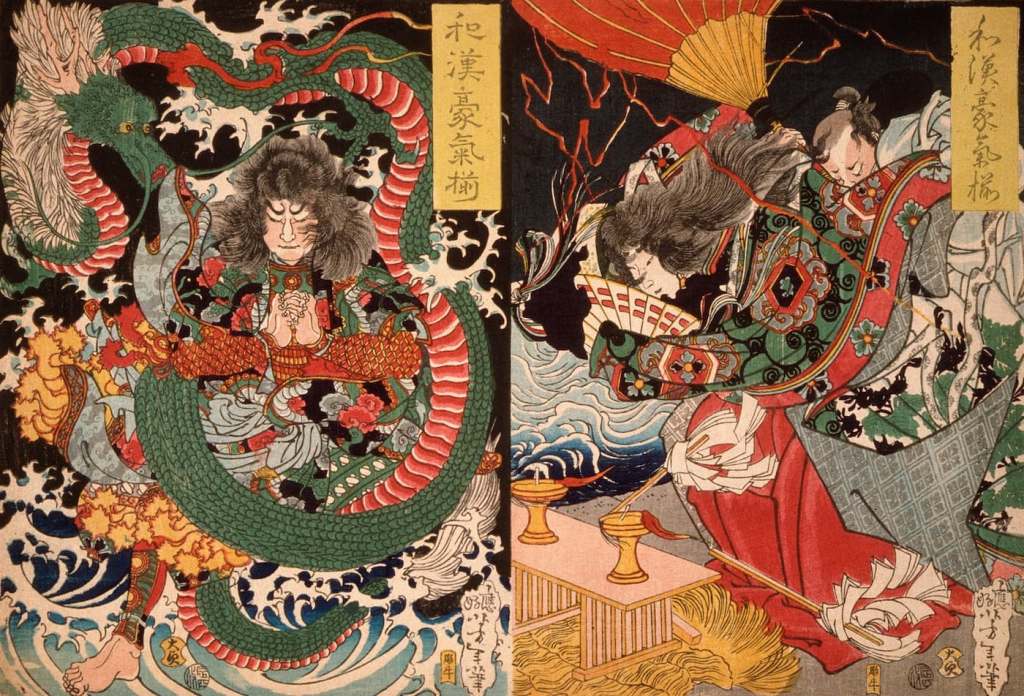
From the series Valor in China and Japan
Herbert R. Cole Collection (M.84.31.198)
Los Angeles County Museum of Art
Otoyo leads Ryūnosuke to safety as Ryūjin Village goes up in flames. This scene is beautifully shot and would make a brilliant ukiyo-e. The glow from the fire in the background illuminates the night sky as the lovers ascend into the surrounding mountains.
Lord Kamio is getting completely sloshed at a party in Furuichi in Ise, at the time Japan’s third-largest red-light district. Otoyo is now working as a maid at Bizen-ya, a brothel catering to wealthy customers. She has caught Kamio’s eye, and he demands access to her. The proprietor explains to Lord Kamio that Otoyo is only a maid and not for sale, but he might be willing to do a deal for the right customer. Kamio is willing to pay any price.
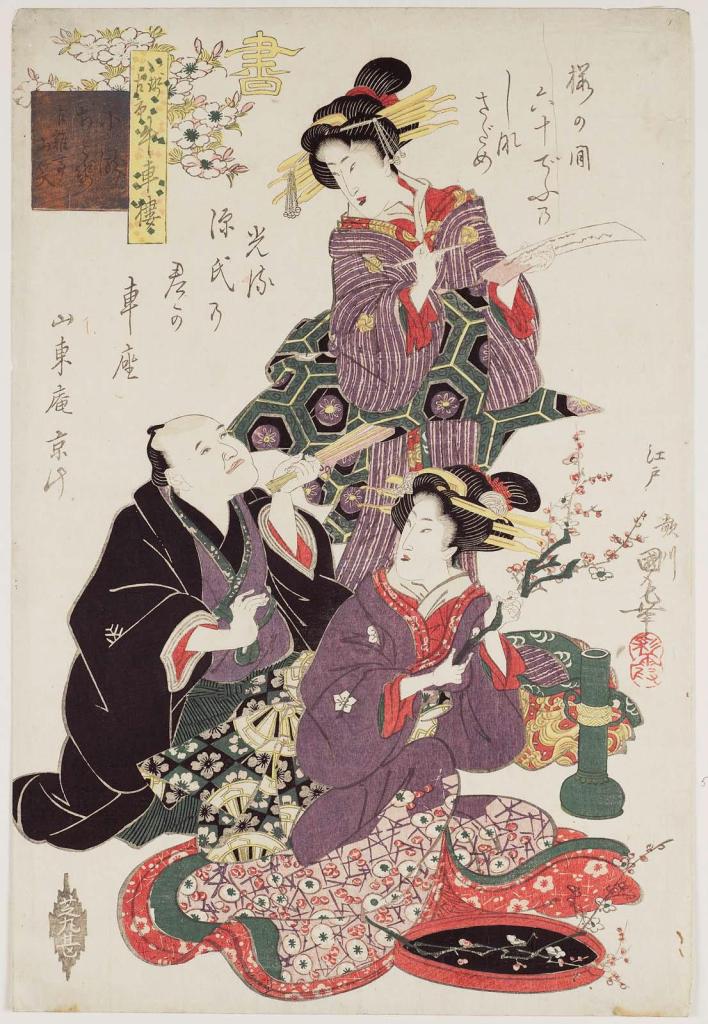
MFA Boston
Gift of Porter Sargent
Accession Number 50.2317
The Gissha-rō or Kyūsha-rō was another name for the elegant brothel known as the Bizen-ya, in the market town next to the Ise Shrine.
Otoyo appears to be ill. She is pale and has an ominous cough. The brothel owner offers to pay her 20 ryō in advance if she will agree to Lord Kamio’s proposal.
Trying to get some sense of monetary values during the late Edo period is tricky. The relative cost of labor and goods was vastly different in 1860s Japan compared to today. There is no single conversion rate, and Bakumatsu Japan had a chaotic currency situation. How much would 20 ryō be in modern terms? A rough estimate: between 100,000 and 600,000 yen, or at current JPY to USD exchange rates $632.00 to $3,795.00.1
To put this in context of the sex trade: a client’s initial visit with a top-ranked courtesan at the Yoshiwara during the Edo period was very costly, about 10 ryō including mandatory banquet fees and paying for the courtesan’s entourage and attendants. 20 ryō for a single encounter is therefore generous by the standards of the time.
Because Otoyo isn’t a prostitute, the going rate is irrelevant. Her unavailability is what Lord Kamio values. Kamio’s offer reflects his self-image as a man who can buy anything he wants. It also gives him leverage over her.
In 19th century Japan a female servant in a household or establishment typically earned about two to three ryō per annum with room and board included. A menial maid at a brothel would sit at the low end of that, so 20 ryō represents approximately seven to 10 years of Otoyo’s pay at the Bizen-ya. Otoyo has been sending her meager earnings to Ryūnosuke, who is unable to support himself due to his blindness and his status as an outlaw. She has also been funding his medical treatment.
Otoyo’s boss affects concern for her, but it’s just emotional blackmail: “Isn’t it time to send money to that samurai in Ominato?”
20 ryō is a large enough sum that refusing it feels like abandoning Ryūnosuke. This makes her choice a sacrifice, not a transaction. And sacrificing herself is exactly what it feels like as we see Otoyo walking alone towards Kamio’s suite of rooms at the Bizen-ya.
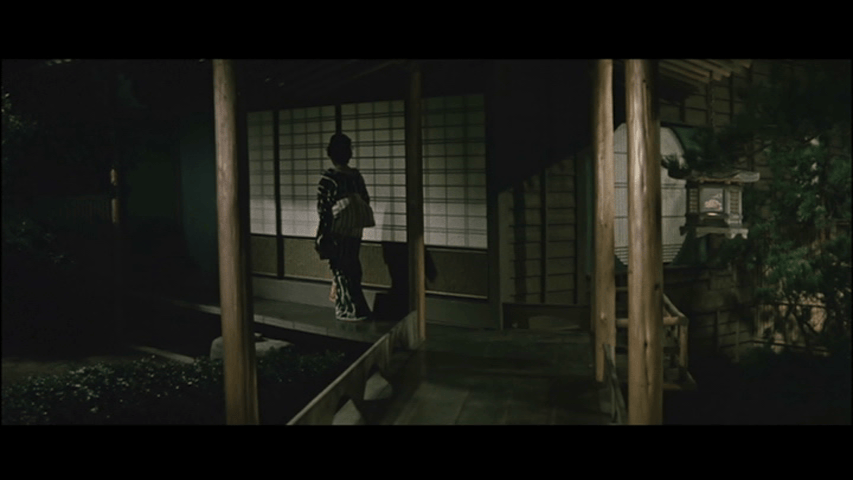
Lord Kamio rapes her. The film does not show this. Her thousand-yard stare afterwards says it all.
Otoyo places a scroll inside some paper and asks her friend Otama (Michiko Hoshi) to take it to Ominato where Ryūnosuke is staying. Otama is a travelling musician, a shamisen player. Her large black dog Muku accompanies her everywhere.
Before he leaves town Kamio wants to see Otoyo again. Her boss at the brothel sends a servant to fetch her. He returns with shocking news: Otoyo has slit her throat. They rush to her room and find her corpse lying in a pool of blood.
Otama travels to Ominato accompanied by Tomo (Kunio Kaga), an acrobat/street performer. She falls in a river and the letter Otoyo entrusted her to deliver gets wet. As the letter is hanging up to dry Tomo catches a glimpse of its contents. The letter contains a will, as well as 20 ryō and a hairpin. In her letter Otoyo bids Ryūnosuke farewell and explains that the enclosed hairpin is her gift to him. It’s a heartbreaking echo of how her relationship with Ryūnosuke began: he gave her his inrō after she had been rescued from drowning.
A gift of a hairpin in these circumstances is loaded with tragic significance. A hairpin (kanzashi) was an intimate personal item traditionally exchanged between lovers. A man courting a woman would give a hairpin to his beloved to indicate his intention to marry her. Otoyo is sending her beloved a piece of herself that her rapist Lord Kamio could not touch or conquer. The hairpin represents her devotion to Ryūnosuke even after death.
Otama arrives at the place where Ryūnosuke is staying. It looks fairly bleak and basic. He appears to be living in a storeroom in the back of a shop. Despite his prosaic surroundings the menace Ryūnosuke exudes remains undiminished: when Otama sees him she recoils. She asks the man who is taking care of the blind samurai to stay with her, but he reassures her that she’ll be fine.
She timidly approaches Ryūnosuke and holds out the letter with both hands: “This is a letter from Otoyo-san.”
He tells her that his eyes are bad and asks her to read it to him. Otama does not know how to read and has to recite the contents from memory. She begins to weep. Seeing Otoyo’s lover betray not the slightest hint of emotion, she asks him why he isn’t sad.
“What good would that do?” he replies. “Fate decides whether we live or die.”
Otama is appalled at Ryūnosuke’s coldness. “Otoyo-sama sold herself for this money.” She hands him the 20 ryō. “Then she took her own life! Until her hour of death, she was concerned about you.”
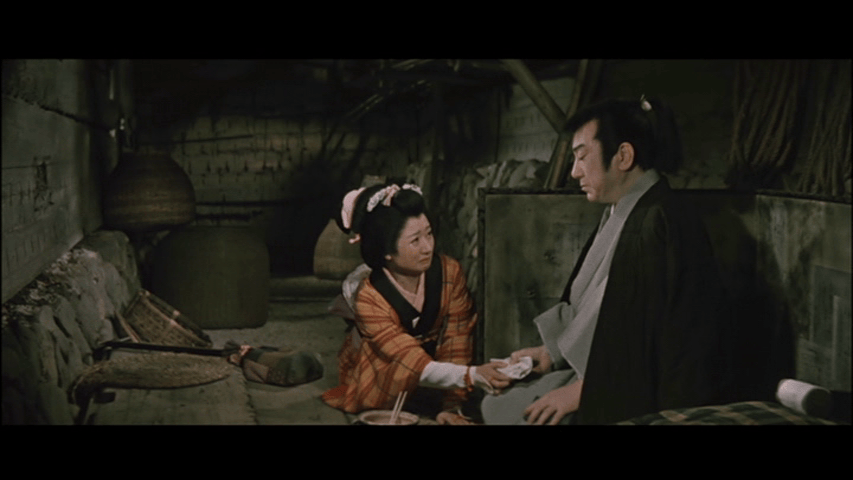
Not even this revelation can melt Ryūnosuke’s icy heart. He gives Otama the hairpin Otoyo enclosed in the letter to thank her. Instead of treating this final, sacred token from Otoyo with reverence, he treats it as currency. For him, Otoyo is gone. A hairpin is merely a piece of metal.
I’m tempted to extend grace to Ryūnosuke here and suggest that he may not be displaying remorse because he is reluctant to show vulnerability in the presence of a stranger. Yet I know that the alternative interpretation— that he doesn’t feel anything — seems more likely. It’s a hard truth to accept because this is the man Otoyo loved and for whom she sacrificed herself. She never knew the other Ryūnosuke whom we have seen, who brutally murdered the mother of his child and who leaves a trail of blood wherever he goes.
Throughout all three parts of Dai-bosatsu tōge the viewer is the only person who has anything approaching a full picture of Ryūnosuke. In the opening of the first film Uchida has Ryūnosuke turn toward the camera and lift his hat to reveal his face. He is showing us who he is. This creates an uneasy relationship between the character and the audience. While Ryūnosuke does some heroic deeds and looks cool doing them, he also engages in reprehensible acts of cruelty and random violence. What are we to do with this knowledge? Are we in collusion with him? Or do we observe him from a dispassionate distance, like some remote omniscient deity?
Ryūnosuke has recovered his vision sufficiently to leave Ominato by himself. He intends to travel by foot along the Tōkaidō Road. He is dressed as a komusō monk.
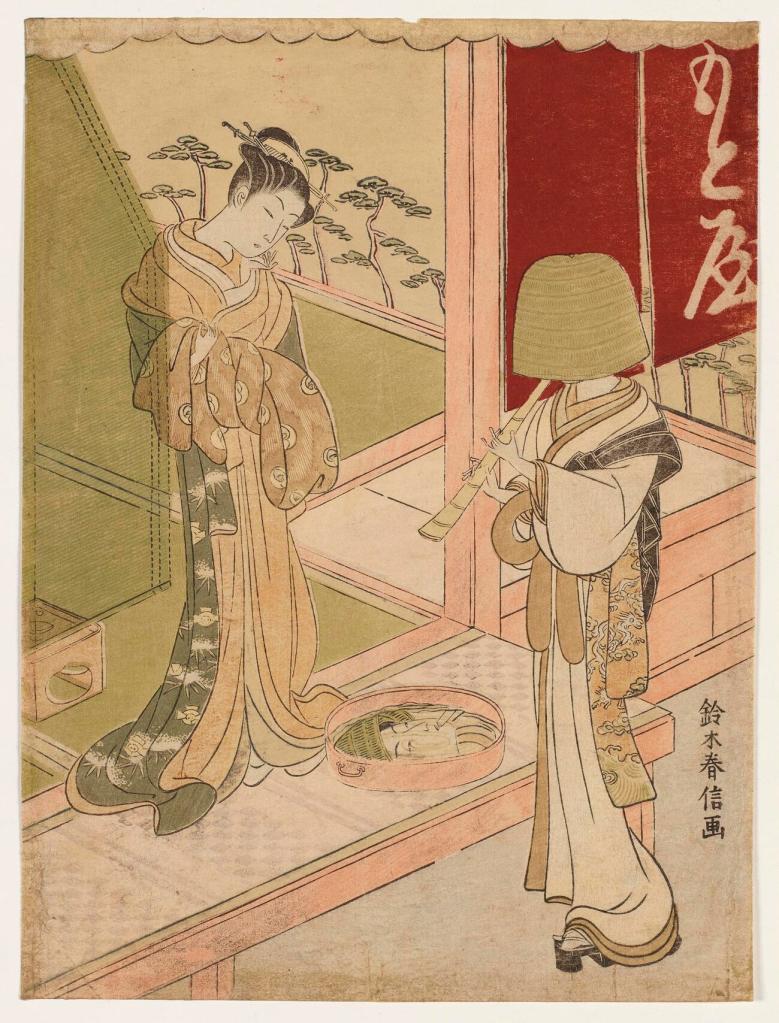
National Museum of Asian Art
Freer Gallery of Art Study Collection
https://asia-archive.si.edu/object/FSC-GR-779.113/
Don’t let that goofy hat fool you! In jidaigeki these guys are almost always rōnin, samurai, or ninja in disguise, and they will mess you up.
Otama’s dog Muku has a mind of his own. He has wandered off and taken a liking to Ryūnosuke. Ryūnosuke talks to the dog and asks him to be his guide if his eyesight deteriorates.
Ryūnosuke runs into trouble in Hamamatsu, a post town on the Tōkaidō. He stops to rest at a Shinto shrine. As he plays the shakuhachi flute a group of drunken samurai start harassing him. This is a bad move on their part for many reasons, not least of which is the fact that a shakuhachi is made of bamboo and can be used as a weapon. Plus Muku’s got his back. After Ryūnosuke finishes his impromptu ass-kicking he removes his basket hat.
Lord Kamio’s concubine Okinu has been watching the action unfold from a house across the street. She likes what she sees and invites the handsome stranger inside. Her facial expression when Ryūnosuke removes his hat is wonderful— her initial reaction is like ‘OMG, he’s blind?’ followed immediately by ‘Damn, he’s hot!’
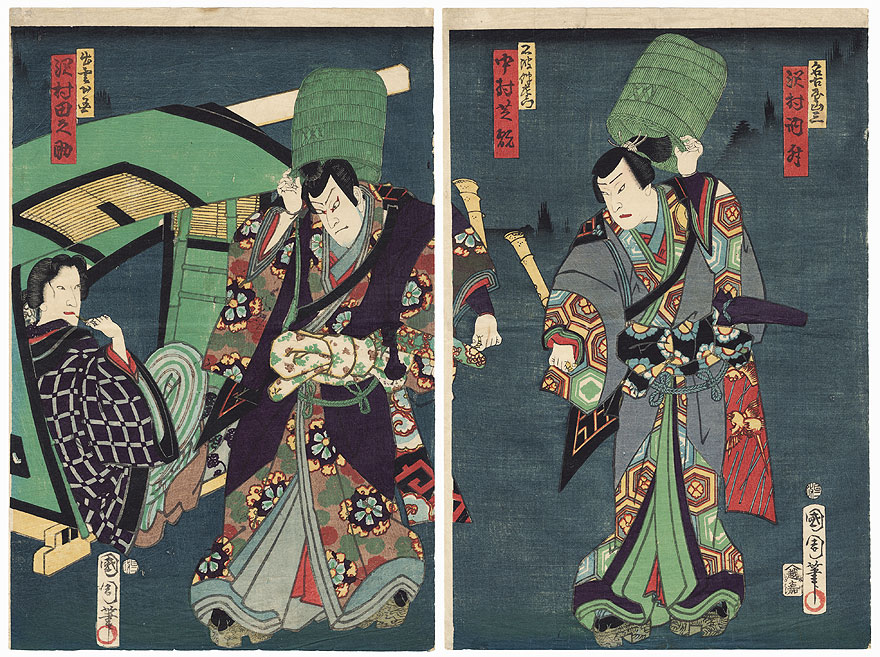
I bought this ukiyo-e because it reminded me of this scene in the movie!
Okinu tells Ryūnosuke to make himself at home. Muku waits for him outside. (Muku finds his way back to Otama the shamisen player, don’t worry.)
This particular town on the Tōkaidō appears to be infested with scoundrels. One of them is Hyaku (Akio Kono). He witnessed what happened with Ryūnosuke and plans to rob him. Hyaku has assumed that because Ryūnosuke is blind this should be an easy job despite the fact that he saw Ryūnosuke lay waste to multiple assailants wielding only a flute. Hyaku is not the sharpest knife in the drawer.
Okinu invites Ryūnosuke to accompany her on her trip to Kōfu. (It beats walking wearing a basket over your head.) They depart Hamamatsu in palanquins and stop for an overnight stay in Kakegawa in Tōtōmi Province. Hyaku follows them there and breaks into the room at an inn where Ryūnosuke is staying with Okinu. It doesn’t go well. Hyaku returns from the attempt alive but thoroughly unnerved. Shichibei is also at the inn. He’s been trailing Ryūnosuke as well and suggests a plan to dispose of the problematic samurai.
Hyaku bribes the palanquin bearers to divert Ryūnosuke’s palanquin in Kōshū in the mountains and abandon him there. Hyaku makes the mistake of turning his back on Ryūnosuke. When he turns round he sees Ryūnosuke standing and pointing his sword at him. Ryūnosuke cuts his hand off. He walks slowly up the road as the man writhes on the ground in agony.
Ryūnosuke is found unconscious in the forest by Otoku (Michiyo Kogure), a medicine peddler. She rescues him and nurses him back to health at her idyllic house in the mountains. Otoku is an attractive widow with an adorable little boy (played by Chiezō’s son Yoshiharu Ueki).
Ryūnosuke has a soft side, believe it or not. Part 1 hinted at this in the scenes depicting him at home with his baby. He plays affectionately with Otoku’s son Kuratarō, who calls him ojisan (uncle). “I feel as though I want to live out my life here,” Ryūnosuke says.
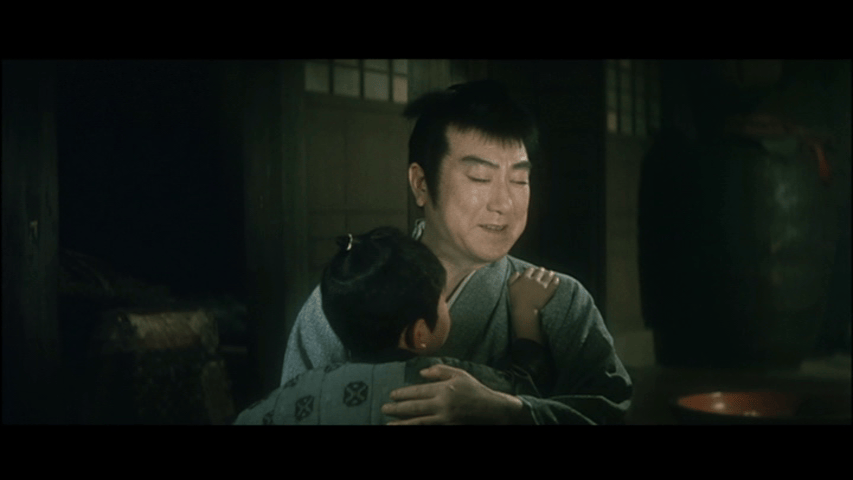
For her part Otoku seems pleased at having a man around the house again. She has no idea what sort of man he is. (Ladies, don’t take home stray samurai.)
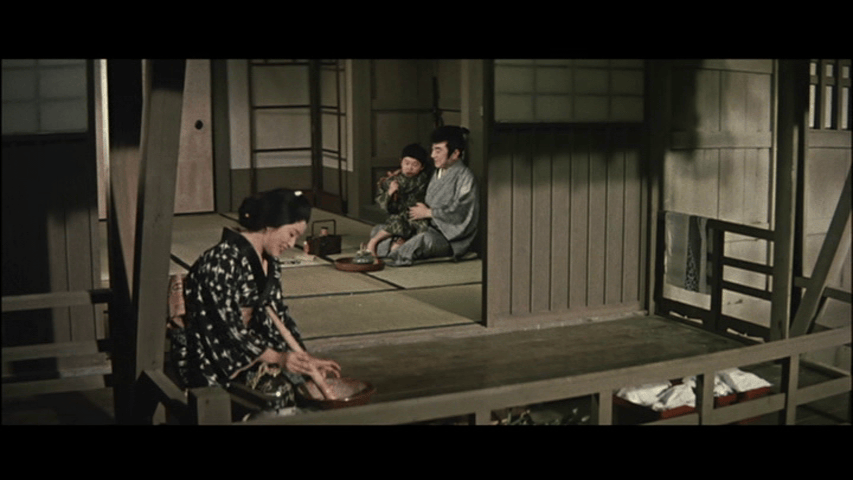
Scenes like this may seem improbable given Ryūnosuke’s violent history, but they’re actually evidence that the filmmakers know what they’re doing. Seeing how gentle Ryūnosuke is as he interacts with a child makes us care about him and shows us that he’s not an inhuman monster. It’s hard to care about what happens to a soulless killing machine.
I don’t think Uchida is trying to convince us that if only Ryūnosuke can get a handle on this pesky homicidal impulse thing he’d be a great dad. Ryūnosuke may not ever become fully domesticated, but he is capable of recognizing goodness in others. Otoku is a loving and compassionate woman. She cannot heal him; he has to do that himself. But will he?
Otoku’s mountain refuge is a place outside the cycle of violence. I believe that Ryūnosuke’s wish to stay there forever is sincere, but it comes from a man who still carries everything he’s done. Nevertheless the universe is giving Ryūnosuke a shot at redemption and something resembling a normal life.
Karma is dynamic, not written in stone. In Buddhist belief, a bad person is not condemned to do bad things forever. He has free will. Ryūnosuke can put down his sword and renounce his destructive ways. He can find peace. All of this is within his power, despite the horrors of his past crimes. Don’t fumble it, Ryūnosuke!
Even if his desire to change is real, Ryūnosuke continues to be plagued by disturbing visions. During his stay with Otoku he sees his son Ichitaro and his former servant Yohachi stacking stones in an eerie landscape.
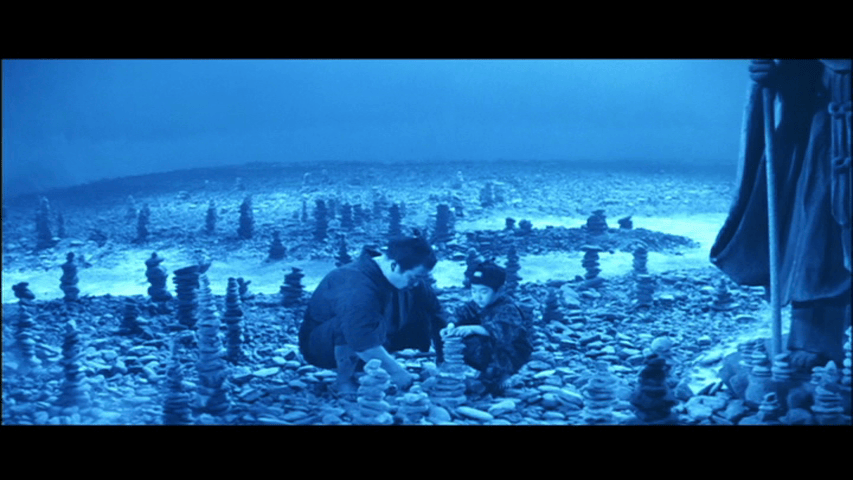
This is Sai no Kawara, the Riverbed of Souls. It is a purgatorial realm located on the banks of the Sanzu River, the Buddhist equivalent of the River Styx, which separates the world of the living from the dead.
Sai no Kawara is populated by the souls of miscarried, stillborn, or very young children. Because they died prematurely these children did not have time to accumulate good karma or perform acts of filial piety. By dying before their parents they caused immense sorrow, which was viewed as a heavy karmic debt.
To make up for this debt and earn merit for passage into the next life the children are forced to gather pebbles and stack them into small towers. They dedicate the first stone to their father, the second to their mother, and the third to their siblings. Just as the tower nears completion, demons from Hell emerge from the river and smash the stone towers with clubs, forcing the children to start all over again. When the demons attack, the bodhisattva Jizō appears to comfort the children. He wraps them in his robes to hide them from the demons and safely guides their spirits across the river into paradise.
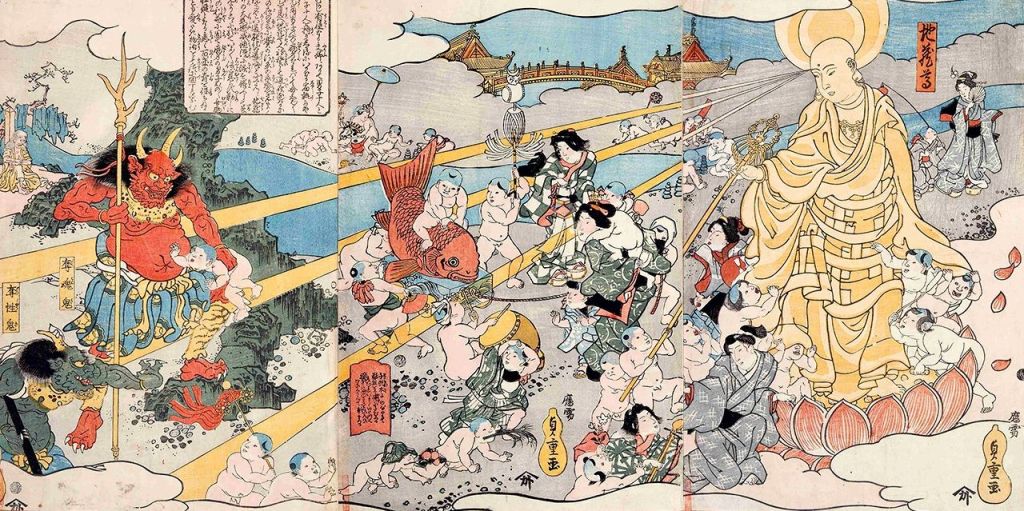
Tokyo Metropolitan Library
Ryūnosuke’s enforced separation from his son clearly weighs heavily upon his mind. As we shall learn later, Ichitaro is alive and well and not consigned to Sai no Kawara.
Ryūnosuke doesn’t have to go looking for trouble— it always finds him. The nefarious Lord Kamio is in the vicinity. He’s holding the groom (Kōtarō Satomi) for a local wedding party hostage nearby in order to extort money from the bridegroom’s wealthy family, the Mochizuki clan. Otoku and Ryūnosuke can hear the young man’s screams as he’s being beaten by Kamio’s henchmen. “Can’t we help him?” Otoku asks.
Ryūnosuke is reluctant to become involved but goes over to the neighboring house anyway. The vibe is very much that of a husband who doesn’t want to do the task his wife set for him. He is toting an enormous spear.
Kuratarō thinks this looks like fun and toddles behind Ryūnosuke. Ryūnosuke tells the boy to go back inside the house with his mom. Ojisan’s got work to do.
Ryūnosuke walks up and asks the confused samurai present if they can appraise his spear. He tells them it’s a special antique spear that is no longer made. The man in charge of torturing the bridegroom tries to get rid of this strange uninvited guest.
Ryūnosuke points the spear at his throat to focus his attention. “If you desire,” Ryūnosuke says, “I could give it to you.” He pierces the man’s throat.
Lord Kamio orders his men to kill Ryūnosuke. Ryūnosuke proves he’s as lethal with a spear as he is with his sword and cuts a swath through Kamio’s retainers. Kamio being a complete dirtbag grabs Otoku’s tiny son and threatens to kill him. Otoku begs Ryūnosuke to put down his spear. He hurls it at Kamio, narrowly missing his head.
Kamio offers to make a deal with Ryūnosuke and asks him to come to his room to talk. Otoku and Kuratarō accompany him. Kamio is impressed with Ryūnosuke’s skills and wants to take him to Kōfu as a hired assassin. Ryūnosuke is tempted. Kōfu is in Yamanashi. From there he could travel to his former home in Sawai Village and reunite with Ichitaro.
“You mustn’t go,” Otoku protests. “You said you wanted to live here quietly, didn’t you?”
Kamio threatens to have her arrested and orders Otoku not to interfere.
Ryūnosuke tells her that his heart has changed. He addresses her as ‘Otoku-dono’. This is a very formal and impersonal mode of address. His tone of voice is gentle, but the frosty honorific is the real message. He is lost to her now. All she can do is watch as Kamio hands Ryūnosuke a valuable Shinto Era sword. It’s like handing an addict a hit of heroin.
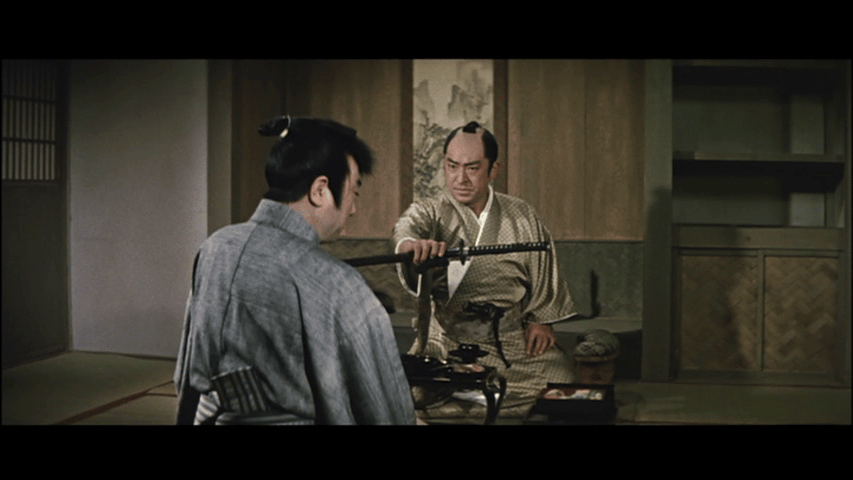
“Who am I to kill with this sword?” Ryūnosuke asks.
Kamio orders him to assassinate Komai Noto-no-kami (Chiyonosuke Azuma), Kamio’s rival who was recently elevated to a rank equivalent to daimyō. Ryūnosuke agrees without hesitating.
Ryūnosuke has just agreed to work for the man who raped his lover Otoyo. She took her own life as a result. Ryūnosuke doesn’t know that Kamio is the reason why Otoyo committed suicide. The irony is brutal.
Kamio tried to buy Otoyo with 20 ryō, and now he buys Ryūnosuke the same way. Everything’s a transaction to him. A person is something to purchase and use. Since Ryūnosuke doesn’t know that Kamio is Otoyo’s rapist, the audience carries the knowledge he lacks, and every scene between them is charged with it.
Why does Ryūnosuke want to work as a hired killer for the man who only moments before took Otoku’s small child hostage? Is it the pull of his old life? Or does Ryūnosuke feel unworthy of the peace he finally found?
What pulls Ryūnosuke away from Otoku isn’t guilt or unworthiness so much as the thing he’s best at. Ryūnosuke knows that Kamio is a despicable person, but getting paid to kill people is a deal Ryūnosuke simply can’t pass up. As he explains, it’s something he willingly does for free. His skill with violence is what he can’t put down. The moment it’s noticed, it drags him right back.
That’s the pattern that makes Uchida’s trilogy so bleak: the films keep offering Ryūnosuke grace, and he keeps failing to receive it. This last chance feels the cruelest because it’s the closest he comes to taking it. What stops him is himself. He is the agent of his own destruction. Ryūnosuke has returned to the same blood-soaked path he was on before. And that path goes only one way.
The heartbroken Otoku and her little boy are praying at a roadside grave. Hyōma approaches her. Noting the sword nearby, he asks her whom she is praying for. She tells him that she prays not for the man who was killed, but for his killer. In his innocence Kuratarō blurts out that the man his mother is praying for is his uncle, a blind samurai. Hyōma immediately recognizes that this can only refer to Ryūnosuke. He asks the boy where the blind samurai went. Kuratarō points in the direction of Lord Kamio’s party, who are en route to Kōfu.
Ryūnosuke travels in procession with Kamio and his men. The sides of his palanquin collapse to reveal a nebulous underworld. Shirō Fukai’s sinister score swells on the soundtrack. Ryūnosuke is in darkness once more.
Next Week: Ryūnosuke goes to Hell in the shattering final chapter of Dai-bosatsu tōge


Leave a Reply