Directed by Tomu Uchida
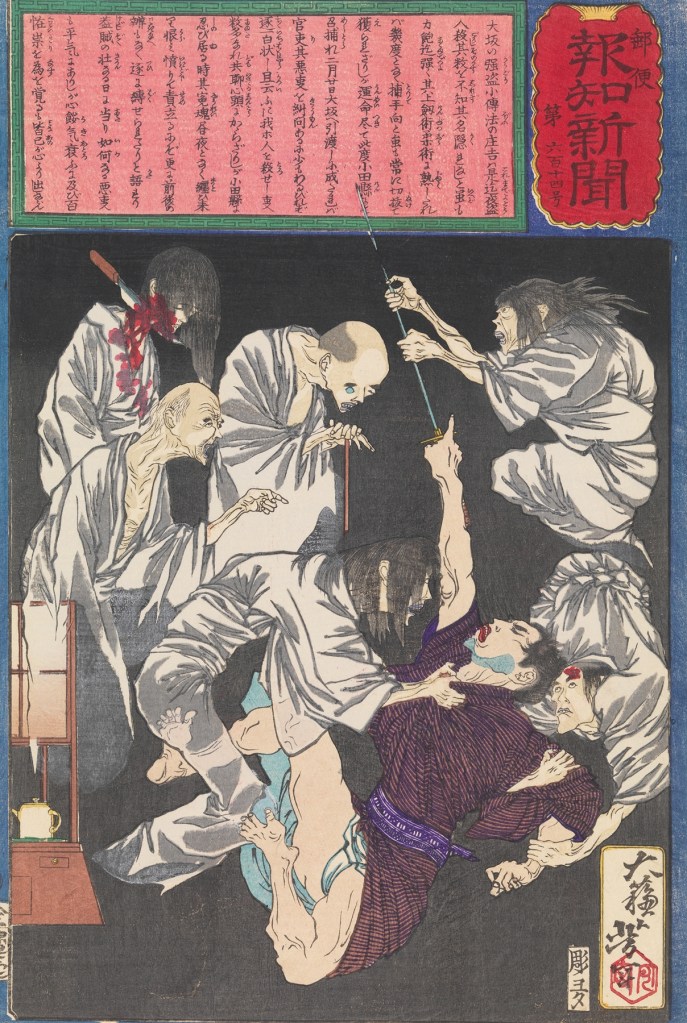
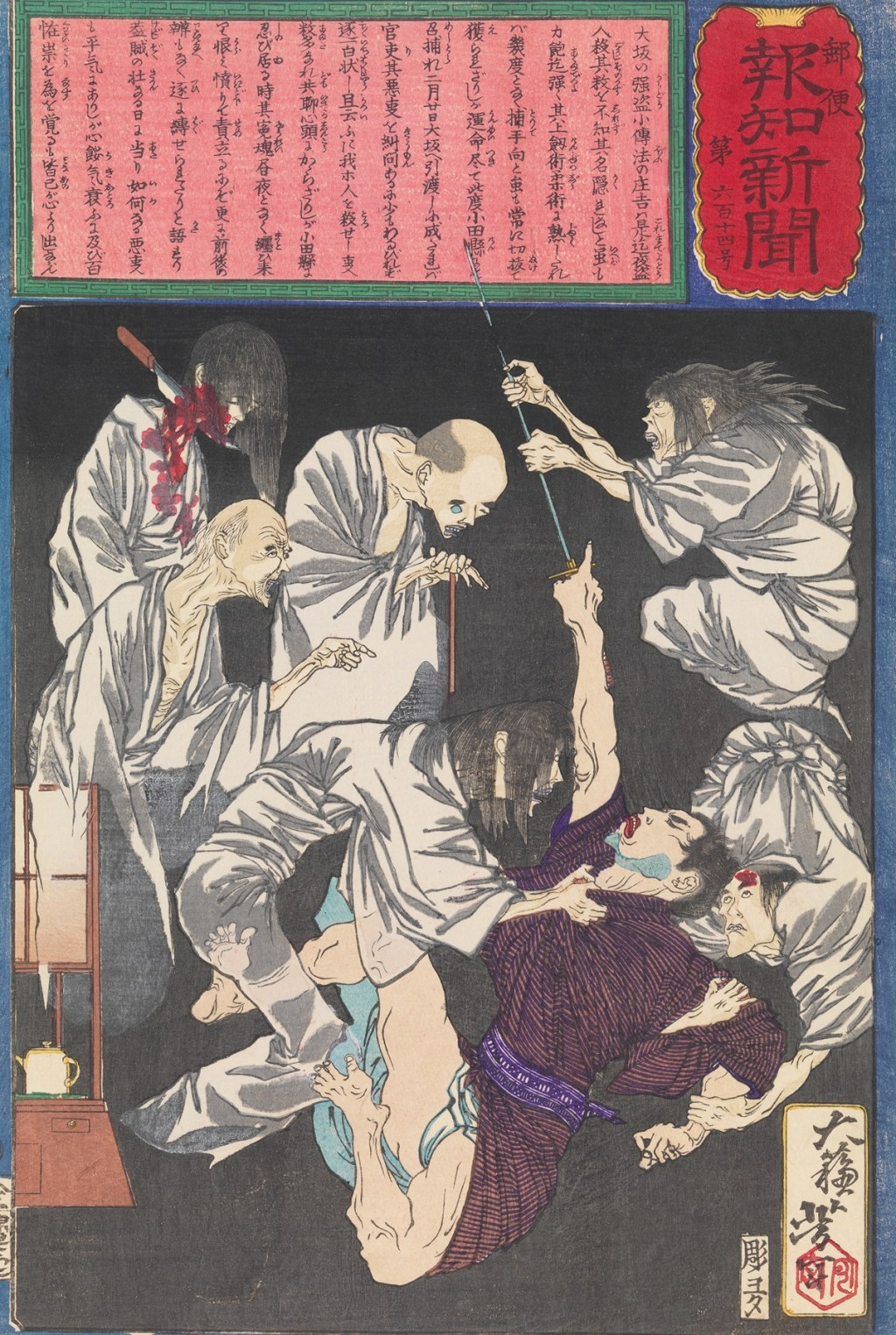
Kodembō no Shōshichi, an Osaka Thief, Tormented by Ghosts (1875)
MFA Boston
William Sturgis Bigelow Collection
Accession Number 11.37899
It is 1858. The twilight of the shogunate. In a few years the feudal world would be gone forever. In the countryside, life continues to go on virtually unchanged as it has done for centuries. We are at Dai-bosatsu Pass in Yamanashi. A man in a wide-brimmed roningasa turns to the camera and lifts his hat, revealing his face to us. In his elegant black kimono he looks out of place. He appears to be waiting for someone.
He turns to his left. Two pilgrims, an elderly man and his young granddaughter, approach a small religious shrine. They pause to admire the stunning view of Mount Fuji visible from the top of the Pass.
The old man wants to rest a while and suggests to his granddaughter that they take a break to pray at the shrine. The girl goes to fetch some water. Her grandfather rings a bell he carries with him, kneels in front of the shrine, and begins to pray. The man in the black kimono walks towards him.
“Old man,” the stranger says. The elderly man turns round and trembles to see an imposing samurai standing next to him. “Look the other way,” the samurai commands in a low growling voice.
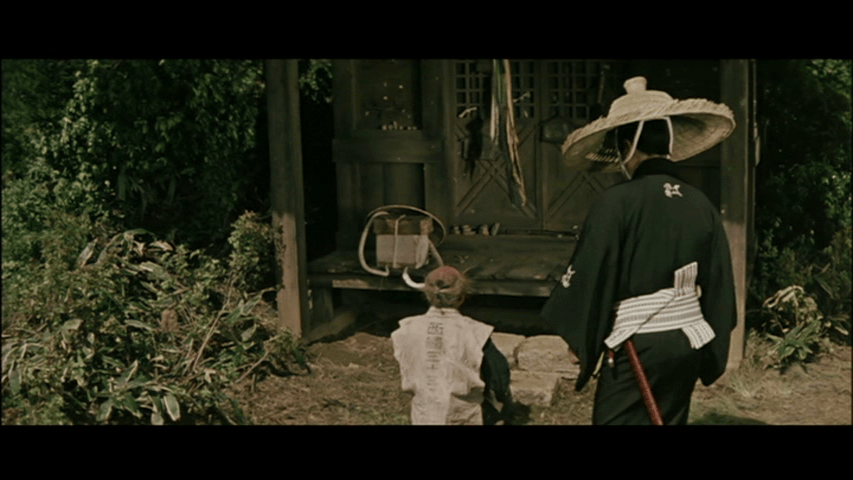
He complies. The samurai draws his sword and slashes the old man from behind, killing him instantly. Then, just as mysteriously as he arrived, the samurai vanishes.
The young girl returns to the shrine to find her grandfather dead. Another traveller arrives on the scene. Noting that the elderly man has been murdered, he looks around to find his assailant. In the distance he sees a black-clad figure wearing a straw hat walking away from Dai-bosatsu Pass.
Sawai Village, Musashi Province. Night has fallen at Tsukue Fencing Hall. The elderly master of the dōjō (Kinnosuke Takamatsu) is an invalid. His son appears. He is the killer in the black silk kimono and Hakata-ori obi whom we saw at Dai-bosatsu Pass.
His father is angry with him. “Ryūnosuke, where did you go?”
Ryūnosuke refuses to answer. He stares at him, his face pale and expressionless.
Ryūnosuke’s father reminds him that he has an important fencing match tomorrow, the Mount Mitake Shrine Match. He warns Ryūnosuke that his fencing skills are deteriorating. “If you, my heir, are this way, what will happen to the Tsukue Dōjō?”
Ryūnosuke dismisses his father’s concerns. “Fencing is not to be taught or learned.”
The old man can’t believe what he’s hearing. “Ryūnosuke! Has your pride fallen that low?” He’s so upset he suffers a coughing fit.
You might interpret Ryūnosuke’s sullen attitude as ordinary rudeness, or as evidence that he was a spoiled child who grew up to become an arrogant adult. For East Asian cultures that place a high value upon filial piety, however, his behavior is a major red flag: it reveals that Ryūnosuke cannot or will not adhere to the most basic organizing principle of society.
A servant informs Ryūnosuke that the sister of Utsugi Bunnujō, the man whom he will face at tomorrow’s match, has arrived at the house and wishes to speak with him.
Ohama (Yumiko Hasegawa) is stylishly dressed. She’s not shy either and gets right to the point: “My request is about tomorrow’s match.” She is worried that Bunnujō will lose the fencing match, which would have disastrous consequences for his career. Ohama is actually Bunnujō’s wife, and she has come here without her husband’s knowledge to ask Ryūnosuke to call off the match.
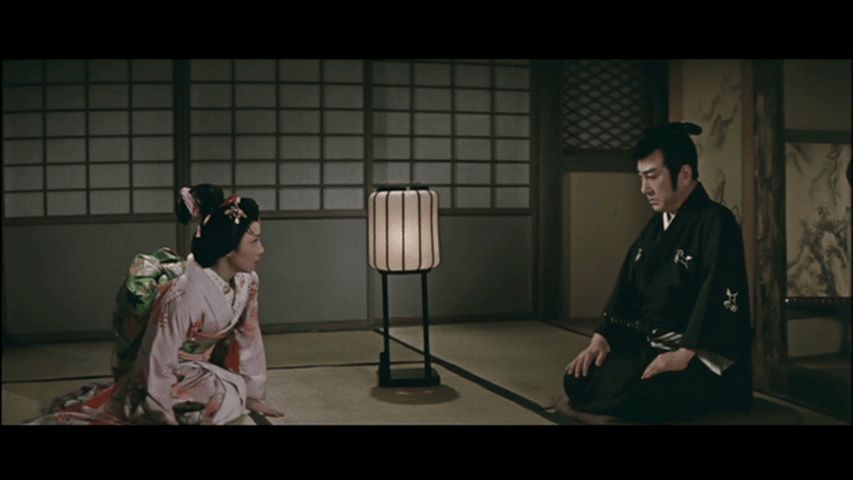
Ryūnosuke refuses. She pleads with him. He remains unyielding. He explains that a fencing match is as non-negotiable for him as a woman’s chastity is for her.
“But what if lives were at stake?” she asks.
“Would a woman be willing to go that far?” He gives her a searching look and leaves.
Yohachi (Akira Kishii), a peasant who grew up on the Tsukue estate, works inside a dilapidated water mill. He carves a small statue of the bodhisattva Jizō.
Ryūnosuke enters. He is wearing a Sōjūrō-zukin, a black hood which gives him a sinister appearance. He sits down and asks Yohachi to come nearer. He leans close to him and whispers something we cannot hear that leaves Yohachi so frightened he can hardly speak. He doesn’t want to do whatever it is Ryūnosuke ordered him to do.
Yohachi accosts Ohama on the road during her return home and, begging the gods to forgive him, abducts her. Yohachi is big and strong, so there’s no way she can resist.
Inside the watermill Ryūnosuke removes a gag tied round Ohama’s mouth. She is bound with ropes, but her fury is free of all constraint.
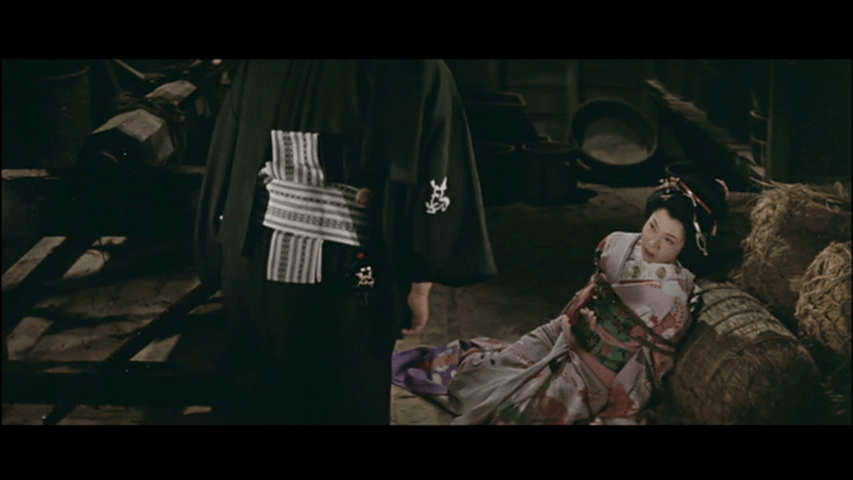
“This is outrageous! What do you plan to do with me? I’m Bunnujō’s wife!”
“I know who you are. That’s why I did this.” His demeanor is cold as ice.
“Coward! You plan to violate his wife before the match!”
“That’s not what I intend to do,” Ryūnosuke says, drawing nearer. “I want to know what was in your heart.”
She looks terrified. “What was in my heart?”
“A samurai’s fencing match and a woman’s chastity,” he says. “I want to know the answer.”
She looks up at him. The film cuts to Yohachi outside the watermill. He is crying.
Inside the mill Ryūnosuke stands over Ohama. She is still tied up. She has a dazed expression. It is not clear what has happened between them, but my guess is it’s nothing good. Ryūnosuke speaks to her: “Unravel this mystery before the drum sounds the start of the matches tomorrow morning.” He leaves. Ohama sobs uncontrollably.
The elliptical nature of this scene raises troubling questions. Is Ryūnosuke a rapist in addition to being a cold-blooded killer? In Kenji Misumi’s Satan’s Sword and Kihachi Okamoto’s The Sword of Doom matters are far more straightforward. Those films were made in the 1960s. If Uchida had wanted to depict Ryūnosuke violating Ohama, the ultra-conservative nature of the 1950s Japanese film industry would have prohibited it. In Japanese films of this period it’s a huge deal if a man and a woman hold hands. Explicit scenes of sexual violence would not be possible.
It strikes me as highly unlikely that Toei, one of Japan’s major studios then known as a producer of family-friendly entertainment, would have cast an icon like Chiezō Kataoka as a rapist in 1957. While this doesn’t exclude the possibility that Ryūnosuke sexually assaults Ohama, the scene is shot in such an ambiguous way that we simply don’t know what he did to her and are left to draw our own disturbing conclusions. This uncertainty casts a long shadow over Ryūnosuke’s relationships with women throughout the rest of the trilogy.

Promotional image from Dai-bosatsu tōge (1957) originally featured in the August 1957 issue of Kindai Eiga, courtesy of the author’s personal collection.
Image is in the public domain.
The caption on the left of the image can be translated as ‘Fated Love’.
Irrespective whether Ryūnosuke raped Ohama or not, by keeping her captive in the mill overnight Ryūnosuke effectively destroyed Ohama’s reputation and her marriage in one stroke. In the Edo period a married woman spending a night with another man regardless of the circumstances was a cause for scandal and grounds for divorce.
On his way back from the watermill Ryūnosuke encounters a traveller, the man who witnessed the murder at Dai-bosatsu Pass in the opening scene. He is Shichibei (Ryūnosuke Tsukigata). Shichibei seems to be in a hurry and is rushing the opposite direction of Ryūnosuke’s house. Ryūnosuke suspects something is up and tries to attack him, but Shichibei is too quick for him and gets away.
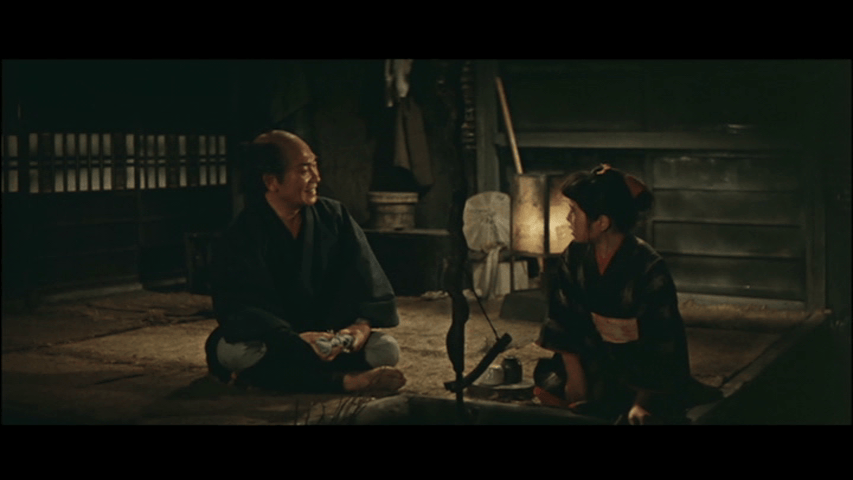
Shichibei is one of those clever kind-hearted thieves whom we meet in period dramas. He has been looking after Omatsu, the granddaughter of the old man whom Ryūnosuke murdered. He plans to take her to Edo where her aunt lives.
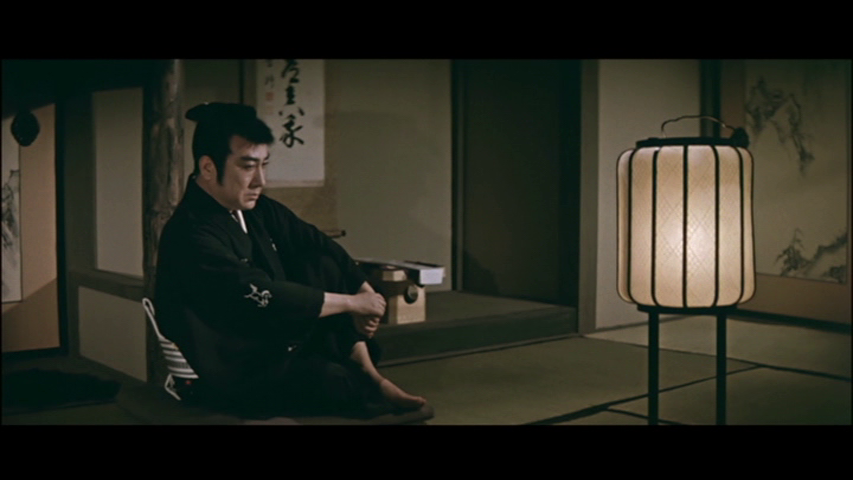
Ryūnosuke returns home. His servants inform him of a burglary. He seems completely unfazed by this, but then again he seems unfazed by everything. Not quite everything: as he sits in his room we hear him murmur Ohama’s name.
The film crosscuts between shots of a pensive Ryūnosuke and Ohama, who has returned to her house. When a film cuts back and forth between two characters, it establishes that their paths are bound to collide. In this particular case the collision is a train wreck waiting to happen.
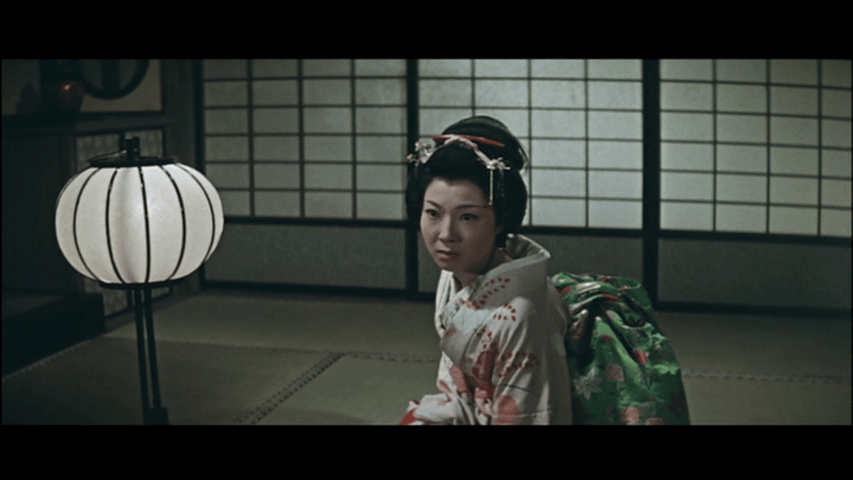
Her furious husband Bunnujō (Susumu Namishima) enters and throws a letter of divorce at her. “At dawn, go back to your village!”
When Ohama asks why, Bunnujō informs her that one of his men saw her at the Tsukue dōjō. “How can I face my opponent knowing that he violated my wife?”
Ohama protests that what he says isn’t true. She explains that she went to Ryūnosuke’s house to ask him to cancel the match because she knew Bunnujō would lose to him. This only pisses her husband off even more, and he departs in a rage. (Yes, this man is angrier about his wife implying he’s not a great fencer than the possibility that she was raped.)
Drums sound. The day of the fencing match has arrived.
As Ryūnosuke approaches Mount Mitake Shrine Yohachi runs up to him and hands him a letter which he says he was asked to deliver to him. It is the letter of divorce Bunnujō gave to his wife.
The match begins.
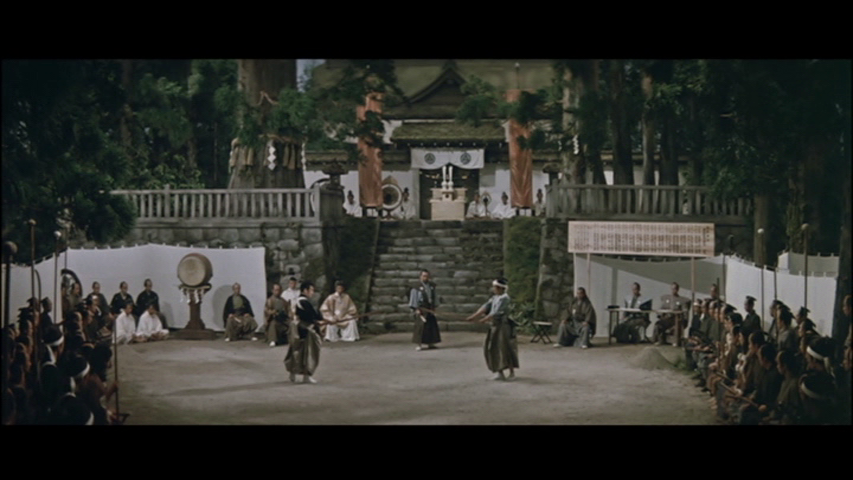
Ryūnosuke adopts his signature ‘silent stance’ otonashi.
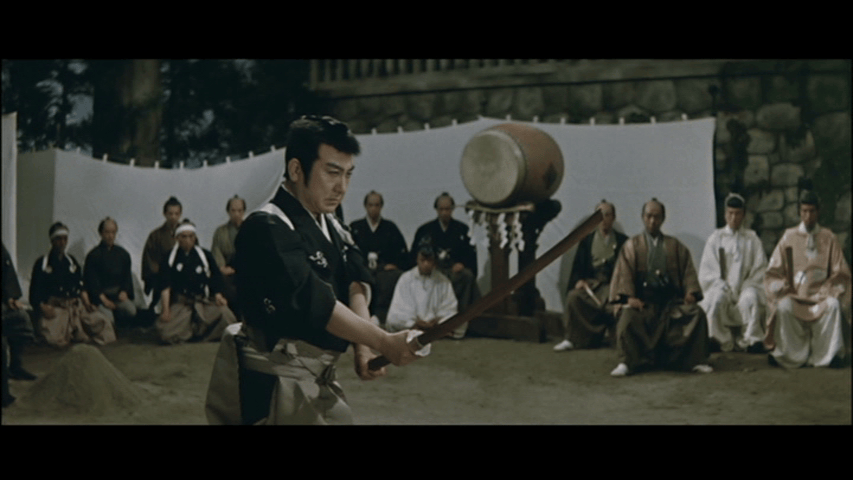
He lowers his sword and waits for his opponent to make the first move. His opponent becomes unnerved by this. Ryūnosuke then annihilates him. As this is a fencing match with bokken wooden swords and not a duel to the death using real swords, killing his opponent is unnecessary. Bokken are still dangerous, however, and the blunt force impact from one can be lethal.
Bunnujō goes on the offense. At the same instant the referee calls out for the match to stop, Ryūnosuke delivers a swift and fatal blow, striking his opponent full force underneath his jaw. The referee calls it: the match is a draw.
Ryūnosuke is outraged. He insists that he won and demands a rematch. The referee refuses. He demands to fight the referee. He is warned to stand down. Bunnujō dies from his injuries. Ryūnosuke leaves.
Ryūnosuke encounters Ohama in a clearing in a dark misty forest. She informs him that her late husband’s friends from his dōjō are planning to ambush him. He regards her with suspicion. “Am I not your sworn enemy for killing your husband?”
“I am no longer Utsugi’s wife,” she replies. She quotes Ryūnosuke’s own words that he said to her at the watermill: “A samurai’s match and a woman’s chastity.”
Ohama kneels beside him. Ryūnosuke warns her that it’s too dangerous for her to remain out in the open like this and urges her to hide. Ohama panics. She grabs his leg and begs him to flee. If he refuses to leave, she pleads with him to kill her.
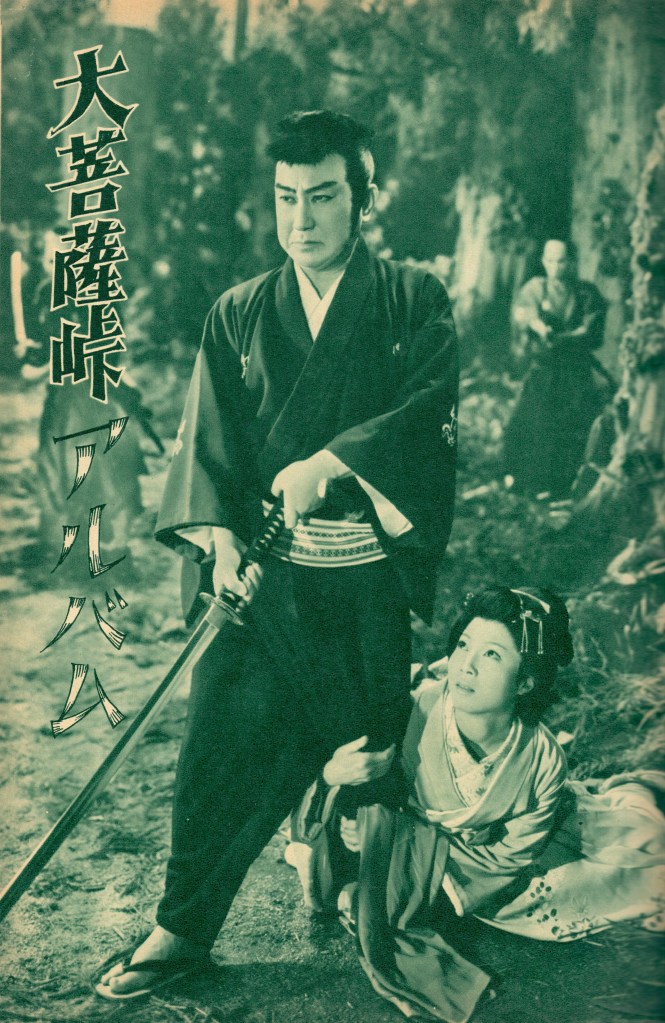
Ryūnosuke looks up and sees that they are now surrounded by samurai from Utsugi’s dōjō. The first of them attacks; Ryūnosuke cuts him down. Ohama clings to his leg in terror. He tells her to let go of him. “You tricked me!” he snarls.
Ohama denies this and begs him to take her with him, wherever that may be. Thus far Ryūnosuke has managed to kill three of these dudes without being able to freely move his legs. He dispatches the rest and flees into the darkness with Ohama at his side.
Shichibei has brought Omatsu to Edo to the shop that her aunt owns. Her aunt is not a good person and denies any knowledge of having a niece named Omatsu. The other customers in the shop are observing this drama unfold including an elegant lady (Harumi Urazato) who appears concerned by what’s going on. The aunt tells the shop clerk with whom she is having an adulterous affair to give Shichibei and the girl some money to make them go away.
Shichibei plays it just right and addresses the man loudly enough so that everyone in the shop can hear. He explains that he didn’t come here to ask for money. He is trying to help the shop owner’s orphaned niece, who is going through a hard time. He hands the money back to the clerk and leaves with Omatsu.
Okinu, the chic customer from the shop, invites Shichibei and Omatsu to her home. She offers to take Omatsu in. Omatsu can live there while working as a domestic servant. While this seems like an altruistic gesture, Okinu is actually looking for young girls to recruit as victims for her patron Lord Kamio, a depraved hatamoto.
We find Ryūnosuke living with Ohama in Edo. They have a baby now, a boy named Ichitaro. Their situation is far from happy, however.
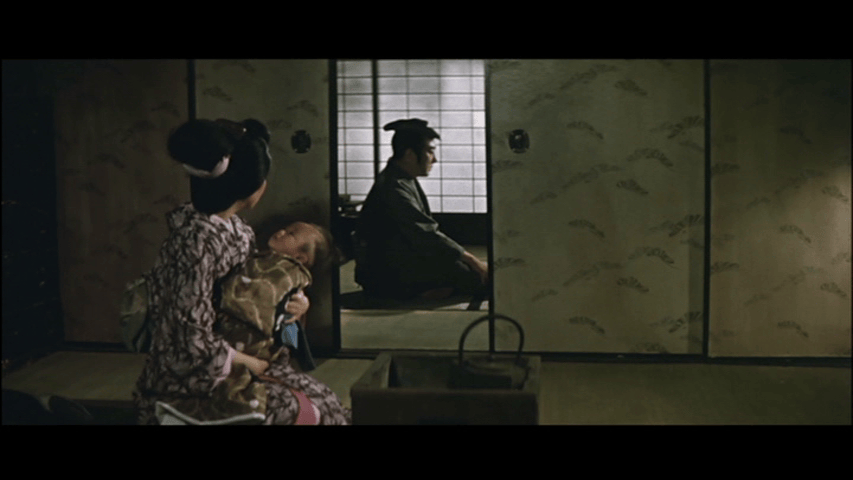
Ryūnosuke has recurring nightmares about what happened at Dai-bosatsu Pass. He and Ohama are not getting along. They quarrel over money. As a fugitive from justice he’s no longer an aristocratic samurai but an impoverished rōnin. Ryūnosuke doesn’t have a job and doesn’t appear motivated to find one. Instead he’s joined the Shinchōgumi, the Edo equivalent of the Shinsengumi.
Ohama treats him with contempt. She calls him a hired killer. Ryūnosuke walks out to avoid having to listen to his wife. It looks as if he does this on a regular basis. The only surprising thing about this grim scenario is that Ryūnosuke is good with the baby.
Ryūnosuke goes for a walk and passes a busy dōjō. He looks inside the window to watch the fencers train. He is impressed with a fresh-faced young man who is clearly talented. Hyōma (Nakamura Kinnosuke) is the younger brother of Ohama’s husband whom Ryūnosuke killed at Mount Mitake Shrine. Ryūnosuke is unaware of this connection. He requests a match with the lad using an assumed name, Yoshida Ryūtaro.
Shimada Toranosuke, the master of the dōjō, agrees to grant Ryūnosuke’s request. Who better to play this great swordsman than Denjirō Ōkōchi?
Ryūnosuke selects a bokken and faces off against Hyōma under Shimada’s watchful eye.
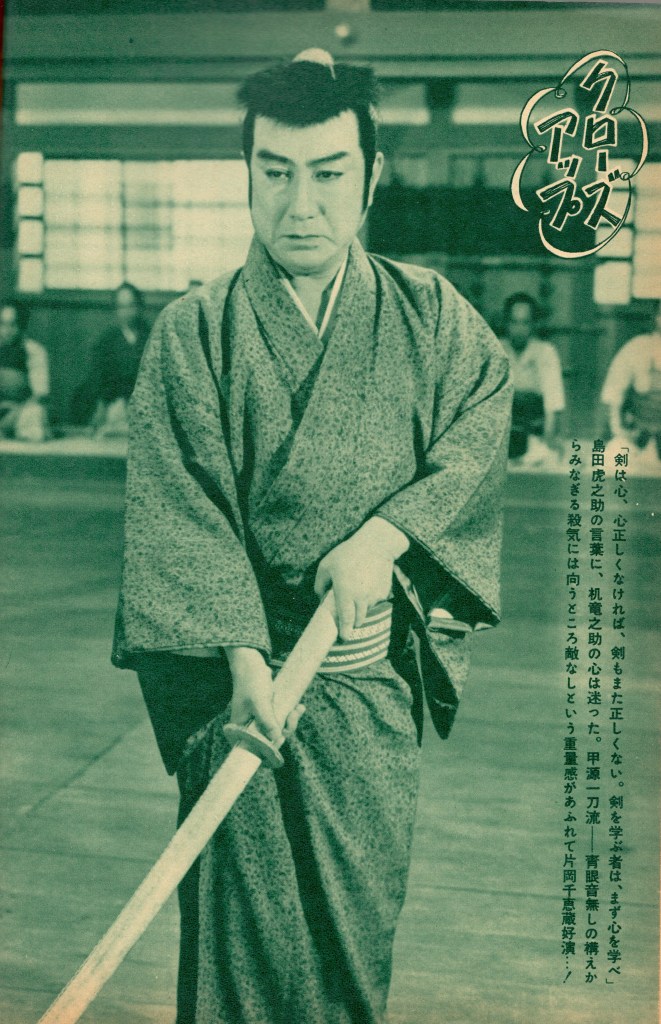
August 1957 issue of Kindai Eiga
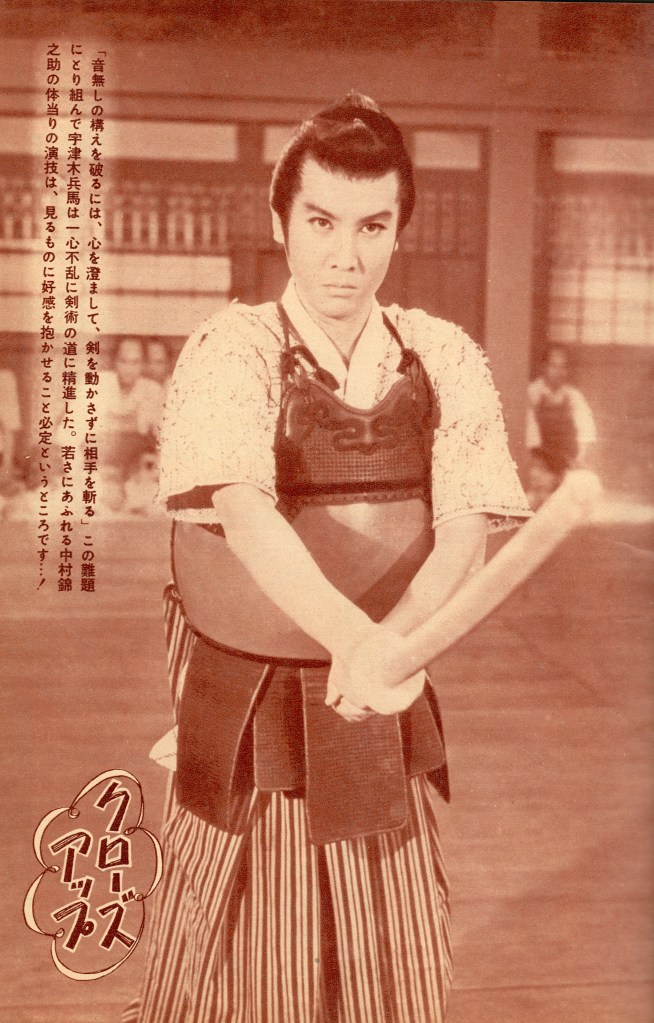
August 1957 issue of Kindai Eiga
Chiezō cuts such an intimidating figure that I feel scared for Kinnosuke. He looks so young and innocent here. This represents a brilliant bit of meta-casting by Toei and Tomu Uchida. Chiezō’s imposing presence and flat affect make Ryūnosuke look like an indestructible demon. How can this kid possibly defeat him?
Shimada notes the samurai’s otonashi stance.
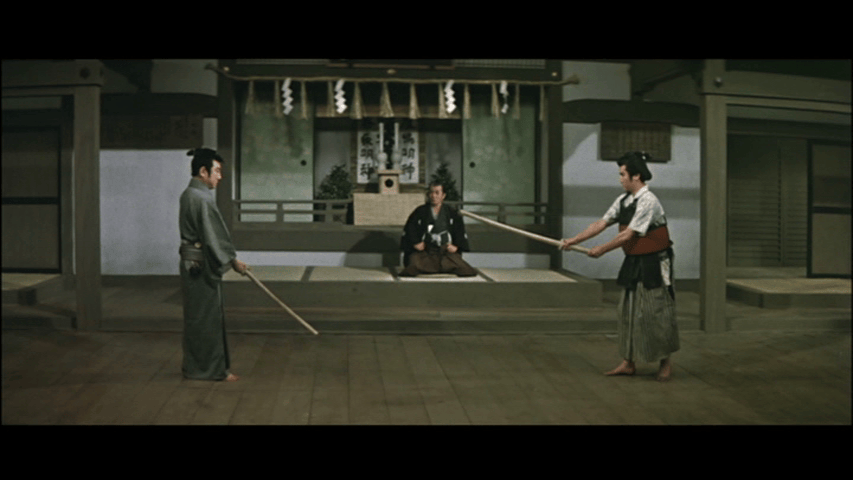
Hyōma makes his move. Ryūnosuke is poised to strike. It’s a replay of the Mount Mitake Shrine match.
Shimada shouts “WAIT!” Everything stops. Hyōma drops his weapon to the floor, approaches Shimada, and kneels before him.
“Shimada-sensei,” Ryūnosuke says, “I would like to request a match.”
Shimada looks at him and does not respond. Ryūnosuke repeats his request. He never has to ask for anything twice, so he must feel humiliated right now. Shimada ignores him and leaves the room. Hyōma follows the dōjō master to a private room. The young man is flustered and ashamed at what just happened. He thinks he screwed up.
Shimada speaks to him calmly. “Hyōma, had I not stopped it, you would have been killed.” He advises Hyōma to proceed with caution.
Okinu prepares Omatsu for her meeting with Lord Kamio. Some time has passed since we last saw Omatsu because she now appears to be in her late teens and is portrayed by a different actress, Satomi Oka. She is reluctant to be Kamio’s plaything for the evening. Okinu uses her charm to cajole and pressure the girl to cooperate.
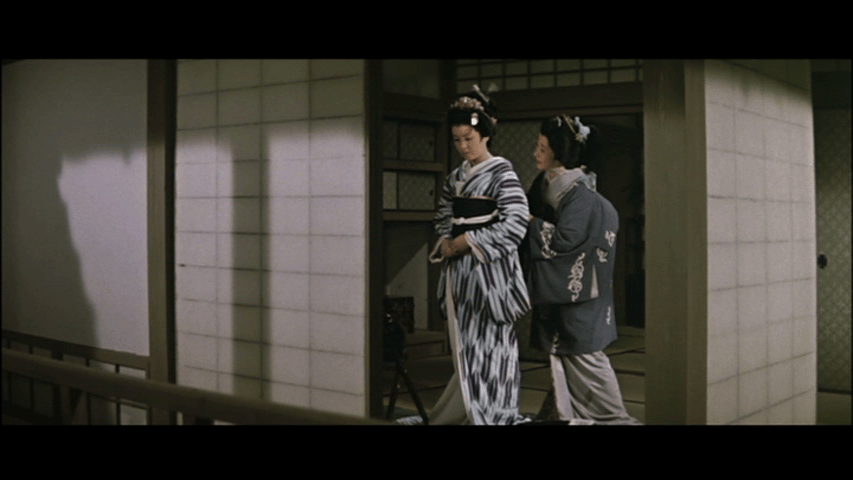
Omatsu (Satomi Oka)
Lord Kamio (Isao Yamagata) is drunk. He is seated at the head of an array of beautiful young women. Cards are laid out in front of them.
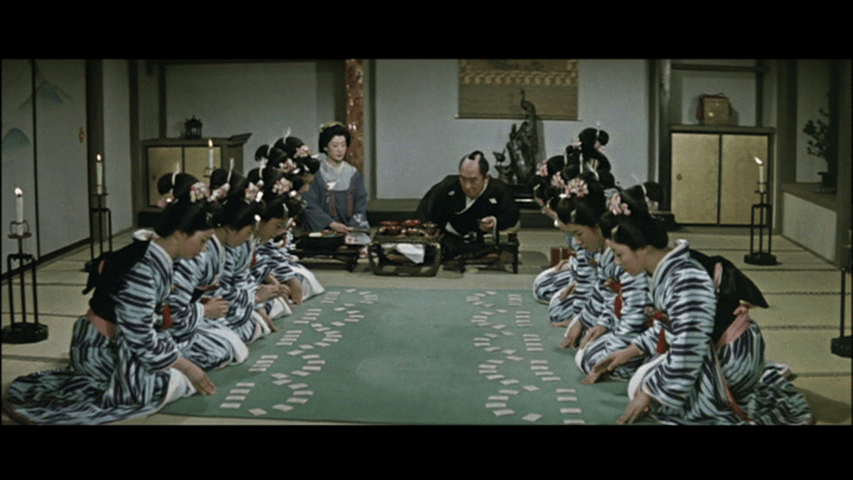
Kamio likes to play his own twisted variation on the traditional card game karuta: the losers have to take off their clothes. Shichibei has been monitoring Omatsu’s situation and is disturbed by what he finds. He makes a racket outside Lord Kamio’s estate to distract him long enough to allow Omatsu to escape.
Ryūnosuke is summoned to carry out a hit for the Shinchōgumi. It’s a cold snowy night. Ryūnosuke and a group of samurai ambush a palanquin in the streets. The Shinchōgumi’s intel is trash because the man inside it is not their intended target: it’s Shimada Toranosuke.
Denjirō explodes out of the palanquin like a tiger escaping its cage. He kicks EVERYBODY’S ass.
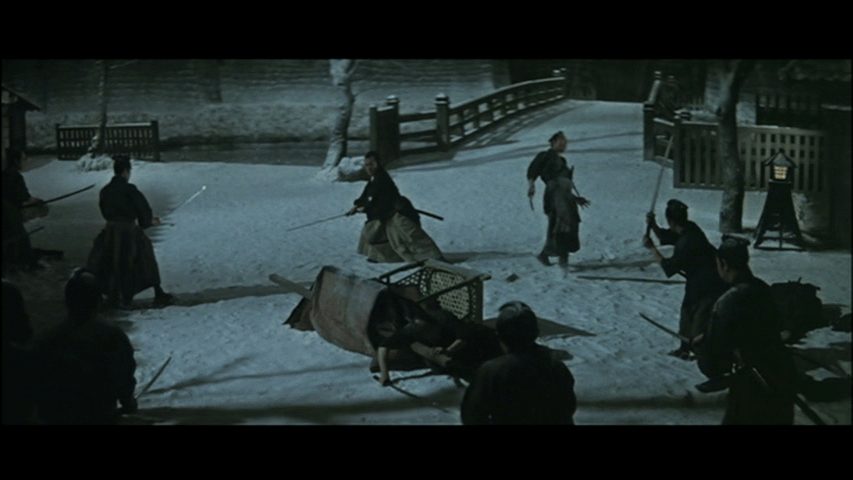
This was one of the last major fight scenes Denjirō filmed before transitioning to more sedate character roles. What a magnificent swan song for this great actor, and how fitting that it’s in the context of the same story he himself filmed 20 years earlier.
Denjirō Ōkōchi was one of the first stars in the silent and early sound eras of Japanese cinema, famed for his signature role as Tange Sazen. Before becoming an actor Denjirō wanted to be a writer. Denjirō and Chiezō had known each other since the 1920s. Whereas Chiezō had trained as a Kabuki actor from childhood, Denjirō didn’t begin acting on a professional basis until he was an adult. His energy, athleticism, and kendo training made him a natural in thrillingly realistic fight scenes.
Ryūnosuke represents the absolute antithesis of the samurai spirit. To stop someone like this, you cannot just use a skilled fighter; you need someone who embodies the true meaning of what it is to be a martial artist. Denjirō Ōkōchi is perfectly cast as Shimada not just because of his skill with a sword, but because his presence carries a unique meta-textual authority.
Ryūnosuke stands on the sidelines and watches the massacre unfold.
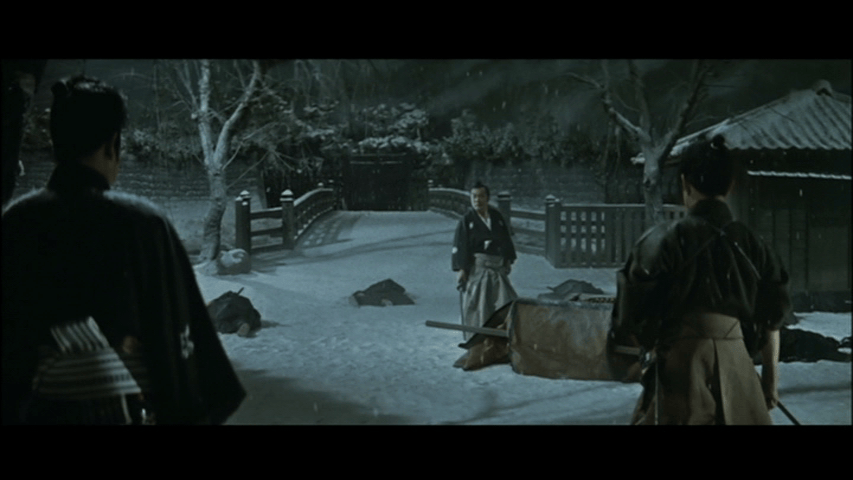
Soon only Ryūnosuke and Hijikata Toshizō (Shoji Kiyokawa) are left alive. Shimada glances with regret at the corpses lying in the snow. “They were all skilled swordsmen.”
Hijikata tries to take him down and fails. Shimada doesn’t kill him but grabs him by the collar. Ryūnosuke draws his sword. He’s got his scary game face on and his otonashi stance working. He’s ready to go.
Shimada knows who he is now. “The otonashi stance? You must be Tsukue Ryūnosuke.”
Ryūnosuke glares at him.
“Fencing is in the heart,” Shimada says. “Without the proper heart, the fencing is also unjust.” He lets Hijikata go. “A person who learns fencing must find his heart first.”
It’s over. Shimada has defeated Ryūnosuke without striking a blow. He sheathes his sword, grabs his coat, and walks away.
Ryūnosuke and Ohama’s relationship continues to circle the drain.
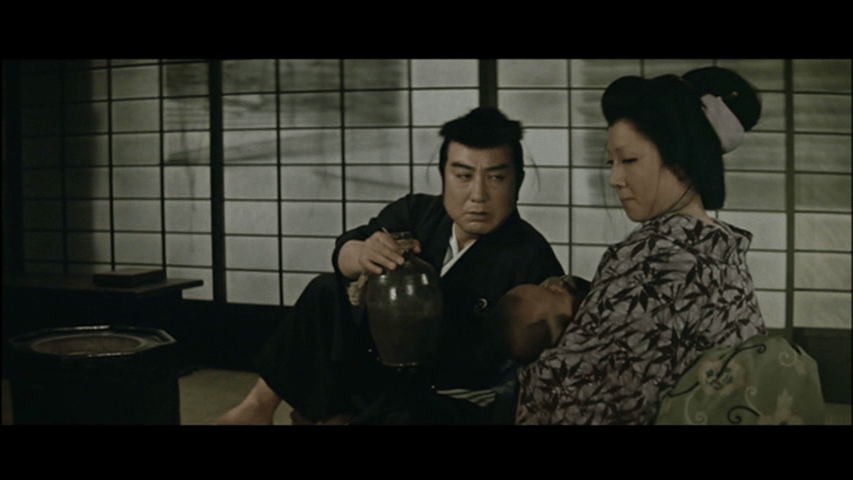
True to iroaku type, he remains unemployed. He lies around the house a lot and shows signs of a growing dependence upon alcohol. Ohama despises him. She believes that they must be under a curse. Ryūnosuke dismisses this as superstitious nonsense, but I think she may be on to something.
Hyōma has been searching Edo for Ryūnosuke, whom he has vowed to kill for murdering his older brother Bunnujō. Hyōma has also befriended Omatsu, who is still on the run after fleeing Lord Kamio’s clutches. Ryūnosuke’s former servant Yohachi is in Edo and joins up with Hyōma and Omatsu. A doctor treating Omatsu for a recent illness mentions that he just came from a house belonging to a “gloomy and creepy” rōnin from Sawai Village. Hyōma asks him if the man’s name was Ryūnosuke. The doctor tells him that his name was Yoshida Ryūtaro.
Hyōma recalls the strange man of that name who challenged him at Shimada’s dōjō and realizes who he really is. He asks the doctor to take him to the gloomy rōnin’s house. Hyōma arrives at Ryūnosuke’s residence and is stunned to see his former sister-in-law Ohama there. Hyōma withdraws without making his presence known.
Ryūnosuke plans to travel to Kyoto to meet up with the Shinsengumi. Ohama is not happy about this. She informs Ryūnosuke that if he insists on going to Kyoto she will ask him to divorce her.
“Fine with me,” Ryūnosuke says.
“If only you weren’t around, I’d be living peacefully as Utsugi’s wife!”
Ryūnosuke asks her, rather insightfully, if she believes that she would have been truly happy married to Bunnujō. He then accuses her of bearing the ultimate responsibility for her late husband’s death. A terrible argument ensues. Ohama calls him a bastard. She flips out and tries to stab her baby. Ryūnosuke overpowers her and wrests the blade from her grasp. He looks exhausted.
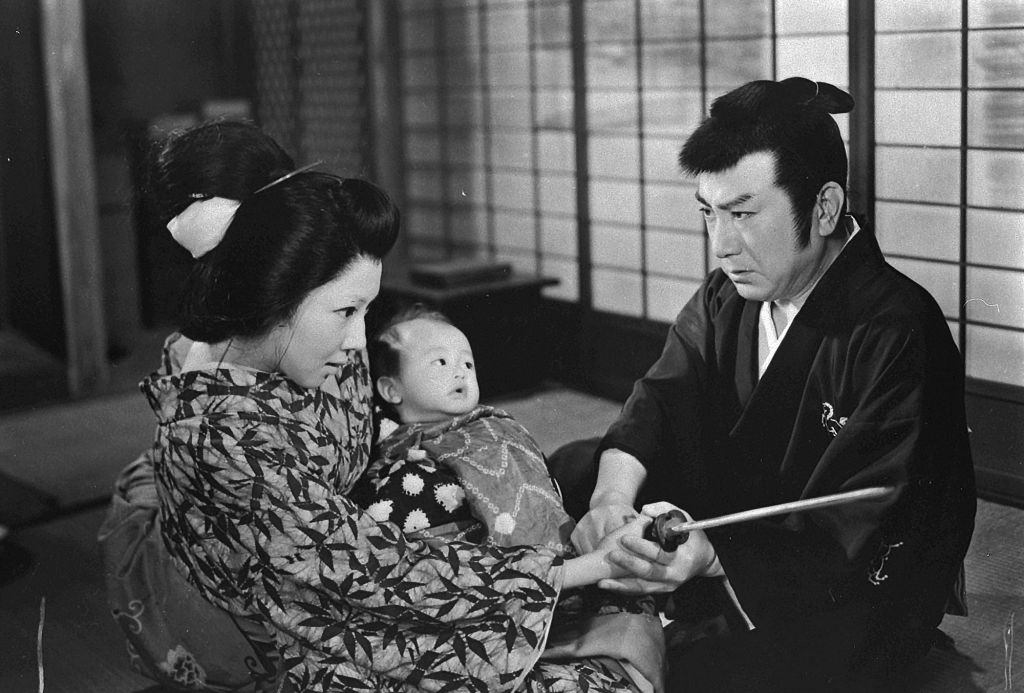
Hyōma has sent a letter to Ryūnosuke challenging him to a duel. Ryūnosuke asks Ohama if her late husband had a younger brother. She confirms that Bunnujō had a brother who is now 16 or 17. Ryūnosuke hands Hyōma’s letter to Ohama. She is horrified. Ryūnosuke confidently asserts that he’ll end up killing both brothers.
Ohama breaks down. She tries to kill Ryūnosuke. He takes the knife off her and pursues her outside. They struggle in the dark woods near the house. A bell from a nearby temple sounds. Ryūnosuke stabs her and she collapses to the ground. He stares at her with a stunned expression. Hyōma arrives for the duel. He hears Ohama’s screams but reaches her too late to save her. Her husband has disappeared.
Yohachi leaves Edo with Ichitaro. They are headed to Ryūnosuke’s residence in Sawai Village. Ryūnosuke’s father gave Yohachi a home when he was abandoned as a child; now Yohachi can return the favor. Ichitaro is the Tsukue family heir. Despite Ryūnosuke’s failure to live up to traditional samurai ideals Yohachi remains devoted to him.
Omatsu reunites with Hyōma in Kyoto, where she works at a brothel.
We see people carrying two apparently lifeless bodies from a large body of water. The man is dead; the woman is still alive, but only just. She is the sole survivor of a shinjū, a double suicide. Men from a nearby village carry the woman to a shed and dump her inside it. A crowd has gathered. Nobody comes forth to help her.
A survivor of a double suicide was not treated as a bereaved victim but as a criminal. The standard punishment was demotion to outcast (hinin) status rather than execution. Hinin means ‘non-human’.
Of all the people assembled at the scene only one man steps forward: Ryūnosuke. He cautiously approaches the unconscious woman. She is the exact double of his late wife.
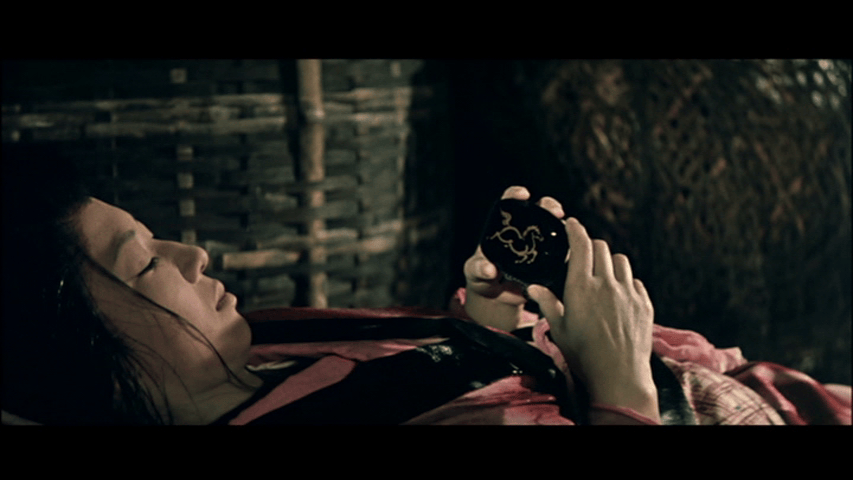
The woman slowly opens her eyes and looks at him. He gazes at her in wonder. “Hama,” he murmurs. Ryūnosuke gives her his inrō, the small decorative case samurai wear around their waist to carry medication and other personal items. The inrō bears Ryūnosuke’s distinctive family crest, an image of an unbridled horse. Giving such a valuable accessory to a stranger in need sends a dual message: ‘You look like you could use this’ and ‘Find me’.
Ryūnosuke travels to Kyoto.
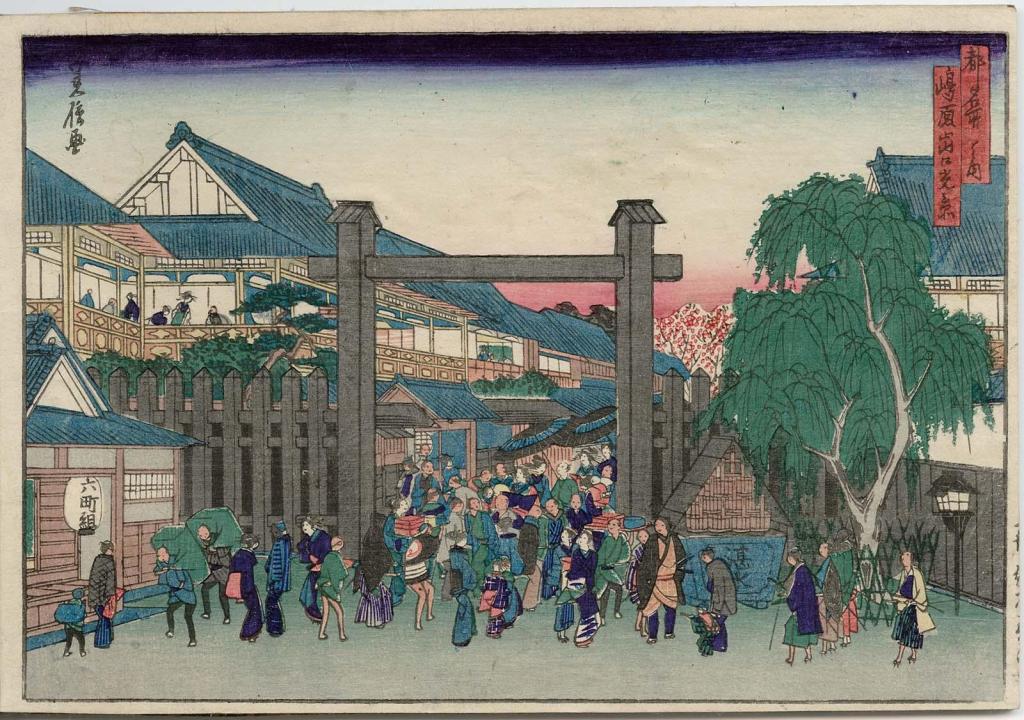
(Shimabara deguchi kōkei)
from the series Famous Places in the Capital (Miyako meisho no uchi)
MFA Boston
William Sturgis Bigelow Collection
Accession Number 11.36386
Ryūnosuke meets with Hijikata at the brothel in Shimabara where Omatsu works. He is drinking heavily. Hijikata invites him to join a plot to assassinate a fellow member of the Shinsengumi. Ryūnosuke declines. Tonight he just wants to get drunk. If there were a girl around, it would be even better.
Ryūnosuke is about to get his wish. Omatsu has been eavesdropping on the two men. Hijikata notices her hiding behind a screen and drags her into the room. He seems uncertain what to do with her.
Ryūnosuke pours himself another drink. “Kill her.” The offhand way he says this is chilling.
Hijikata refuses and leaves the terrified young woman with Ryūnosuke inside an area enclosed by sudare bamboo blinds. The way it’s lit makes it look like a cage. Ryūnosuke warns her that if she tries to escape he’ll kill her.
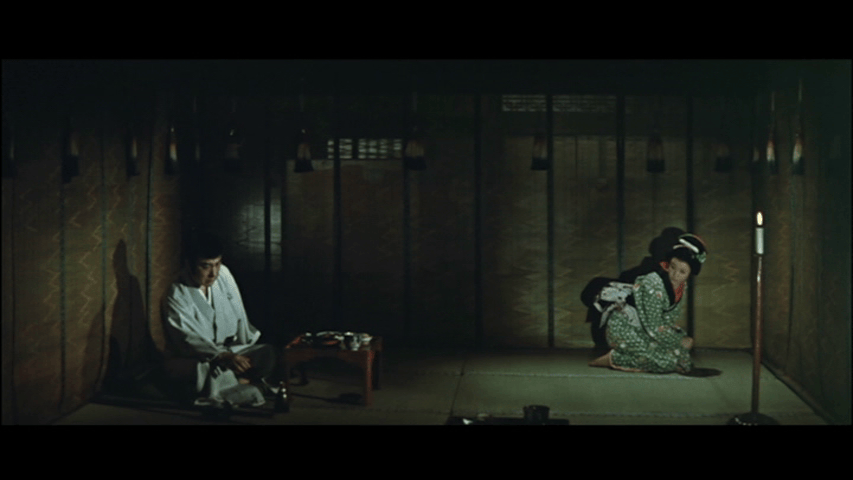
We hear the tinkling bells of the pilgrims at Dai-bosatsu Pass. Ryūnosuke sees the old man whom he murdered. He slashes at the bamboo blinds and enters a dark space filled with mist. Other ghostlike figures appear before him. He strikes wildly at them with his sword. He has gone mad.
We discover Ryūnosuke standing motionless in a catatonic state near what appears to be a Shinto shrine. His kimono is stained with blood. A man stops to help him. He is Ueda Tango-no-kami (Koreya Senda), a martial arts master and Shinto priest who serves Omiwa Shrine. How Ryūnosuke got to Omiwa Shrine from Kyoto in his severely impaired condition is not explained.
The woman who survived the suicide attempt reunites with Ryūnosuke at Ueda Tango’s dōjō where he is recovering from his illness. There is something slightly unreal about her. We see her smiling beatifically at Ryūnosuke while he is asleep. She kneels next to him and returns his inrō to him, gently so as not to wake him up. She looks like a vision of Kannon, the bodhisattva of compassion who responds to suffering without judging who is suffering.
Her name is Otoyo. While she could be Ohama’s twin (and is played by the same actress, Yumiko Hasegawa), there the resemblance ends. She is gentle and sweet, and an altogether different person. Having the same actress play both characters makes Otoyo feel like a haunting echo or a kind of second chance.
For reasons known only to Buddha himself this woman was brought back from the brink of death to meet Ryūnosuke. Their relationship has a fated feel to it. Both outcasts, they are drawn to one another. Ryūnosuke and Otoyo hide themselves away in Miwa Village from the hostile world, a world where Otoyo is officially classified as a non-human and Ryūnosuke is an outlaw wanted for multiple murders. Otoyo knows nothing of Ryūnosuke’s crimes. For her he is a lonely man trying to heal from some unspecified trauma in his past.
The serenity of their refuge is disrupted when a man from the village rudely accosts Otoyo on the grounds of the shrine while she is feeding some birds. He’s been sending letters to Otoyo, asking her to marry him. A mortified Otoyo extricates herself from the importunate man’s grasp and shelters next to Ryūnosuke, who has arrived at the scene in the nick of time.
Ryūnosuke doesn’t have to say a single word to this creep. His stance communicates loud and clear: Fuck all the way off. The annoying man makes his exit.
Later we see Otoyo and Ryūnosuke sitting together illuminated by the full moon and a hanging lantern. In the distance music from a festival can be heard. The atmosphere is languid and dreamlike. A subtle erotic tension fills the space between them like incense.
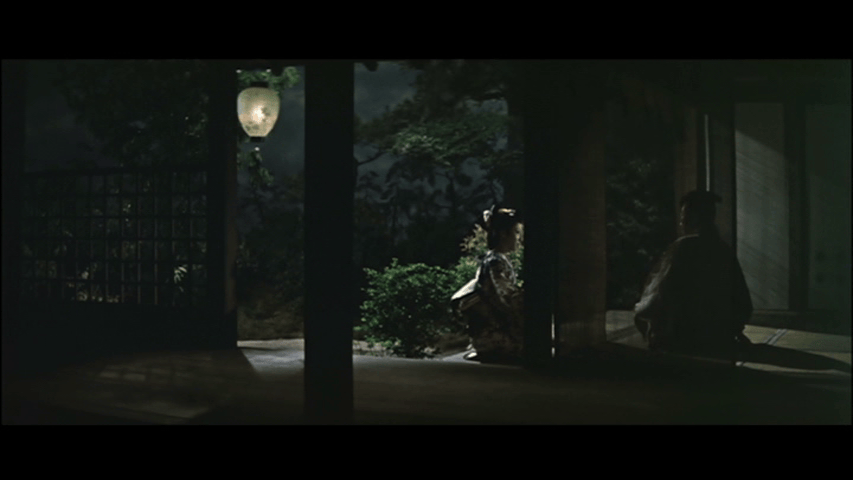
Ryūnosuke can’t help staring at her. “You look exactly like my late wife… you don’t feel like a stranger.”
Otoyo smiles. “She must be Ohama-sama.”
“Hama?”
“Yes… that’s what you called me by the shore.”
Otoyo tells him that she heard that he will be leaving soon for Kanto. She asks him to take her with him.
Ryūnosuke reaches for her hand. “You want to come with me?”
Otoyo bows her head. “Yes.”
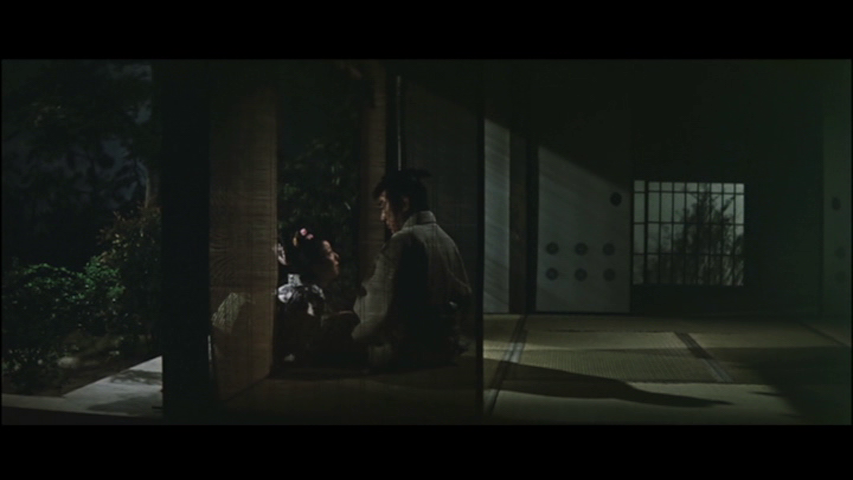
while making direct eye contact with her.
Viewer discretion is advised
It’s the day of Ryūnosuke’s departure for Kanto. Otoyo waits for him by a tree. A rough-looking man emerges from the woods. He attacks her. During the struggle Otoyo faints. The man carries her away to a nearby cave. Kinzō (Eijirō Kataoka), the annoying man who harassed her earlier, is there. He has been spying on Otoyo and Ryūnosuke. He embraces the unconscious Otoyo and tells her how much he wants her. It’s unbearably creepy. Kinzō paid a local ruffian to abduct Otoyo. But the man isn’t content with money. He wants Otoyo for himself. They fight. Kinzō drowns the man in a stream.
Meanwhile Ryūnosuke has arrived at the spot under the tree where Otoyo was waiting to meet him only moments before. Her hat and her belongings lie on the ground, evidence that something bad has happened. But he does not see them. Assuming that Otoyo has changed her mind about accompanying him, Ryūnosuke sets off for Kanto alone.
Hyōma, Shichibei, and Omatsu arrive at Miwa Village where Ryūnosuke and Otoyo had been staying and meet with Ueda Tango. They are constantly trying to catch up with Ryūnosuke. He is always several steps ahead of them. The next time we see Ryūnosuke he is under fire, staggering through a battlefield with the shattered remnants of the Tenchugumi, a faction of anti-shogunate samurai.
Hyōma travels to Ryūjin Village where we find Otoyo living with Kinzō. I’m very sorry to report that they appear to be married. (You know you’re in Hell when this is your best option. Girl, NO.)
Hyōma tells Otoyo that he’s looking for a missing person and presses her for information about Ryūnosuke. Like him, Hyōma is astonished at Otoyo’s resemblance to Ohama. In the course of their conversation Otoyo reveals that a man named Ryūnosuke told her that she looked just like his late wife. “Ryūnosuke-sama must hate me,” she says, and lowers her gaze in sorrow.
The surviving members of the Tenchugumi assemble inside a hut in the mountains in Kishu. The hopelessness of their situation is such that they propose to end their lives like samurai and commit suicide. Ryūnosuke growls: “I refuse.”
One of the men asks him: “Have you no pride as a samurai?”
“None,” Ryūnosuke replies.
Hyōma has tracked Ryūnosuke down to Kishu. He hurls a hand grenade at the cabin where the Tenchugumi are holed up. Injured samurai stagger outside only to be fired upon by pro-shogunate forces, who have them surrounded. Hyōma tries to search what’s left of the cabin but is driven back by the Tenchugumi. Ryūnosuke slowly emerges from the ruins. He has been blinded by the explosion. Miraculously, he can still fight.
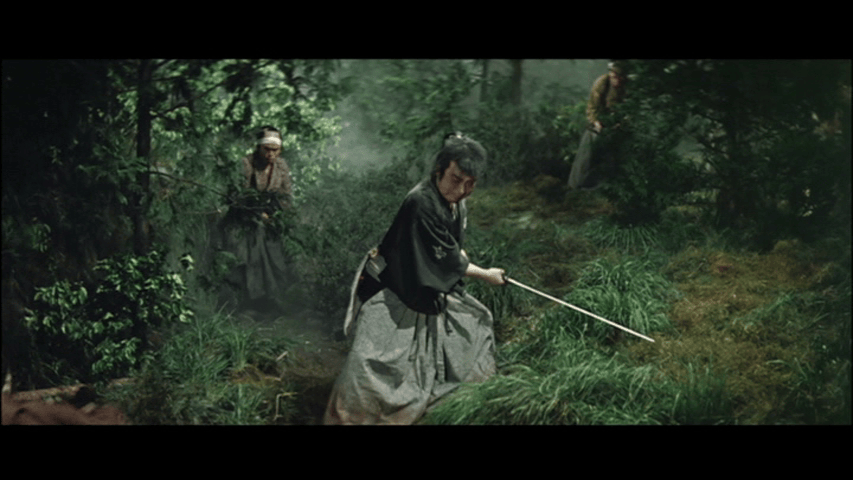
A person who cannot and will not be fucked with. See also: Tsukue Ryūnosuke
He fends off a series of samurai before leaping from a precipice overlooking a river.
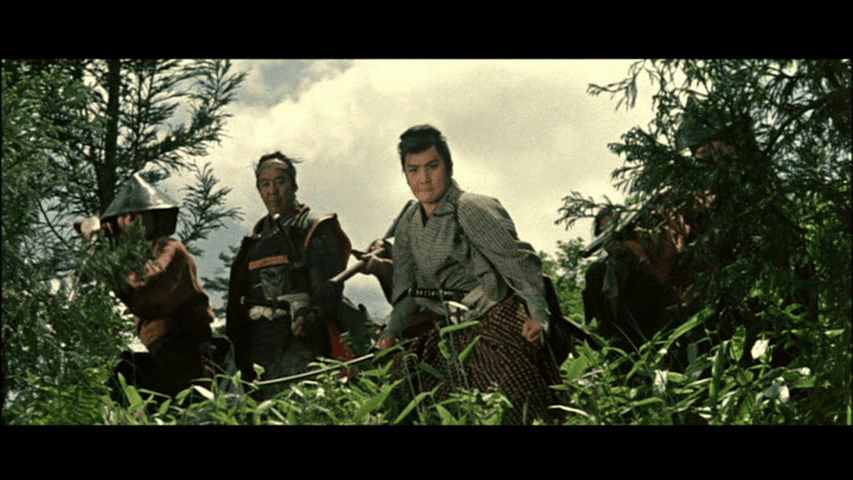
Survival appears impossible. But this is Ryūnosuke we’re talking about. He’s harder to kill than Godzilla.
Next Week: Ryūnosuke isn’t done yet. Stay tuned for Part 2 of Tomu Uchida’s epic Dai-bosatsu tōge


Leave a Reply